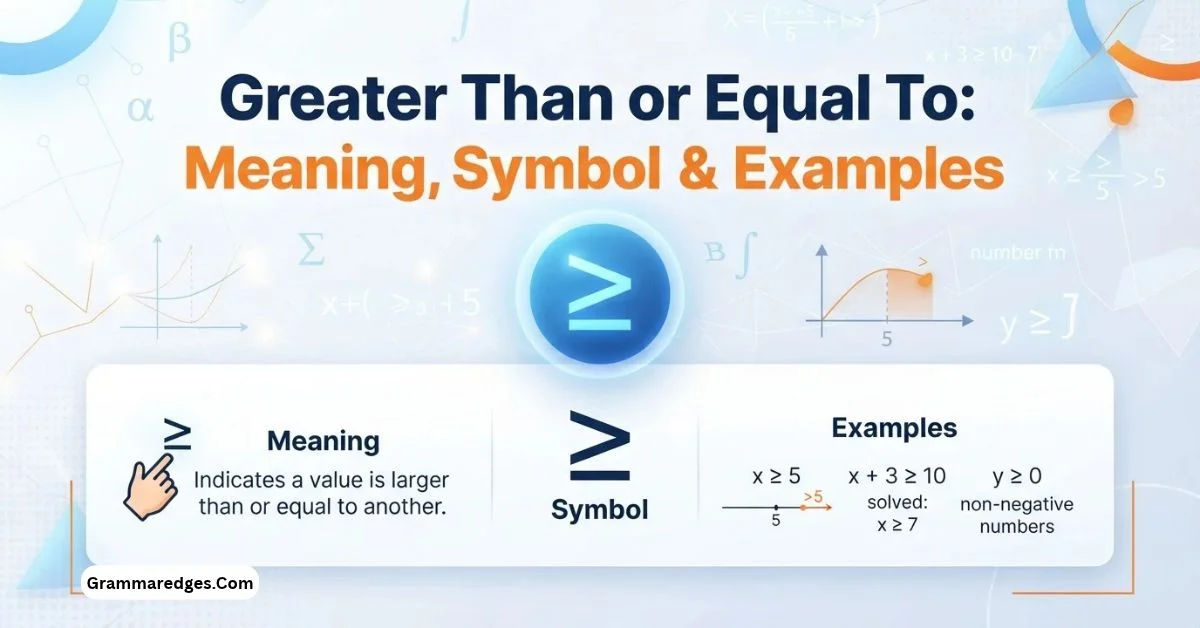
Greater than or equal to means a value is either larger than another value or exactly the same. Its mathematical symbol is ≥. For example, x ≥ 5 means x can be 5 or any number greater than 5, such as 6, 10, or 100. The symbol is commonly used in algebra, inequalities, and real-life minimum requirements.
Key Takeaways
- ≥ means greater than or equal to.
- The value can be larger than or exactly equal to the comparison value.
- x ≥ 10 means x can be 10, 11, 12, or any larger value.
- Phrases such as “at least,” “minimum,” and “no less than” can represent ≥.
- On a number line, the boundary value is included.
- In many programming languages, the same comparison is written as
>=.
What Does Greater Than or Equal To Mean?
Greater than or equal to describes a relationship between two values. It tells us that the value on one side is either larger than the value on the other side or exactly equal to it.
The mathematical symbol is:
≥
For example:
8 ≥ 5
This statement is true because 8 is greater than 5.
But the following is also true:
5 ≥ 5
Why? Because the two values are equal.
That second example is important. The phrase does not mean only “greater than.” It allows two possibilities: greater than or equal to.
You can think of the symbol as combining these two ideas:
> + = → ≥
The line underneath the greater-than sign tells you that equality is allowed.
Greater Than or Equal To Symbol
The symbol for greater than or equal to is ≥.
You read it as:
- Greater than or equal to
- Greater than or equal
- At least
For example:
x ≥ 7
You can read this as:
“x is greater than or equal to 7.”
This means that x can be 7 or anything larger than 7.
Some possible values are:
- 7
- 8
- 9
- 10
- 25
- 100
If you are working with real numbers, values such as 7.1, 7.5, and 8.25 can also satisfy x ≥ 7.
The important point is that 7 itself is included.
Greater Than vs. Greater Than or Equal To
The difference between > and ≥ is small but important.
| Symbol | Meaning | Example | Is the boundary included? |
|---|---|---|---|
| > | Greater than | x > 5 | No |
| ≥ | Greater than or equal to | x ≥ 5 | Yes |
Consider these two statements:
x > 5
Here, x must be larger than 5. The value 5 does not qualify.
x ≥ 5
Here, x can be 5 or anything larger.
So:
5 > 5 → False
5 ≥ 5 → True
The extra horizontal line under the symbol is what allows equality.
Examples of Greater Than or Equal To
The easiest way to understand an inequality is to see it in action.
Basic Number Examples
10 ≥ 4
True, because 10 is greater than 4.
6 ≥ 6
True, because 6 equals 6.
3 ≥ 8
False, because 3 is neither greater than nor equal to 8.
12 ≥ 12
True, because both values are equal.
Variable Examples
Suppose you see:
x ≥ 20
This means x can be 20 or any number greater than 20.
For example:
x = 20 → True
x = 25 → True
x = 100 → True
x = 19 → False
Another example is:
y ≥ -3
Here, y can be -3, -2, 0, 5, 10, or any other number greater than -3.
Negative numbers can sometimes make inequalities confusing, so always compare the actual values rather than relying on how the numbers look.
Real-Life Examples
Greater than or equal to is useful whenever something has a minimum requirement.
For example:
Age ≥ 18
This means a person must be 18 or older.
Another example:
Score ≥ 70
This means a score of 70 qualifies, as does any score above 70.
You could also write:
Height ≥ 48 inches
This means the required height is 48 inches or taller.
These examples show why the “equal to” part matters. A person who is exactly 18 years old meets an “18 or older” requirement.
“At Least” and Other Phrases That Mean ≥
Math problems often use words instead of symbols. Knowing these phrases makes it easier to translate a sentence into an inequality.
At Least
“At least” means greater than or equal to.
For example:
You need at least 10 points.
Write:
p ≥ 10
The score can be exactly 10 or higher.
No Less Than
“No less than” also means greater than or equal to.
For example:
The package must weigh no less than 5 pounds.
Write:
w ≥ 5
Five pounds is acceptable, as are weights above five pounds.
Minimum
The word “minimum” often signals a lower limit.
For example:
The minimum age is 21.
This can be represented as:
age ≥ 21
The minimum is 21, so 21 is included.
Or More
When a statement says “10 or more,” it means 10 or a larger number.
For example:
Bring 10 or more items.
Mathematically:
n ≥ 10
Remember this simple connection:
At least = ≥
No less than = ≥
Minimum = ≥
Or more = ≥
Greater Than or Equal To on a Number Line
A number line gives you a visual way to understand an inequality.
Consider:
x ≥ 4
Because 4 is included, you place a closed or filled circle on 4. Then shade or draw the line toward the right because all numbers greater than 4 are also included.
Conceptually:
4 ●────────→
The filled circle tells you that 4 counts.
Compare that with:
x > 4
For x > 4, 4 is not included, so you use an open circle at 4 and extend the line to the right.
The key rule is:
- ≥ → filled circle at the boundary
- > → open circle at the boundary
This visual difference helps prevent one of the most common inequality mistakes.
Greater Than or Equal To in Interval Notation
You can also express an inequality using interval notation.
For example:
x ≥ 4
is written as:
[4, ∞)
The square bracket next to 4 means that 4 is included.
The parenthesis next to infinity is used because infinity is not a specific number that can be included as an endpoint.
So:
x ≥ 4 → [4, ∞)
This notation describes every real number from 4 upward.
How to Solve Greater Than or Equal To Inequalities
Greater-than-or-equal inequalities can often be solved much like equations.
Consider:
x + 3 ≥ 8
Subtract 3 from both sides:
x ≥ 5
So every value of x that is 5 or greater is a solution.
Example With Multiplication
Consider:
2x ≥ 10
Divide both sides by 2:
x ≥ 5
Again, the solution is every value from 5 upward.
What Happens When You Divide by a Negative Number?
There is one important rule to remember.
When you multiply or divide both sides of an inequality by a negative number, reverse the inequality symbol.
For example:
-2x ≥ 10
Divide by -2:
x ≤ -5
Notice that ≥ changed to ≤.
This rule is different from ordinary equation solving and is a major source of mistakes for students.
Greater Than or Equal To in Programming
You may also see the expression:
>=
This is commonly used in programming languages as the greater-than-or-equal comparison operator.
For example, in JavaScript:
5 >= 5
returns true.
Likewise:
8 >= 5
returns true.
But:
3 >= 5
returns false.
The meaning is the same basic comparison as ≥, but the notation is different because programming languages generally use keyboard characters rather than the single mathematical symbol.
So remember:
Math: ≥
Programming: >=
Common Mistakes to Avoid
Mistake 1: Forgetting That Equality Counts
Some people read ≥ as simply “greater than.”
That is incorrect.
x ≥ 5 includes 5.
Mistake 2: Confusing ≥ With ≤
Remember:
≥ = greater than or equal to
≤ = less than or equal to
The direction matters.
Mistake 3: Treating “At Least” as “Greater Than Only”
“At least 10” means 10 or more, not only numbers above 10.
Therefore:
x ≥ 10
is correct.
Mistake 4: Forgetting to Reverse the Sign
When multiplying or dividing an inequality by a negative number, the inequality direction changes.
For example:
-x ≥ 4
becomes:
x ≤ -4
after multiplying both sides by -1.
FAQs About Greater Than or Equal To
What does greater than or equal to mean?
It means a value is either larger than another value or exactly equal to it. For example, x ≥ 6 means x can be 6 or any value greater than 6.
What is the symbol for greater than or equal to?
The mathematical symbol is ≥. It combines the greater-than sign with a horizontal line underneath it to show that equality is also allowed.
Is 5 greater than or equal to 5?
Yes. 5 ≥ 5 is true because “greater than or equal to” includes equality. The two numbers do not have to be different for the statement to be true.
What does “at least” mean in math?
“At least” means greater than or equal to. For example, “at least 20” means 20 or any number greater than 20, which can be written as x ≥ 20.
How do you graph x ≥ 3?
Place a filled circle at 3 and extend the line or arrow to the right. The filled circle shows that 3 is included, while the rightward direction represents values greater than 3.
What is the difference between ≥ and >?
> means strictly greater than, so the boundary value is excluded. ≥ means greater than or equal to, so the boundary value is included. Thus, 5 > 5 is false, while 5 ≥ 5 is true.
Conclusion
Greater than or equal to is an inequality that means a value can be larger than or exactly equal to another value. Its symbol is ≥, and the horizontal line underneath the greater-than sign is what tells you that equality is included.
For example, x ≥ 10 means x can be 10 or any number above 10. Phrases such as “at least,” “minimum,” “no less than,” and “or more” often express the same idea.
Once you remember that the boundary value is included, the concept becomes much easier. Whether you are reading an algebra problem, interpreting a number line, or working with programming code such as >=, the central idea stays the same: the value is greater than or equal to the specified limit.