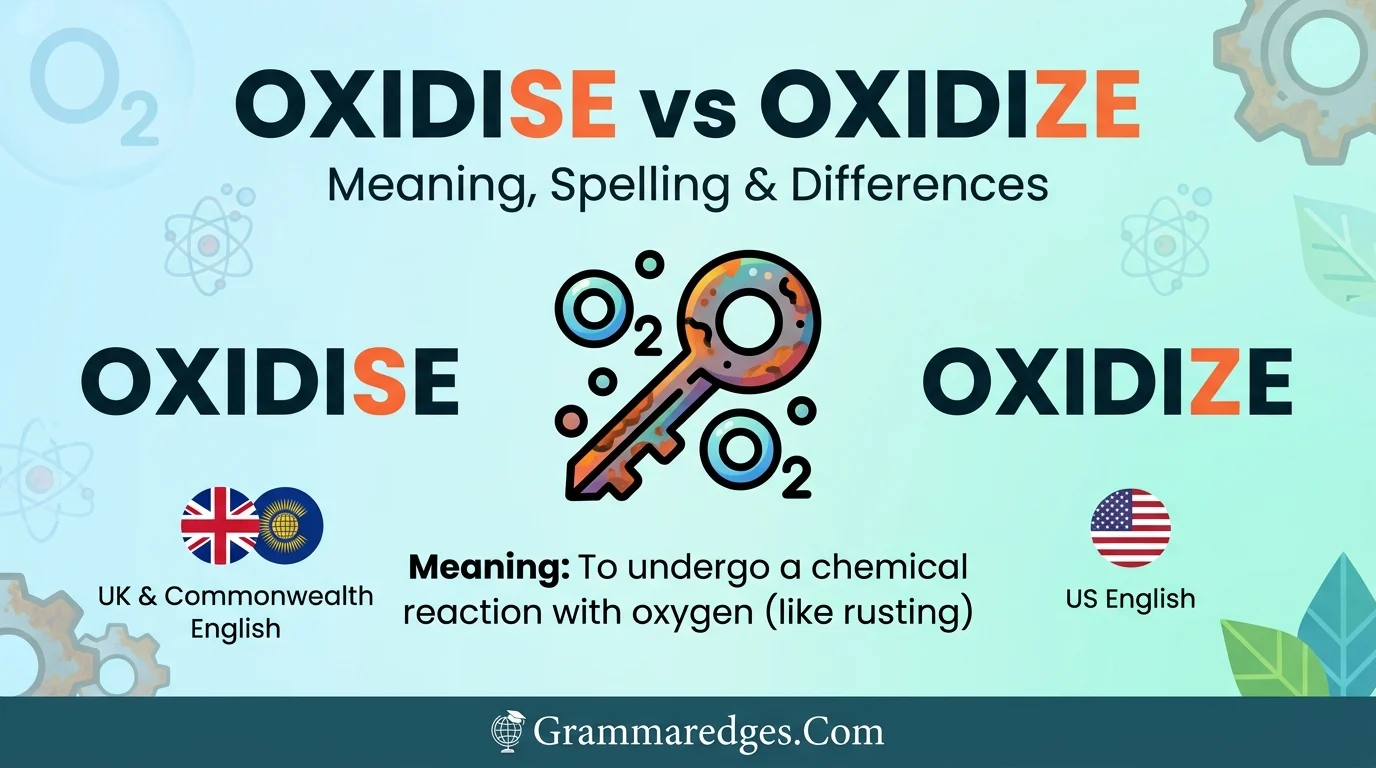
Oxidise or Oxidize is a common spelling question for people learning the differences between British and American English. Both words are correct, but their spelling depends on the English variety you follow.
American English uses “oxidize,” while British English traditionally prefers “oxidise.” Both forms describe a chemical process in which a substance undergoes oxidation. You may encounter these words in science lessons, chemistry textbooks, educational articles, and everyday discussions.
Understanding their spelling, meaning, and usage will help you avoid confusion and write more confidently. Let’s explore their differences with simple explanations and practical examples.
Key Takeaways
- Oxidize is the American English spelling; oxidise is the British English spelling.
- Both words mean the same thing and are pronounced the same way: OK-sih-dize.
- Scientific writing around the world uses oxidize far more often, even outside the US.
- Whichever form you choose, use it consistently through the whole document.
What Does “Oxidize” Mean?
To oxidize means to combine with oxygen, or to cause something to combine with oxygen, in a chemical reaction. The result is a new substance called an oxide.
The most familiar example is rust. When iron is left in damp air, it reacts with oxygen and forms iron oxide — the orange-brown flakes we call rust. Silver tarnish, the brown layer on a cut apple, and the fading of old paint are all forms of oxidation you can see in daily life.
In chemistry, the word also has a wider technical meaning: a substance oxidizes when it loses electrons during a reaction. That is why oxidation can happen even when no oxygen is involved.
The word works the other way, too. You can oxidize a substance, or a substance can oxidize on its own. White wine left open too long oxidizes, losing its fresh flavor and turning darker.
Oxidise vs. Oxidize: The Only Difference Is One Letter
Here is the honest truth: there is nothing to choose between the two words except spelling.
| Oxidize | Oxidise | |
|---|---|---|
| Used in | United States | United Kingdom |
| Ending | -ize | -ise |
| Meaning | Combine with oxygen | Combine with oxygen |
| Pronunciation | OK-sih-dize | OK-sih-dize |
| Example | The metal will oxidize. | The metal will oxidise. |
Oxidise is not a misspelling, and oxidize is not slang or a typo. Dictionaries list oxidize as the main form and oxidise as the British variant — Collins notes that in British English you “also use oxidise,” and Dictionary.com labels oxidise “especially British.” The same pattern appears in words like organize/organise and recognize/recognise.
Even the noun is nearly identical: oxidation is the standard form everywhere.
Which Spelling Should You Use?
Use the spelling your readers expect. That one rule settles almost every case.
Writing for an American audience
Use oxidize. It is the form in Merriam-Webster, and it is what American style guides like the AP Stylebook and The Chicago Manual of Style expect. An American reader may flag oxidise as a typo, even though it is a real word.
Writing for a British audience
Use oxidise for general readers — it is the everyday British choice. But oxidize is not wrong in Britain. Oxford spelling, used by Oxford University Press and many academic publishers, keeps the -ize ending there, and British scientists use oxidize routinely.
Writing about science
Use oxidize, wherever you live. Scientific English settled on the z form long ago. A search of published research indexed on PubMed, reported by The BMJ, found “oxidize” outnumbering “oxidise” by about 95% to 5%.
Why does English have two spellings?
The -ize ending comes from the Greek ending -izein, carried into Latin as -izare. French later softened the ending to -iser, and British English picked up that French-style -ise. American spelling kept -ize, which is why the z form is actually the older, more original one.
Whatever you pick, pick it once. Mixing oxidize in one paragraph and oxidised in the next looks careless and can confuse readers. Set your spellchecker to US English or UK English, and let it police the choice for you.
Every Word Form: Oxidize and Oxidise Side by Side
The s/z swap runs through almost every form of the word. Only the noun oxidation stays the same in both varieties, which makes it the safest form when you are unsure.
| Form | American English | British English |
|---|---|---|
| Base verb | oxidize | oxidise |
| Third person | oxidizes | oxidises |
| Past tense | oxidized | oxidised |
| -ing form | oxidizing | oxidising |
| Adjective | oxidizable | oxidisable |
| Noun (process) | oxidation | oxidation |
Spellcheckers accept all of these forms, so the “correct” one is simply the one that matches the rest of your document.
Examples in Sentences
American spelling (oxidize):
- Copper oxidizes slowly and turns green over time.
- The chemist heated the sample until it oxidized completely.
- Store the oil in a dark bottle so it does not oxidize and go rancid.
British spelling (oxidise):
- Iron oxidises quickly when it is left out in the rain.
- The paint had oxidised and lost its shine.
- Do not leave the wine open — it will oxidise overnight.
Both sets of sentences are correct. What would be wrong is mixing them, like writing “the metal had oxidised” in one sentence and “it will oxidize again” in the next. Together they clash; apart, each is fine.
Common Mistakes to Avoid
- Treating oxidise as a typo. It is standard British spelling, listed in every major dictionary.
- Thinking oxidize is banned in the UK. British science journals and Oxford-style publishers use it regularly.
- Mixing the two forms in one article, essay, or website. This is the only real error here.
- Using “oxidate” as your main verb. It exists, but oxidize/oxidise is the standard, expected form.
- Adding an s to the noun. The everyday noun is oxidation in both American and British English.
The 10-Second Rule
If your audience is American, write oxidize. If your audience is British, write oxidise — unless you are writing science, where oxidize wins everywhere. Then stay consistent. That is genuinely all there is to it.
And when you are editing someone else’s work and both forms appear, standardize to the audience’s variety instead of “correcting” everything to your own.
Frequently Asked Questions
Is oxidise or oxidize correct?
Both are correct. Oxidize with a z is the standard spelling in American English, and oxidise with an s is the standard spelling in British English. Neither is a mistake — choose the one that matches your audience.
How do you spell oxidize in British English?
The everyday British spelling is oxidise. However, oxidize is fully accepted in Britain under Oxford spelling and is the normal choice in British scientific publishing.
What is the past tense — oxidised or oxidized?
It follows your base spelling. American writers use “oxidized,” as in “the surface had oxidized.” British writers use “oxidised,” as in “the surface had oxidised.”
How do you pronounce oxidise and oxidize?
They sound identical: OK-sih-dize (/ˈɒk.sɪ.daɪz/). The s and z spellings make no difference to the pronunciation at all.
What does it mean when food oxidizes?
It means the food is reacting with air and changing because of it. Fruit flesh turns brown, cooking oils go rancid, and open wine loses its fresh flavor — all because of oxidation.
Is oxidation spelled differently in British English?
No. Oxidation is the standard noun in both varieties. A form spelled oxidisation exists as a rare variant of “oxidization,” but almost all writers use oxidation.
Conclusion
Oxidise or Oxidize may look different, but both spellings express the same meaning. The main difference comes from regional English conventions. “Oxidize” is the standard American English spelling, whereas “oxidise” is commonly used in British English. Neither form is universally incorrect, so your choice should depend on your target audience and writing style.
If you are creating content for American readers, use “oxidize” consistently. For British readers, “oxidise” is generally the preferred option. Understanding this small spelling difference can improve your writing accuracy and help you communicate clearly in scientific, educational, and everyday contexts.