
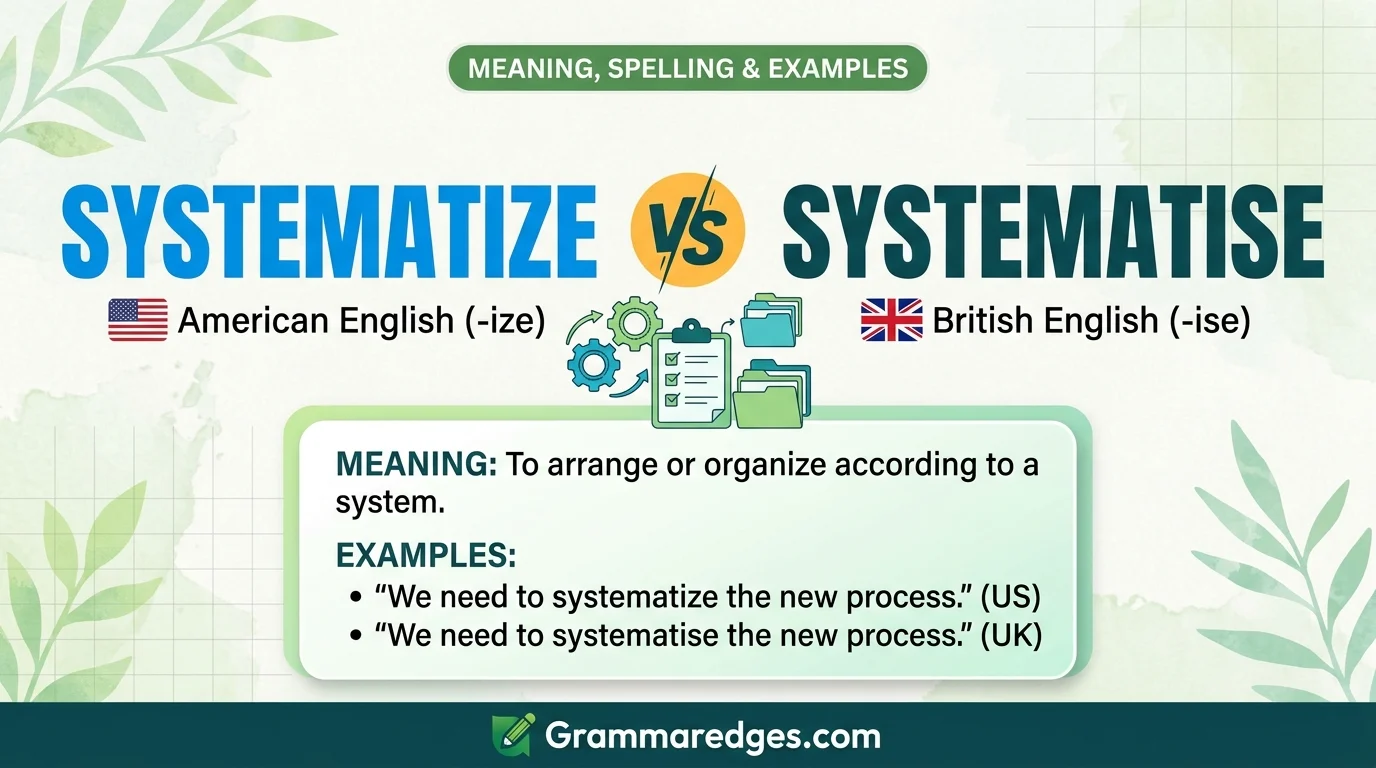
Are you confused about whether to write systematize or systematise? Both spellings are correct, but choosing the right one depends on your target audience.
The difference comes from American and British English spelling conventions, not meaning or pronunciation. American writers generally use systematize, while British writers commonly prefer systematise.
Both words describe organizing something according to a clear system or method. In this guide, you’ll discover their meanings, spelling differences, practical sentence examples, and related word forms.
By the end, you’ll know which spelling to use in emails, academic writing, business documents, and everyday communication.
Key Takeaways
- Systematize is the standard choice in American English.
- Systematise is commonly used in British English.
- Both words mean to organize something into a structured system.
- Their pronunciation and grammatical functions are the same.
- Use one spelling consistently throughout your writing.
What Is the Difference Between Systematize and Systematise?
The main difference between systematize and systematise is their regional spelling preference. American English generally uses the letter z, whereas British English commonly uses s in this word.
Neither spelling is incorrect. Both describe the process of arranging information, activities, or procedures according to an organized method.
Here is a quick comparison:
| Feature | Systematize | Systematise |
|---|---|---|
| English variety | American English | British English preference |
| Meaning | Organize into a system | Organize into a system |
| Pronunciation | Same | Same |
| Part of speech | Verb | Verb |
| Past tense | Systematized | Systematised |
| -ing form | Systematizing | Systematising |
| Preferred US spelling | Yes | No |
For example:
- American: We need to systematize our daily operations.
- British: We need to systematise our daily operations.
Both sentences communicate exactly the same idea.
What Does Systematize Mean?
Meaning and Definition
Systematize is a verb that means to organize something according to a particular system, structure, or method.
It involves creating order, establishing clear procedures, and arranging different activities so they can be managed more effectively.
People use this word when discussing business operations, academic research, education, administration, and personal organization.
For example, a company might systematize its hiring process by creating standard application forms, interview guidelines, and employee evaluation procedures.
The goal is to make activities more organized, consistent, and easier to manage.
Example Sentences
Here are some practical examples of how to use systematize correctly:
- We should systematize the filing process to save time.
- The manager wants to systematize the company’s daily operations.
- Teachers can systematize their lesson plans to improve classroom organization.
- The researcher decided to systematize the collected information.
- Our team needs to systematize its communication procedures.
- She developed a method to systematize her weekly tasks.
- The organization plans to systematize its record-keeping process.
In each sentence, the verb describes creating an organized method rather than simply putting things in random order.
Why Does American English Use Systematize?
American English generally follows the -ize spelling pattern in words such as organize, recognize, prioritize, and systematize.
This spelling convention is widely established in American dictionaries, educational materials, newspapers, and professional writing.
The letter Z is part of the spelling, not an indication of a different pronunciation or meaning.
Consider these examples:
- Systematize your business processes.
- Organize your documents.
- Prioritize important assignments.
- Standardize the reporting procedure.
If you are writing for an American audience, systematize is the natural choice.
It is particularly suitable for:
- American academic assignments.
- Business reports and proposals.
- Professional emails.
- Website content targeting US readers.
- Educational publications.
Using the American spelling throughout your content helps maintain a consistent writing style.
Why Is Systematise Used in British English?
British English commonly uses the -ise spelling in words that American English usually writes with -ize.
Therefore, British writers often choose systematise instead of systematize.
This preference appears in British publications, educational writing, and professional documents.
For example:
- The school plans to systematise its teaching methods.
- The company wants to systematise its administrative procedures.
- Researchers worked together to systematise the available evidence.
However, there is an important detail: British English does not always require -ise spellings. The Oxford spelling convention also accepts and uses many -ize forms, including systematize.
Therefore, systematise is a common British preference, not an exclusive British spelling.
If you are following a British style guide that prefers -ise, use systematise consistently.
Systematized vs Systematised: Related Verb Forms
Both spellings follow the same grammatical rules. The only difference is whether you use Z or S.
Understanding their related forms helps you avoid spelling mistakes when changing the tense of a sentence.
| American English | British English |
|---|---|
| Systematize | Systematise |
| Systematizes | Systematises |
| Systematized | Systematised |
| Systematizing | Systematising |
| Systematization | Systematisation |
1. Systematized vs Systematised
Both forms are past-tense and past-participle versions of the verb.
Examples:
- American: The department systematized its reporting process.
- British: The department systematised its reporting process.
2. Systematizing vs Systematising
These are the present participle forms. They can describe an ongoing activity.
Examples:
- American: We are systematizing our workflow.
- British: We are systematising our workflow.
3. Systematization vs Systematisation
These are noun forms describing the process of organizing something into a system.
Examples:
- American: The systematization of records improved efficiency.
- British: The systematisation of records improved efficiency.
Remember that changing the spelling convention does not change the underlying meaning.
Systematize vs Systematise Examples in Different Contexts
Understanding the word in different situations makes it easier to use naturally.
In Business
Businesses use this verb when discussing workflows, management, and standard operating procedures.
- We need to systematize our customer service process.
- The company plans to systematise its employee training program.
- Management wants to systematize the inventory system.
In Education
Teachers and educational institutions can use the word when organizing learning activities.
- The teacher decided to systematize the classroom schedule.
- Schools should systematise their assessment procedures.
- The department worked to systematize its teaching resources.
In Research
Researchers may use the word when arranging information, evidence, or findings.
- The research team systematized the collected data.
- The study aims to systematise existing knowledge.
- Researchers developed a framework to systematize their observations.
In Everyday Life
The word can also describe personal organization and daily routines.
- I want to systematize my morning routine.
- She systematised her household responsibilities.
- He created a checklist to systematize his weekly activities.
These examples show that the word is useful in both professional and everyday contexts.
Common Mistakes to Avoid
Although both spellings are correct, writers sometimes make mistakes when switching between American and British English.
Here are some common problems to watch for:
1. Mixing spelling styles
Incorrect for consistent American English: The company systematized its records and then systematised its procedures.
Better: The company systematized its records and procedures.
2. Assuming the words have different meanings
Systematize and systematise do not describe two different activities. They are spelling variations of the same verb.
3. Using the wrong past-tense ending
American English: systematized.
British English: systematised.
4. Confusing systematize with organize
Both words are related, but they are not always interchangeable. Organize is a broader term for arranging things, while systematize specifically emphasizes creating or following an organized system.
5. Forgetting the target audience
When writing for American readers, choose systematize. When following a British -ise style guide, choose systematise.
Which Spelling Should You Use?
The best spelling depends on your audience and the English variety you are following.
If you are writing for readers in the United States, choose systematize. It is the standard American spelling and fits American dictionaries and professional writing conventions.
If you are writing for a British audience, systematise is a common choice, especially when following a style guide that prefers -ise endings.
For international publications, either form may work. The important thing is to select one spelling convention and apply it consistently.
You should also check related words, such as systematized, systematizing, and systematization, to ensure that the entire document follows the same style.
Frequently Asked Questions
1. Is it systematize or systematise?
Both spellings are correct. Systematize is preferred in American English, while systematise is commonly preferred in British English. Both have the same definition and grammatical function.
2. What does systematize mean?
Systematize means to organize something according to a particular system or method. It usually involves creating clear procedures, arranging information, and establishing an organized structure.
3. Is systematize American or British English?
Systematize is the standard American spelling. However, it is also accepted in British English, particularly under Oxford spelling conventions. Systematise is another common British spelling.
4. What is the past tense of systematize?
The American English past tense is systematized. The British -ise spelling is systematised. Both forms describe an action that has already happened.
5. What is the difference between systematize and organize?
Organize generally means to arrange things in an orderly way. Systematize means to arrange something according to a defined system or method. Systematize often emphasizes creating a repeatable structure.
6. Is systematization or systematisation correct?
Both are correct noun forms. Systematization is the American spelling, while systematisation is commonly used in British English. Both refer to the process of organizing something into a system.
7. Do systematize and systematise have the same pronunciation?
Yes. Both spellings have the same standard pronunciation. The spelling difference does not change how the word is spoken.
Conclusion
When comparing systematize vs systematise, the main difference is regional spelling preference, not meaning. Both words describe organizing something according to a clear system or method.
American English generally prefers systematize, while British English commonly uses systematise. Their related forms, including systematized, systematised, systematizing, and systematising, follow the same spelling patterns.
If you are writing for an American audience, choose systematize throughout your content. For British readers, systematise is a suitable choice when following an -ise style guide. Most importantly, maintain consistency so your writing remains clear, professional, and easy to understand.