“Whether or not” means that there are two possible outcomes or choices, and the result applies regardless of which one is true. It is grammatically correct and commonly used in American English. For example: “I will go whether or not you come.” In some sentences, “whether” alone has the same meaning.
Key Takeaways
- Whether or not introduces two possibilities or emphasizes that either outcome is possible.
- It is grammatically correct in both everyday and formal English.
- Whether can often replace whether or not without changing the basic meaning.
- “Or not” is useful when you want to make the two alternatives explicit.
- Whether is generally preferred over if when discussing alternatives, especially in formal writing.
What Does “Whether or Not” Mean?
Whether or not is a phrase used when something involves two possible situations, choices, or outcomes.
It usually means “regardless of which possibility is true” or “if one thing happens or if it does not happen.”
For example:
I will attend the meeting whether or not my manager comes.
This means the speaker will attend in either situation:
- The manager comes.
- The manager does not come.
Another example is:
We need to decide whether or not we should leave early.
Here, the speaker is considering two possibilities: leaving early or not leaving early.
The phrase is common in everyday conversation, business writing, academic writing, and other forms of English.
Is “Whether or Not” Grammatically Correct?
Yes. “Whether or not” is completely grammatically correct.
Some writers wonder whether “or not” is unnecessary because whether already introduces alternatives. In many sentences, that is true. However, adding “or not” can make the alternatives clearer or emphasize that the result does not depend on the outcome.
Compare these sentences:
- I don’t know whether she will come.
- I don’t know whether or not she will come.
Both are correct.
The first sentence simply presents uncertainty about whether she will come. The second makes both possibilities more explicit: she may come, or she may not.
When “Or Not” Is Important
There are situations where or not adds useful emphasis.
For example:
You must complete the application whether or not you agree with the decision.
The meaning is clear: you must complete it in either case.
Without or not, the sentence could become less direct:
You must complete the application whether you agree with the decision.
This can sound as though the writer is focusing mainly on the possibility that the person agrees.
Another useful example:
Whether or not it rains, the event will continue.
This strongly communicates that the event will continue in either weather condition.
When “Whether” Is Enough
You do not always need or not.
For example:
I don’t know whether John is available.
This already communicates uncertainty between the possibilities.
You can also say:
I don’t know whether John is available or not.
Both are correct, but the second version is more explicit.
A simple rule is:
Use “whether” when the alternatives are already clear. Use “whether or not” when you want to emphasize that either outcome is possible or that the result will remain the same.
Whether vs. Whether or Not
The difference is usually one of emphasis and structure, rather than basic meaning.
| Expression | Typical meaning | Example |
|---|---|---|
| whether | Introduces alternatives or uncertainty | I wonder whether she will call. |
| whether or not | Emphasizes both possible outcomes | I will go whether or not she calls. |
Consider these examples:
Whether:
We need to determine whether the plan will work.
Whether or not:
We will continue with the plan whether or not it works.
The second sentence emphasizes that the action will happen regardless of the result.
This distinction is useful in professional writing because it can make your intended meaning more precise.
Whether or Not vs. If
Whether and if can sometimes be used in similar sentences, but they are not always interchangeable.
For example:
I don’t know whether she is coming.
You can often say:
I don’t know if she is coming.
In everyday American English, both are common.
However, whether is generally better when the sentence clearly involves two alternatives.
For example:
We need to decide whether to stay or leave.
The structure clearly presents two alternatives: stay or leave.
You would not normally write:
We need to decide if to stay or leave.
That construction is not standard English.
When “If” Works
If is especially natural when describing a condition:
If it rains, we will stay inside.
Here, the sentence describes a condition and its result.
Compare that with:
I don’t know whether it will rain.
This sentence expresses uncertainty about two possibilities.
Another example:
I don’t know whether he will attend.
This is about determining which possibility is true.
So, although if and whether overlap in some situations, whether is often the safer choice when you are expressing alternatives or an indirect question.
How to Use “Whether or Not” in a Sentence
There are several common sentence patterns.
At the Beginning of a Sentence
You can begin a sentence with whether or not.
Whether or not you agree, the decision has been made.
Whether or not she arrives on time, we will start the meeting.
Whether or not the weather improves, the game will continue.
This structure often means “regardless of whether.”
After a Verb
The phrase can also follow verbs such as know, decide, determine, discuss, consider, and wonder.
Examples:
I don’t know whether or not he is coming.
We need to decide whether or not to accept the offer.
She is considering whether or not to apply.
They discussed whether or not the project was practical.
These sentences use whether or not to introduce an indirect question or decision.
With “Regardless”
Another common structure is:
regardless of whether
For example:
We will continue regardless of whether they approve the proposal.
This has a similar meaning to:
We will continue whether or not they approve the proposal.
Both communicate that the outcome does not change the main action.
Whether or Not Examples
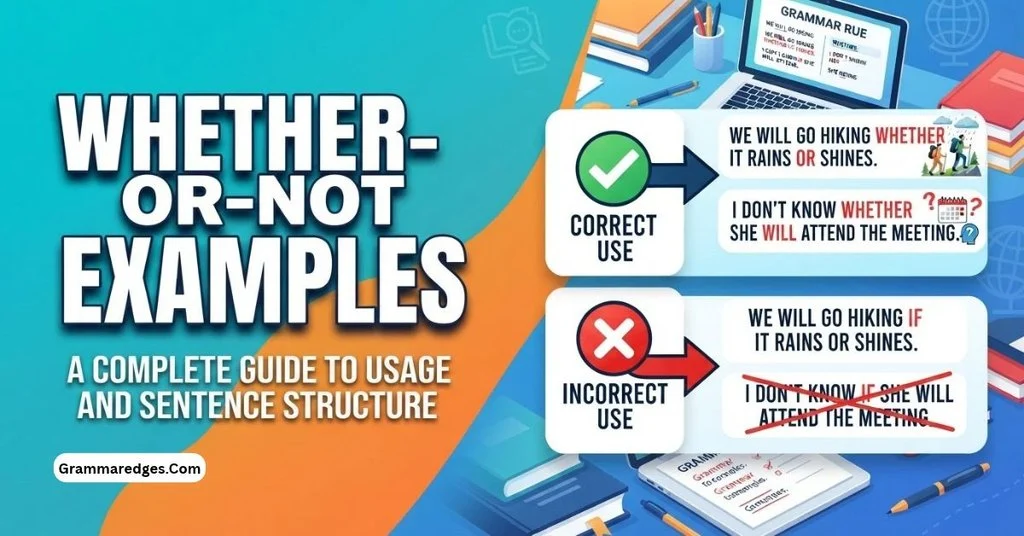
Examples make the difference easier to understand.
Everyday Examples
- I’ll go whether or not you come with me.
- She doesn’t know whether or not he called.
- We need to decide whether or not to order pizza.
- Whether or not you like it, this is the situation.
- I will finish the work whether or not I feel tired.
Professional Examples
- The company will move forward whether or not the proposal is approved.
- Please let us know whether or not you can attend the meeting.
- We need to determine whether or not the information is accurate.
- The deadline remains unchanged whether or not additional staff are available.
Formal Writing Examples
- The study examines whether or not the treatment produces measurable results.
- Researchers must consider whether or not the findings can be replicated.
- The committee will review the application whether or not additional documents are submitted.
These examples show why the phrase is useful: it can express either uncertainty about alternatives or an action that remains true regardless of the outcome.
Common Mistakes With “Whether or Not”
Mistake 1: Thinking “Whether or Not” Is Incorrect
It is not incorrect. The phrase is standard English.
Correct:
I don’t know whether or not she is available.
Mistake 2: Using “If” With an Alternative
When two alternatives are directly stated, whether is usually the better choice.
Better:
I can’t decide whether to stay or leave.
Not standard:
I can’t decide if to stay or leave.
Mistake 3: Adding “Or Not” Every Time
Although whether or not is correct, or not is not always necessary.
For example:
I wonder whether she knows.
This is perfectly natural.
You could also write:
I wonder whether or not she knows.
The second version emphasizes both possibilities, but the first is shorter.
Mistake 4: Confusing “Whether” With “Weather”
These words sound similar but have completely different meanings.
- Whether = introduces alternatives or uncertainty.
- Weather = conditions such as rain, wind, heat, or snow.
For example:
I don’t know whether he will come.
But:
The weather is cold today.
This is a common spelling issue because the words are pronounced similarly.
Frequently Asked Questions
What does “whether or not” mean?
Whether or not means that there are two possible outcomes and can emphasize that something is true or will happen regardless of which outcome occurs. For example, “I will attend whether or not she comes” means the speaker will attend if she comes and also if she does not.
Is “whether or not” grammatically correct?
Yes. Whether or not is grammatically correct and widely used in American English. It can introduce alternatives, express uncertainty, or emphasize that an action will happen regardless of the outcome. In some sentences, whether alone is enough.
Is it better to say “whether” or “whether or not”?
Neither is always better. Use whether when the alternatives are already understood. Use whether or not when you want to make the two possibilities explicit or emphasize that something applies in either case.
Can “whether or not” start a sentence?
Yes. For example: “Whether or not you agree, we need to move forward.” This construction is grammatical and often emphasizes that the main action or conclusion remains unchanged regardless of the situation.
Can I use “if” instead of “whether or not”?
Sometimes. In informal English, if can often replace whether when expressing uncertainty. However, whether is preferred when presenting clear alternatives, such as “I don’t know whether to stay or leave.” Avoid using if in the construction “if to stay or leave.”
Conclusion:
“Whether or not” is correct, natural, and useful English. It is especially helpful when you want to show that there are two possible outcomes or emphasize that something remains true regardless of what happens.
In many cases, whether alone works just as well. The choice depends on the sentence and the emphasis you want.
If the alternatives need to be clearly stated, whether or not can make your meaning easier to understand. If the meaning is already obvious, whether may be more concise.
The easiest rule to remember is: use “whether” for alternatives and uncertainty, and use “whether or not” when you want to emphasize either possibility or an outcome that applies in both cases.