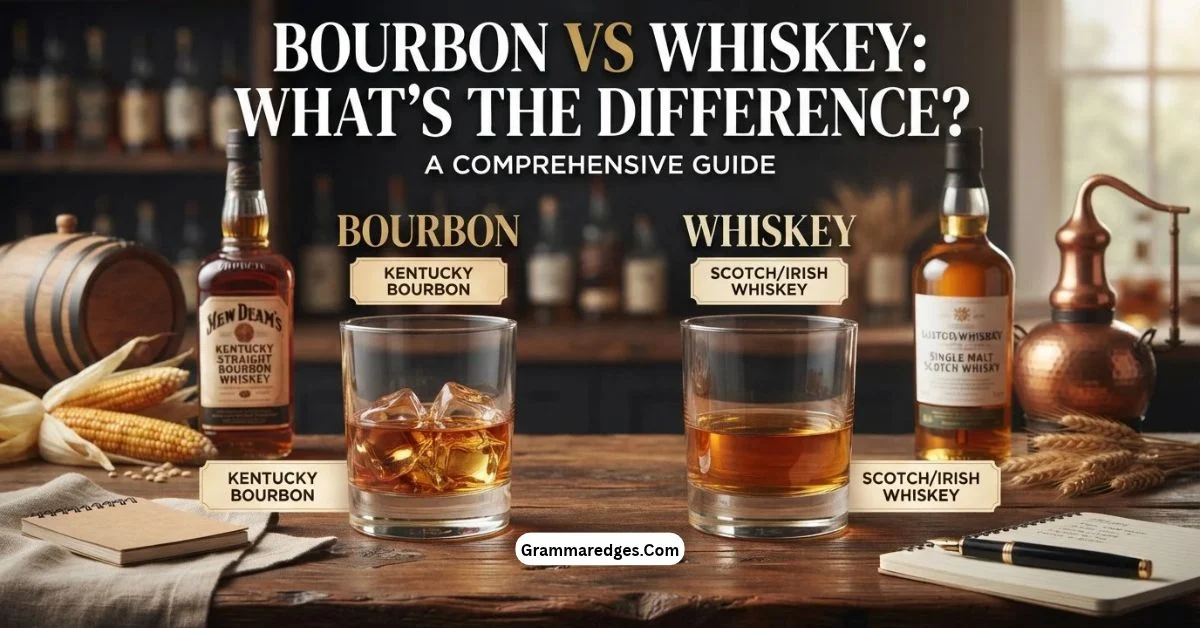
Bourbon is a type of whiskey, but whiskey is the broader category. Bourbon is an American whiskey made from a grain mixture containing at least 51% corn and aged in new, charred oak containers under specific U.S. requirements. Other whiskeys can use different grains, production methods, barrel rules, and countries of origin.
Key Takeaways
- Bourbon is whiskey, but not every whiskey is bourbon.
- Bourbon must contain at least 51% corn in its grain mash.
- Bourbon must be produced in the United States and stored in new, charred oak containers.
- Whiskey is a much broader category that includes bourbon, rye, Scotch, Irish whiskey, and other styles.
- Bourbon often has sweet, vanilla, caramel, and oak notes, but whiskey flavors vary widely by style and production method.
What Is Whiskey?
Whiskey is the larger category. In general, it is a distilled spirit made from fermented grain mash. The grains can include corn, rye, wheat, barley, or malted grains, depending on the type of whiskey and the applicable production rules.
That means the word “whiskey” alone does not tell you exactly what is in the bottle.
For example, whiskey can include:
- Bourbon
- Rye whiskey
- Tennessee whiskey
- Irish whiskey
- Scotch whisky
- Canadian whisky
- Japanese whisky
- Other regional and specialty styles
Each style can have its own rules and traditions.
This is the key to understanding the bourbon vs whiskey question: whiskey is the broad family, while bourbon is one specific member of that family.
What Is Bourbon?
Bourbon is a legally defined type of American whiskey.
Under U.S. federal standards, bourbon must be made from a fermented mash containing at least 51% corn. It must be distilled at no more than 160 proof, entered into new charred oak containers at no more than 125 proof, and bottled at at least 80 proof.
The requirement for new, charred oak is particularly important because the barrel contributes much of bourbon’s recognizable character.
The easiest rule to remember is:
Bourbon is whiskey with a specific American rulebook.
So if a whiskey does not meet the bourbon requirements, it cannot simply be labeled bourbon.
Bourbon’s Legal Requirements
| Requirement | Bourbon |
|---|---|
| Main grain requirement | At least 51% corn |
| Production location | United States |
| Maximum distillation proof | 160 proof |
| Maximum barrel-entry proof | 125 proof |
| Barrel | New, charred oak |
| Minimum bottling strength | 80 proof / 40% ABV |
| General minimum aging | None |
| Straight bourbon | At least 2 years |
The U.S. regulations distinguish regular bourbon from straight bourbon. Straight bourbon must be stored in new charred oak for at least two years and meet additional requirements.
Bourbon vs Whiskey: Key Differences
The biggest mistake is thinking these are two completely separate spirits.
They are not.
Bourbon belongs inside the whiskey category.
The actual difference is that bourbon has specific requirements that a whiskey does not necessarily have.
Grain and Mash Bill
Bourbon must contain at least 51% corn.
The remaining grains can include ingredients such as rye, wheat, and malted barley. The exact combination affects the final character of a bourbon.
Other whiskey styles have different grain requirements or traditions.
For example, U.S. rye whiskey must contain at least 51% rye. That higher rye content generally contributes a more peppery or spicy character compared with many corn-forward bourbons.
Where It Is Made
Bourbon must be produced in the United States under the U.S. standard.
This is one reason bourbon is strongly associated with American whiskey culture.
Kentucky is particularly famous for bourbon, but bourbon does not legally have to come from Kentucky. The federal definition focuses on production in the United States, not a requirement that it come from one particular state.
Barrels and Aging
Bourbon must be stored in new, charred oak containers.
That requirement has a major effect on its flavor and color. New charred oak can contribute characteristics commonly described as vanilla, caramel, toasted wood, and oak.
One important misconception is that every bourbon must be aged for a certain number of years.
That’s not true.
There is no general federal minimum aging period for bourbon. However, the term straight bourbon requires at least two years of aging in new charred oak.
Distillation and Proof
Bourbon has specific proof limits during production.
Federal standards require bourbon to be distilled at no more than 160 proof and entered into the barrel at no more than 125 proof. It must be bottled at no less than 80 proof, or 40% alcohol by volume.
These rules do not mean every bourbon tastes equally strong.
Proof is simply a measure of alcohol concentration. A whiskey can be higher or lower in proof depending on the product.
Does Bourbon Taste Different From Other Whiskey?
Often, yes—but “whiskey” is too broad a category to have one single flavor.
Bourbon commonly has a profile associated with:
- Vanilla
- Caramel
- Oak
- Brown sugar
- Sweet grain
- Baking spices
The combination of corn and new charred oak helps create this recognizable profile.
But compare bourbon with a heavily peated Scotch, and the difference can be dramatic. Compare it with Irish whiskey, and you may find another combination of fruit, grain, oak, and spice.
So instead of asking, “What does whiskey taste like?” it is more useful to ask:
“What type of whiskey is it?”
Bourbon vs Whiskey: Side-by-Side Comparison
| Feature | Bourbon | Whiskey |
|---|---|---|
| Category | A type of whiskey | Broad category |
| Grain | At least 51% corn | Depends on style |
| Production | United States | Multiple countries |
| Barrel rules | New, charred oak | Depends on style |
| Flavor | Often sweet, vanilla, caramel, oak | Can range from sweet to spicy, fruity, smoky, or malty |
| Aging | No general minimum | Depends on style and country |
| Proof | Specific U.S. bourbon limits | Varies by type |
| Examples | Kentucky bourbon, wheated bourbon, high-rye bourbon | Bourbon, rye, Scotch, Irish, Canadian, Japanese styles |
The important point is that “whiskey” does not represent one specific recipe. It is a family of different styles.
Is Bourbon Stronger Than Whiskey?
Not necessarily.
“Bourbon” describes a category and production requirements. It does not automatically mean that the drink has more alcohol than every other whiskey.
For example, two bottles can have different proof levels even when both are bourbon.
Likewise, another whiskey may have a higher or lower proof.
If you’re comparing strength, look at the bottle’s proof or ABV, rather than assuming bourbon is stronger because of its name.
In the United States, bourbon must be bottled at a minimum of 80 proof, or 40% ABV.
Bourbon vs Rye, Scotch, and Irish Whiskey
Bourbon vs Rye Whiskey
Both are American whiskey styles, but their required dominant grains differ.
Bourbon: at least 51% corn.
Rye whiskey: at least 51% rye.
That grain difference can create a noticeable flavor contrast. Bourbon is often associated with sweeter, rounder notes, while rye commonly brings more peppery spice and a drier impression.
Bourbon vs Scotch Whisky
Scotch is whisky produced in Scotland under its own regulations.
Scotch can have very different characteristics from bourbon, including malt, fruit, oak, smoke, or peat, depending on the style.
The spelling also commonly differs: American and Irish products generally use “whiskey,” while Scotch and several other traditions commonly use “whisky.”
Bourbon vs Irish Whiskey
Irish whiskey is another broad whiskey tradition with its own production rules.
Compared with many bourbons, Irish whiskey can offer different combinations of fruit, grain, malt, oak, and spice.
The important takeaway is that neither “bourbon” nor “whiskey” automatically describes one universal flavor.
Which Is Better for Cocktails?
There is no universal winner because the best choice depends on the cocktail and the flavor you want.
Bourbon is widely used in cocktails such as:
- Old Fashioned
- Whiskey Sour
- Mint Julep
- Boulevardier
Its sweetness and oak character can work especially well when combined with sugar, bitters, citrus, or other cocktail ingredients.
But many whiskey cocktails also work with rye, Scotch, or other whiskey styles.
For example, switching from bourbon to rye in an Old Fashioned can produce a noticeably spicier and drier character.
So when a recipe simply says “whiskey,” check the recipe context. The choice of whiskey style can change the finished drink.
Common Bourbon and Whiskey Mistakes
Mistake 1: Thinking bourbon and whiskey are separate categories
The correct relationship is:
Bourbon → Whiskey
Bourbon is a subset of whiskey.
Mistake 2: Assuming all whiskey is bourbon
A Scotch whisky is whiskey in the broad sense, but it is not bourbon.
Rye whiskey is also whiskey, but it is not bourbon simply because it is American.
Mistake 3: Assuming bourbon must come from Kentucky
Kentucky has a major bourbon tradition, but the federal bourbon definition requires production in the United States, not specifically Kentucky.
Mistake 4: Assuming bourbon must be aged for years
Regular bourbon has no general minimum federal aging period. Straight bourbon, however, must meet the two-year aging requirement.
Mistake 5: Assuming bourbon is always stronger
Proof varies from bottle to bottle. Check the label instead of judging alcohol strength from the category name.
Frequently Asked Questions
Is bourbon the same as whiskey?
Not exactly. Bourbon is a type of whiskey. Whiskey is the larger category, while bourbon has specific U.S. requirements involving its grain mixture, production, distillation, barrel, and bottling. Therefore, every bourbon qualifies as whiskey, but many whiskeys do not qualify as bourbon.
Is bourbon a type of whiskey?
Yes. Bourbon is a legally defined style of American whiskey. One of its most important requirements is that its fermented grain mash contain at least 51% corn. It must also meet specific U.S. production and barrel requirements.
Does bourbon have to come from Kentucky?
No. Bourbon must be produced in the United States, but federal rules do not require bourbon to come specifically from Kentucky. Kentucky is historically and commercially important to bourbon, but it is not the legal definition of bourbon.
Is bourbon always sweeter than whiskey?
No. Bourbon often has a sweeter profile because of its corn-heavy mash and new charred oak, but whiskey covers many styles. Rye can be spicy, while some Scotch can be smoky or peaty. Flavor depends on the specific whiskey style and production method.
Is straight bourbon older than regular bourbon?
“Straight bourbon” has a specific legal aging requirement of at least two years in new charred oak. Regular bourbon does not have the same general federal minimum aging requirement.
Is bourbon stronger than whiskey?
Not automatically. Bourbon and other whiskey styles can be bottled at different proof levels. To compare alcohol strength, check the bottle’s ABV or proof rather than relying on the name of the category.
Conclusion
The easiest way to remember bourbon vs whiskey is simple: bourbon is whiskey, but whiskey is not necessarily bourbon.
Whiskey is the larger category containing many styles from different regions. Bourbon is a specific American style with strict requirements, including at least 51% corn in the mash and storage in new, charred oak.
These rules help explain why bourbon often develops familiar vanilla, caramel, and oak characteristics. But whiskey as a whole is much more diverse, ranging from spicy rye to smoky Scotch and other regional styles.
Once you understand that bourbon is a subcategory of whiskey, the comparison becomes much easier—and reading whiskey labels becomes a lot less confusing.