
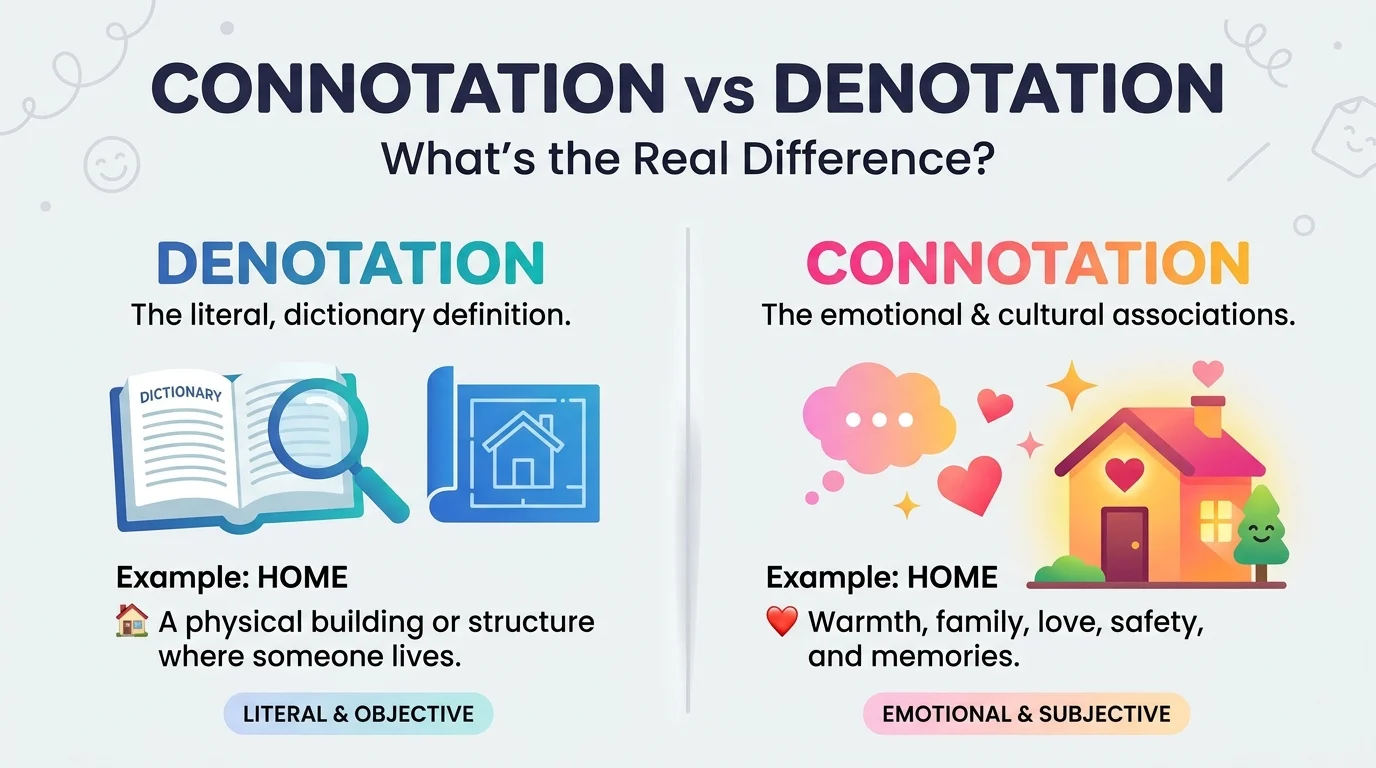
Have you ever wondered why two words with similar meanings can create completely different feelings? That’s where connotation vs denotation becomes important. Although both terms explain the meaning of words, they serve different purposes.
Denotation refers to a word’s literal or dictionary definition, while connotation describes the emotions, ideas, and associations connected to it. For example, home and house can refer to the same place, but home often suggests love, comfort, and belonging.
Understanding this difference can improve your vocabulary, writing, and reading skills. Let’s explore simple definitions, real-life examples, and key differences to make everything clear.
Key Takeaways
- Connotation is the emotional or implied meaning associated with a word.
- Denotation is the literal or dictionary definition of a word.
- Connotations can be positive, negative, or neutral.
- Two words can have similar denotations but create different feelings.
- Understanding both concepts helps improve reading, writing, and communication.
What Is Connotation?
Connotation is the additional meaning, feeling, or association that a word creates in someone’s mind. It goes beyond the literal definition and can influence how readers understand a sentence.
For example, the words confident and arrogant describe people who show strong belief in themselves. However, they create different impressions. Confident usually suggests a positive quality, while arrogant suggests an overly proud or unpleasant attitude.
Connotations can come from personal experiences, culture, society, and the situation in which a word is used. A word that sounds positive to one person may feel negative to another.
Writers use connotation to create emotion, establish tone, describe characters, and make their messages more effective.
Example:
- She is a slim woman.
- She is a skinny woman.
Both words describe someone with a thin body. However, slim often sounds complimentary, while skinny can sound critical.
This difference shows why word choice matters.
What Is Denotation?
Denotation is the direct, literal meaning of a word. It is the meaning you generally find in a dictionary, without focusing on the emotions or personal associations connected to it.
For example, the denotation of snake is a long, legless reptile. Some people may associate snakes with danger, fear, or dishonesty, but those ideas are connotations rather than the basic definition.
Denotation helps readers understand exactly what a word refers to. It is especially useful in academic writing, scientific explanations, instructions, and other situations where accuracy matters.
Examples of denotation:
- Rose: A flowering plant that often has thorns.
- Home: A place where someone lives.
- Child: A young human being.
- Snake: A legless reptile.
These definitions explain what the words literally mean without adding personal feelings.
Connotation vs Denotation: Key Differences
Although connotation and denotation are closely related, they describe two different parts of a word’s meaning.
| Feature | Connotation | Denotation |
|---|---|---|
| Meaning | Implied or associated meaning | Literal meaning |
| Focus | Feelings and ideas | Actual definition |
| Emotion | May create emotions | Does not depend on emotion |
| Context | Often changes with context | Usually more stable |
| Personal views | Can vary between people | Generally shared |
| Main purpose | Creates tone and impression | Communicates direct meaning |
| Example | Home suggests comfort | Home means a place to live |
The easiest way to remember the difference is that denotation tells you what a word means, while connotation tells you what a word makes you feel or think.
For example, inexpensive, cheap, and affordable can all describe something that costs relatively little. However, cheap may suggest poor quality, while affordable often creates a more positive impression.
Understanding this distinction helps you select words that communicate your intended message.
10 Examples of Connotation vs Denotation
The following examples show how words with similar literal meanings can create different impressions.
| Word | Denotation | Connotation |
|---|---|---|
| Home | A place where someone lives | Comfort, love, belonging |
| House | A building used for living | Shelter, structure |
| Slim | Thin in body shape | Attractive, healthy |
| Skinny | Thin in body shape | Too thin, unhealthy |
| Childlike | Having qualities of a child | Innocent, playful |
| Childish | Showing immature behavior | Silly, immature |
| Affordable | Within someone’s budget | Reasonably priced |
| Cheap | Low in price | Poor quality |
| Fragrance | A pleasant smell | Freshness, beauty |
| Stench | A very unpleasant smell | Disgust, discomfort |
Example 1: Home vs House
Both words refer to a place where people live. However, home often creates feelings of family, safety, and comfort. House usually describes the physical building.
Example 2: Childlike vs Childish
Childlike suggests positive qualities such as curiosity and innocence. Childish suggests behavior that is immature or inappropriate for someone’s age.
Example 3: Affordable vs Cheap
Affordable usually suggests that something is reasonably priced. Cheap can sometimes suggest low quality, even though both words relate to a low cost.
These examples demonstrate that a word’s emotional effect can be just as important as its literal meaning.
Connotation vs Denotation Examples: 10 Words That Show the Difference
Connotation and denotation become easier to understand when you compare words with similar literal meanings but different emotional associations. Denotation explains what a word directly means, while connotation describes the feelings or ideas it creates.
| Word | Denotation | Connotation |
|---|---|---|
| Home | A place where someone lives | Love, comfort, belonging |
| House | A building for living | Shelter, structure |
| Slim | Having a thin body shape | Attractive, healthy |
| Skinny | Having a thin body shape | Too thin, unhealthy |
| Childlike | Having qualities of a child | Innocence, playfulness |
| Childish | Showing child-related behavior | Immaturity |
| Fragrance | A smell | Pleasant, fresh |
| Stench | A strong, unpleasant smell | Disgust |
| Affordable | Within a person’s budget | Reasonable, accessible |
| Cheap | Low in price | Possibly poor quality |
These examples show that words can communicate more than their dictionary definitions. When choosing between similar words, consider the impression you want to create in your reader’s mind.
Denotation and Connotation Worksheet: Practice With Easy Exercises
A denotation and connotation worksheet helps students understand literal meanings and emotional associations through practical exercises. Instead of memorizing definitions, learners can practice identifying how different words affect a sentence.
Exercise 1: Identify the Meaning
Decide whether each statement describes denotation or connotation.
- A rose is a flowering plant.
- A rose represents love and romance.
- A snake is a legless reptile.
- A snake may symbolize dishonesty.
- A home is associated with comfort and family.
Exercise 2: Choose the Correct Word
Select the word that creates the intended impression.
- She is a (slim / skinny) model.
- He is (confident / arrogant) about his abilities.
- My grandmother lives in a (home / house) filled with memories.
- The room had a pleasant (fragrance / stench).
Answer Key:
- Exercise 1: 1. Denotation, 2. Connotation, 3. Denotation, 4. Connotation, 5. Connotation.
- Exercise 2: 1. Slim, 2. Confident, 3. Home, 4. Fragrance.
These activities help students recognize how literal and emotional meanings work together in everyday English.
Connotation vs Denotation PDF: What Should a Study Guide Include?

A connotation vs denotation PDF can make learning easier by putting definitions, comparisons, examples, and practice questions in one convenient study resource. Students can use a printable guide for homework, classroom activities, test preparation, and vocabulary practice.
A useful study guide should include:
- Simple definitions: Explain connotation and denotation in easy language.
- Comparison chart: Show how literal and emotional meanings differ.
- Word examples: Include home vs house, slim vs skinny, and childish vs childlike.
- Practice exercises: Give students sentences to analyze.
- Answer key: Help learners check their understanding.
- Writing activities: Allow students to replace neutral words with positive or negative alternatives.
For example, a worksheet might ask students to explain why generous sounds more positive than giving in a particular sentence.
A well-organized PDF can help learners review the topic quickly without reading long explanations. You can also use the examples and exercises in this article to create your own printable classroom handout.
Give 5 Examples of Denotation and Connotation
If you want to understand these concepts quickly, the following five examples show how literal definitions differ from emotional associations.
| Word | Denotation | Connotation |
|---|---|---|
| Dove | A type of bird | Peace, hope, purity |
| Home | A place where someone lives | Family, warmth, security |
| Rose | A flowering plant | Love, romance, beauty |
| Snake | A legless reptile | Danger, betrayal, fear |
| Lion | A large wild cat | Courage, strength, leadership |
1. Dove: Its denotation is a bird, while its common symbolic connotation is peace.
2. Home: Its denotation is a place to live, but it can suggest family and emotional security.
3. Rose: It literally refers to a flower, but it often represents love and beauty.
4. Snake: It denotes a reptile, but it may suggest danger or dishonesty.
5. Lion: It denotes a wild animal, while its symbolic associations often include bravery and power.
Remember that connotations can vary across cultures and situations. These examples show common associations rather than meanings that everyone must share.
Denotation and Connotation in Communication: Why Word Choice Matters
Denotation and connotation in communication play an important role in how people understand messages. The words you choose can influence the tone, emotional impact, and overall impression of your conversation.
For example, consider these two statements:
- “He is confident about his decision.”
- “He is arrogant about his decision.”
Both describe someone’s strong belief in a decision, but the second sentence creates a more negative impression.
Here are three areas where these concepts matter:
Professional Communication: In emails, meetings, and reports, neutral words can help prevent misunderstandings and maintain a respectful tone.
Everyday Conversations: Choosing words carefully can make your message sound friendly, supportive, or critical.
Marketing and Advertising: Businesses often select emotionally appealing words to influence how customers view a product or service.
Understanding both concepts helps you communicate your message more accurately and recognize the feelings that other people’s words may express.
Connotation vs Annotation: Are These Words Different?
Connotation and annotation may look similar, but they have completely different meanings. Connotation relates to the emotional associations of a word, while annotation means adding notes or explanations to a text.
| Feature | Connotation | Annotation |
|---|---|---|
| Meaning | Emotional or implied association | A note or explanation |
| Purpose | Creates an impression | Adds information |
| Common use | Language and literature | Reading and studying |
| Example | Rose suggests love | A note explaining a poem |
Example of Connotation:
The word home can suggest comfort, safety, and belonging.
Example of Annotation:
A student writes a note beside the word home in a textbook to explain its meaning.
The important difference is that connotation is part of how a word communicates meaning, while annotation is an additional comment written to explain or clarify information.
Denotation and Connotation Words: Positive, Negative, and Neutral Examples
Some words have similar dictionary meanings but create different impressions. Learning these word groups can help you select more appropriate vocabulary for conversations, essays, and professional writing.
| Neutral Word | Positive Connotation | Negative Connotation |
|---|---|---|
| Thin | Slim | Skinny |
| Confident | Self-assured | Arrogant |
| Economical | Thrifty | Stingy |
| Curious | Inquisitive | Nosy |
| Different | Unique | Strange |
| Fragrance | Aroma | Stench |
| Determined | Persistent | Stubborn |
| Inexperienced | Newcomer | Amateur |
How to Use These Words
- Choose positive words when you want to praise someone or describe something favorably.
- Use negative words when criticism or an unfavorable impression is appropriate.
- Choose neutral words when you want to communicate facts without adding unnecessary emotion.
For example, thrifty often describes someone who spends money carefully in a positive way, while stingy suggests that someone is unwilling to spend or share.
Connotation vs Denotation vs Annotation: Complete Difference With Examples
Connotation, denotation, and annotation are three different language concepts. Connotation describes the feelings connected to a word, denotation explains its literal definition, and annotation refers to a written note that provides additional information.
| Concept | Definition | Example |
|---|---|---|
| Connotation | Emotional or associated meaning | Rose suggests romance |
| Denotation | Direct dictionary meaning | Rose is a flowering plant |
| Annotation | A note explaining information | A student writes a note about a rose in a textbook |
Let’s understand all three with one example:
Imagine you are studying a poem that mentions a rose.
- Denotation: A rose is a type of flowering plant.
- Connotation: The rose may represent love, beauty, or romance.
- Annotation: You write a note beside the poem explaining why the author may have used the rose as a symbol.
The three concepts work in different ways. Denotation explains the actual word, connotation reveals its possible emotional meaning, and annotation helps readers record their understanding.
What Are the Three Types of Connotation?
Connotations are commonly grouped into three categories: positive, negative, and neutral. These categories help explain the emotional impression a word creates.
Positive Connotation
A positive connotation creates a pleasant, favorable, or encouraging impression. It makes a person, object, or situation sound appealing.
Examples:
- Confident: Suggests self-belief and strength.
- Generous: Suggests kindness and willingness to help.
- Youthful: Suggests energy and freshness.
- Fragrance: Suggests a pleasant smell.
- Thrifty: Suggests careful and sensible spending.
For example, saying “She is generous with her time” creates a positive impression of someone who willingly helps others.
2. Negative Connotation
A negative connotation creates an unpleasant, critical, or unfavorable impression. It may suggest a problem, weakness, or undesirable quality.
Examples:
- Arrogant: Suggests excessive pride.
- Stingy: Suggests unwillingness to share.
- Skinny: Can suggest being unhealthily thin.
- Stench: Suggests a very bad smell.
- Childish: Suggests immature behavior.
For example, saying “He is stingy with his money” creates a negative impression of someone who does not like spending or sharing.
3. Neutral Connotation
A neutral connotation communicates information without strongly positive or negative emotional associations.
Examples:
- House: A building where people live.
- Thin: Having relatively little body fat or thickness.
- Inexpensive: Not costing much.
- Walk: To move on foot.
- Residence: A place where someone lives.
Neutral words are particularly useful in professional, academic, and factual writing because they help communicate information without unnecessary emotional influence.
Why Are Connotation and Denotation Important?
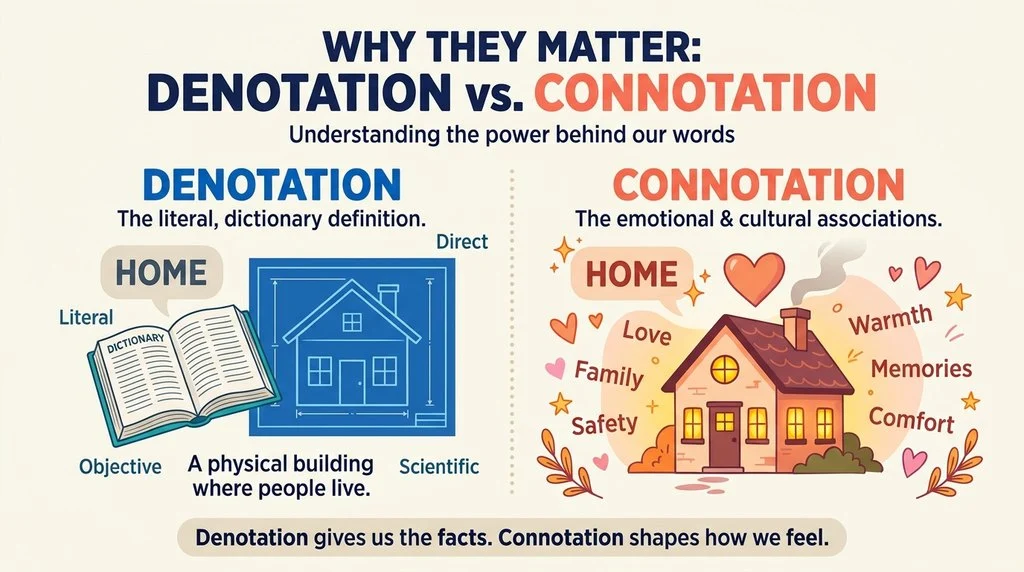
Understanding connotation and denotation helps you communicate more clearly and understand the deeper meaning of written or spoken language. Both concepts are important in everyday conversations, education, professional communication, and creative writing.
Here are four important reasons to learn them.
1. Improve Your Writing
Choosing the right words helps you express your thoughts accurately. For example, calling someone determined creates a more positive impression than calling them stubborn, even when both describe someone who refuses to give up easily.
2. Understand Literature
Authors use connotations to create emotions, develop characters, and communicate ideas. Recognizing these associations helps readers understand poetry, stories, novels, and other literary works.
3. Communicate Professionally
In business emails, reports, and workplace conversations, word choice can affect how people interpret your message. Neutral and respectful language can help avoid misunderstandings.
4. Improve Reading Comprehension
Knowing the difference helps you understand what an author says directly and what they suggest indirectly. This is especially useful when analyzing advertisements, news articles, speeches, and persuasive writing.
How to Identify Connotation and Denotation in a Sentence
You can identify both concepts by examining the literal definition of a word and the feelings or associations it creates.
Follow these simple steps:
- Find the important word: Identify the word whose meaning you want to understand.
- Check its dictionary meaning: Determine what the word literally describes. This is its denotation.
- Consider its emotional effect: Ask what feelings or ideas the word creates.
- Examine the context: Read the complete sentence to understand why the writer selected that particular word.
- Compare similar words: Replace the word with a synonym and notice whether the sentence sounds more positive, negative, or neutral.
Example:
“After winning the competition, Sarah was confident.”
- Denotation: Confident means having belief in yourself or your abilities.
- Connotation: It suggests self-assurance, strength, and a positive attitude.
- Context: Sarah’s confidence is presented as a positive quality because she has achieved something.
Now compare it with this sentence:
“Sarah was arrogant after winning the competition.”
The literal meanings are different, but both words relate to how someone views their abilities. Arrogant creates a negative impression of Sarah’s behavior.
Common Mistakes to Avoid
Students and English learners sometimes confuse connotation and denotation because both explain the meaning of words. Avoid these common mistakes:
- Treating them as identical: Denotation is the literal definition, while connotation refers to associated ideas and feelings.
- Assuming every connotation is negative: Words can have positive, negative, or neutral associations.
- Ignoring context: A word’s emotional effect can change depending on the sentence and situation.
- Confusing synonyms: Two words can have similar dictionary meanings but different emotional effects.
- Assuming everyone feels the same way: Personal experiences and cultural backgrounds can influence how people interpret words.
Remember that a word can have both a denotation and a connotation. These meanings work together to communicate a complete message.
Frequently Asked Questions
1. What is the difference between connotation and denotation?
Connotation is the emotional or implied meaning associated with a word, while denotation is its direct dictionary definition. For example, home denotes a place where someone lives but often connotes comfort, family, and belonging.
2. What is an example of connotation and denotation?
Consider the word rose. Its denotation is a flowering plant. Its connotations may include love, beauty, romance, and affection. The literal meaning identifies the flower, while the associated meaning explains the feelings it may represent.
3. What are the three types of connotation?
The three common types are positive, negative, and neutral connotation. Positive connotations create favorable impressions, negative connotations create unfavorable impressions, and neutral connotations communicate information without strong emotional judgment.
4. Is connotation positive or negative?
Connotation can be positive, negative, or neutral. For example, generous usually has a positive connotation, stingy has a negative connotation, and careful is often neutral. The intended meaning can also depend on context.
5. What is the denotation of a word?
The denotation of a word is its direct or literal meaning. It explains what the word refers to without focusing on emotional associations. For example, the denotation of school is an institution where students receive education.
6. Can two words have the same denotation but different connotations?
Yes. Two words can refer to similar things but create different impressions. For example, childlike and childish both relate to characteristics associated with children. However, childlike is usually positive, while childish is often negative.
7. Why are connotation and denotation important in writing?
They help writers communicate accurate information while controlling the tone and emotional effect of their words. Denotation ensures clarity, while connotation helps create the desired impression. Understanding both makes writing more effective and meaningful.
Conclusion
Understanding connotation vs denotation makes it easier to recognize how words communicate both direct meanings and emotional messages.
Denotation explains what a word literally means, while connotation describes the feelings, ideas, and associations connected to it. Words such as home and house demonstrate how two similar terms can create different impressions.
Learning these concepts can improve your vocabulary, reading comprehension, and writing skills.
If you are studying English, analyzing literature, or communicating professionally, choosing words carefully makes a difference. Always consider both the dictionary definition and the emotional effect of a word before using it.