
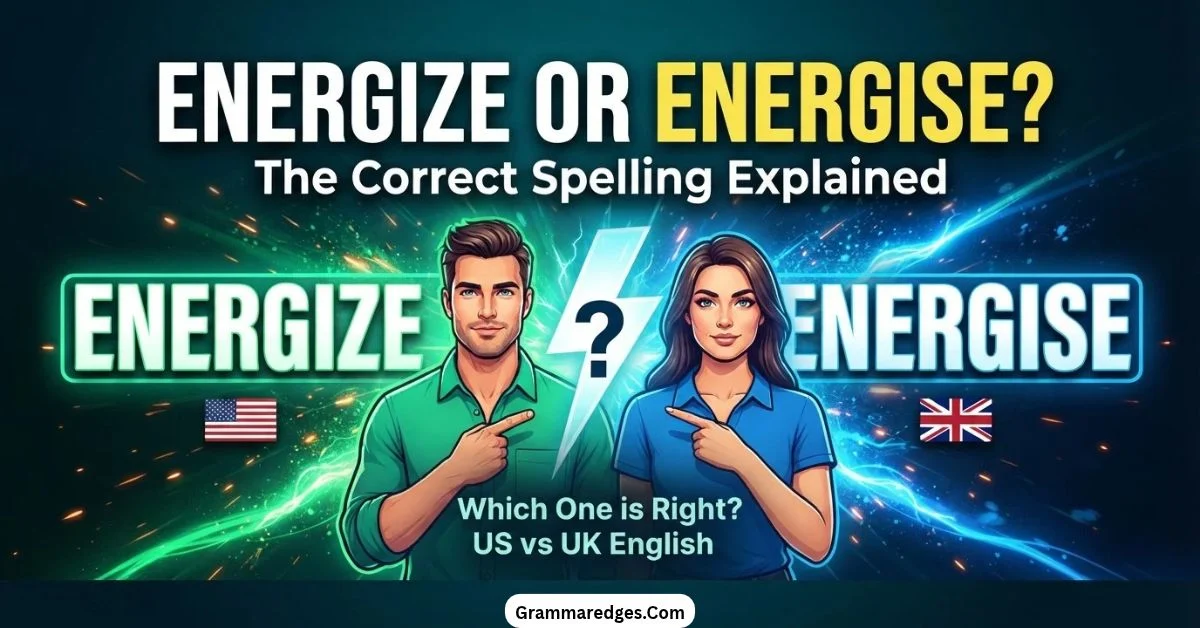
Are you confused about whether to write energize or energise? Both spellings are correct, but the right choice depends on your audience. Energize is the preferred spelling in American English, while energise is commonly used in British English.
Both words mean to give someone or something energy, enthusiasm, or power. You may encounter them in everyday conversations, fitness articles, motivational writing, and scientific contexts.
Understanding this simple spelling difference can help you avoid mistakes and keep your content consistent. In this guide, Grammaredges explains the meaning, differences, and examples of energize vs energise.
Key Takeaways
- Energize is the American English spelling; energise is the British English spelling.
- The two spellings do not have different meanings — that is a common myth.
- The word covers both people (give energy and enthusiasm) and machines (supply power).
- Both spellings are pronounced the same way: EN-er-jize.
What Does “Energize” Mean?
To energize means to give energy, life, or enthusiasm to someone or something.
Used about people, it means filling someone with energy and motivation. A good coach energizes a tired team. A strong cup of coffee energizes you on a slow morning. One exciting idea can energize a whole company.
Used about machines and systems, it means supplying power. Electricians talk about energizing a circuit — switching on the power that runs through it. In physics, atoms can be energized too, raised to a higher energy level.
Notice that both meanings work with both spellings. Energize and energise each do both jobs; only the region changes.
Energize vs. Energise: One Letter, Two Varieties
| Energize | Energise | |
|---|---|---|
| Used in | United States | United Kingdom |
| Ending | -ize | -ise |
| Meaning | Give energy or power | Give energy or power |
| Pronunciation | EN-er-jize | EN-er-jize |
| Example | The music energized the crowd. | The music energised the crowd. |
Usage guides treat energize as the North American spelling and energise as the preferred British spelling. Energise is not a typo, and energize is not slang — they are the same word wearing two regional spellings, exactly like realize/realise and oxidize/oxidise.
Do Energize and Energise Mean Different Things?
No — and this is worth saying clearly, because some websites claim otherwise.
You may read that energise means giving people vitality while energize means giving devices power. No major dictionary supports that split. Collins, Merriam-Webster, and the Oxford dictionaries give both spellings the same definitions. The difference is geography, not meaning.
A British writer can energise a circuit, and an American writer can energize a crowd. If a page tells you the s form is “for people” and the z form is “for machines,” it is inventing a rule that does not exist.
Which Spelling Should You Use?
Match the spelling to your readers. That one habit answers almost every case.
Writing for an American audience
Use energize. It is the form in Merriam-Webster and the one American editors, teachers, and style guides expect. In US writing, an s spelling will often be flagged as a typo, even though it is a real word.
Writing for a British audience
Use energise for general British readers — it is the everyday choice in British books, news, and schools. Energize is still acceptable in Britain: Oxford spelling keeps the -ize ending, so you will see the z form in British academic and scientific publishing as well.
Writing technical or electrical content
The word’s technical sense — supply power — appears constantly in manuals and safety documents: “Energize the system only after the inspection is complete.” Follow the variety of the document you are writing. US manuals always use the z form; British manuals usually use the s form, though -ize is common in engineering.
Why does English have two spellings?
Energize is built from “energy” plus the verb ending -ize. “Energy” itself comes from the Greek word energeia, meaning activity or working. The -ize ending also traces back to Greek, but French later reshaped it to -iser, and British spelling picked up that French-style -ise. American English kept -ize.
Whatever you choose, choose it once. “The speech energized the team” in one paragraph and “an energising speaker” in the next looks like a mistake, because consistency is what readers actually notice.
Every Word Form: Energize and Energise Side by Side
The s/z swap runs through every form of the word, verbs and nouns alike.
| Form | American English | British English |
|---|---|---|
| Base verb | energize | energise |
| Third person | energizes | energises |
| Past tense | energized | energised |
| -ing form | energizing | energising |
| Noun (person/device) | energizer | energiser |
| Noun (process) | energization | energisation |
Match the noun to your verb: if your document says “energize,” its process noun is “energization,” and the device or person doing it is an “energizer.”
Examples in Sentences
American spelling (energize):
- A short walk can energize you better than a second cup of coffee.
- The new manager energized the whole sales team in her first week.
- Do not energize the circuit until the cover is back on.
British spelling (energise):
- The announcement energised supporters across the country.
- Live music energises a tired crowd like nothing else.
- The battery energises the whole system.
Both sets are correct, for people and for machines. The only real error is mixing them inside one piece of writing.
Common Mistakes to Avoid
- Believing the spellings have different meanings. The “people vs. machines” split is a myth; geography is the only difference.
- Mixing forms in one document. Energized in one paragraph and energising in the next looks careless.
- Mismatching your audience. Energise will look like a typo to many American readers; energize everywhere can make a British text feel Americanized.
- Using “energize” where the noun “energy” belongs. “I need more energize” is wrong — energize is only a verb. Write “I need more energy.”
- “Correcting” a quotation. If a British source wrote “energised,” leave it as it is inside a direct quote; quotes keep the original spelling.
The 10-Second Rule
American readers: energize. British readers: energise. Same word, same meaning, same sound — only the map changes. Pick the form your audience uses, apply it to every form of the word, and move on.
Frequently Asked Questions
Is it energize or energise?
Both are correct. Energize with a z is the standard spelling in American English, and energise with an s is the standard spelling in British English. Choose the one that matches your readers.
Do energize and energise have different meanings?
No. Some websites claim energise is for people and energize is for devices, but dictionaries give both spellings identical definitions. The difference is regional spelling, nothing more.
What is the past tense — energized or energised?
It follows your base spelling. American writers use “energized,” as in “the speech energized the team.” British writers use “energised,” as in “the speech energised the team.”
How do you pronounce energize and energise?
They sound identical: EN-er-jize (/ˈɛn.ər.dʒaɪz/). The s and z spellings change nothing about the sound.
Can you energize a machine, or only people?
Both. For people, energize means to fill with energy and enthusiasm. For machines and systems, it means to supply power, as in “energize the circuit.” Both senses work with either spelling.
How is “energizer” spelled in British English?
For a person or device that energizes, British spelling is “energiser.” Note that “Energizer” with a z is also a well-known battery brand name, and brand names keep their own spelling everywhere.
Conclusion
Choosing between energize vs energise becomes easy when you understand American and British English spelling conventions. Energize is the preferred form in the United States, while energise is widely used in British English.
Both words have the same meaning and can describe giving energy, enthusiasm, or power to a person or thing. Neither spelling is universally wrong, so your choice should match your target audience and preferred style guide.
For clear, professional writing, use one spelling consistently throughout your article. Remember this simple rule, and you can confidently choose between energize and energise whenever you write.