
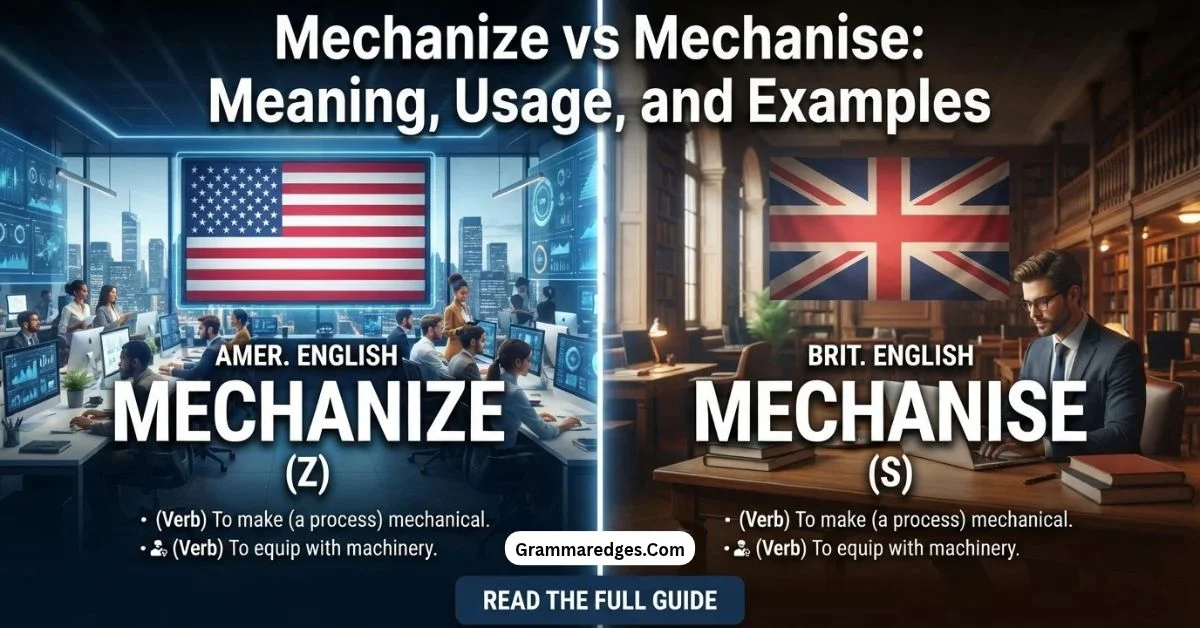
Have you ever wondered whether to write mechanize or mechanise? Both spellings are correct, but the right choice depends on your target audience. Mechanize is the preferred spelling in American English, while mechanise is commonly used in British English.
Both words mean to introduce machines or automated systems to a process, often to improve efficiency and reduce manual work. Understanding this spelling difference can help you write clearly and avoid inconsistencies in your content.
In this guide, Grammaredges explains the meaning, differences, usage, and examples of mechanize vs mechanise so you can confidently choose the correct form.
Key Takeaways
- Mechanize is the American English spelling; mechanise is the British English spelling.
- Both words mean the same thing and are pronounced the same way: MEK-uh-nize.
- The noun follows the same pattern: mechanization (US) and mechanisation (UK).
- Whichever form you choose, use it consistently through the whole document.
What Does “Mechanize” Mean?
To mechanize something is to introduce machines into a job or process that people used to do by hand. When a farm mechanizes its harvest, workers with baskets give way to tractors and combine harvesters. When a factory mechanizes its packing line, machines seal and stack the boxes instead.
The word is common in farming, manufacturing, and warehousing — anywhere hand labor is replaced by equipment. It says nothing about computers or software. A process can be mechanized with simple machines that have no electronics at all.
There is also a military meaning. To mechanize a military unit is to equip it with armored vehicles and motor transport, so soldiers travel and fight from vehicles rather than on foot. That is why you see phrases like “mechanized infantry” and “mechanized division” in history books and news reports.
In a looser, everyday sense, mechanize can also mean to make something mechanical or routine — to strip the human judgment out of a task until it runs like a machine.
Mechanize vs. Mechanise: The Only Difference Is One Letter
Strip away the spelling, and there is nothing to choose between these two words.
| Mechanize | Mechanise | |
|---|---|---|
| Used in | United States | United Kingdom |
| Ending | -ize | -ise |
| Meaning | Introduce machines into a process | Introduce machines into a process |
| Pronunciation | MEK-uh-nize | MEK-uh-nize |
| Example | The plant will mechanize the line. | The plant will mechanise the line. |
Mechanise is not a misspelling, and mechanize is not slang or an error. Dictionaries list mechanize as the main form and mechanise as the British variant — Collins adds the regional note “in BRIT, also use mechanise,” and Webster’s marks mechanise as “especially British.” The same pattern appears in words like standardize/standardise and categorize/categorise.
Which Spelling Should You Use?
Use the spelling that matches your readers. That single rule settles nearly every case of mechanize vs mechanise.
Writing for an American audience
Write mechanize. It is the form listed in Merriam-Webster, and it is the spelling American style guides expect. To an American reader, mechanise can look like a typo, even though it is a perfectly real word.
Writing for a British audience
Write mechanise for general readers — it is the everyday choice in British publishing. But mechanize is not an error in Britain. Oxford spelling, the system used by Oxford University Press and many academic publishers, keeps the -ize ending, so British textbooks and journals print mechanize more often than you might expect.
Writing about the military or machinery
Follow the house style of whoever publishes you, because usage splits here. US Army and NATO English-language publications use mechanize — think “mechanized infantry.” British forces write mechanise, as in “light mechanised infantry.” The word means the same in both; only the spelling follows the flag.
Why does English have two spellings?
The -ize ending comes from the Greek ending -izein, carried into Latin as -izare. French later softened the ending to -iser, and British English picked up that French-style -ise. American spelling kept -ize, which is why the z form is actually the older, more original one.
Whatever you pick, pick it once. Mixing mechanize in one paragraph and mechanised in the next looks careless and can confuse readers. Set your spellchecker to US English or UK English, and let it police the choice for you.
Every Word Form: Mechanize and Mechanise Side by Side
The s/z swap runs through every form of the word, including the noun and the word for the person or company doing the work.
| Form | American English | British English |
|---|---|---|
| Base verb | mechanize | mechanise |
| Third person | mechanizes | mechanises |
| Past tense | mechanized | mechanised |
| -ing form | mechanizing | mechanising |
| Noun (process) | mechanization | mechanisation |
| Noun (person/company) | mechanizer | mechaniser |
Spellcheckers accept all of these forms, so the “correct” one is simply the one that matches the rest of your document.
Examples in Sentences
American spelling (mechanize):
- The company plans to mechanize its warehouse within two years.
- Farmers mechanized the harvest as labor became harder to find.
- The army mechanized its infantry divisions before the war.
British spelling (mechanise):
- The factory mechanised its bottling line last year.
- British farms mechanised rapidly after the war.
- The regiment was fully mechanised by 1943.
Both sets of sentences are correct. What would be wrong is mixing them, like writing “the plant had mechanised” in one sentence and “it will mechanize the rest” in the next. Together they clash; apart, each is fine.
Common Mistakes to Avoid
- Treating mechanise as a typo. It is standard British spelling, listed in every major dictionary.
- Assuming mechanize is wrong in British English. Oxford spelling and British academic publishers use it regularly.
- Mixing the two forms in one article, report, or website. This is the only real error here.
- Confusing mechanize with motorize. Motorize means to equip something with motor vehicles specifically. Mechanize is the broader word for bringing machines into any process.
- Letting the noun drift from the verb. If you write mechanize, write mechanization. If you write mechanise, write mechanisation.
The 10-Second Rule
If your audience is American, write mechanize. If your audience is British, write mechanise — and mirror that same choice in mechanization/mechanisation. Then stay consistent. That is genuinely all there is to it.
And when you are editing someone else’s work and both forms appear, standardize to the audience’s variety instead of “correcting” everything to your own.
Frequently Asked Questions
Is mechanise a correct spelling?
Yes. Mechanise is the standard British English spelling of the verb. It means exactly the same as mechanize, and it appears in British newspapers, books, and farming and industry writing every day.
What does mechanized mean?
It describes something that has been equipped with machines. A mechanized farm uses tractors and harvesters instead of hand labor, and a mechanized army unit travels in armored vehicles instead of on foot.
What is the past tense — mechanized or mechanised?
It follows your base spelling. American writers use “mechanized,” as in “the plant mechanized its line.” British writers use “mechanised,” as in “the plant mechanised its line.”
How do you pronounce mechanize and mechanise?
They sound identical: MEK-uh-nize (/ˈmɛk.ə.naɪz/). The s and z spellings make no difference to the pronunciation at all.
What is the difference between mechanize and automate?
Mechanizing means bringing machines into a process; the machines may be simple and still run by people. Automating means making a process run by itself, usually with sensors, controls, or software. Mechanization often comes first, automation second.
Is it mechanization or mechanisation?
Both are correct, and they follow the same rule as the verb. American English uses mechanization with a z; British English uses mechanisation with an s. Match the noun to the spelling you chose for the verb.
Conclusion
Choosing between mechanize vs mechanise is simple once you understand the difference between American and British English.
Mechanize is the standard choice for American audiences, while mechanise is widely used in British English. Both spellings share the same meaning: to equip a process or system with machines or automation.
Neither form is universally wrong, so your decision should depend on your readers and preferred style guide. For consistent writing, avoid switching between the two forms in the same article. Keep this spelling rule in mind, and use the correct version confidently in your writing.