
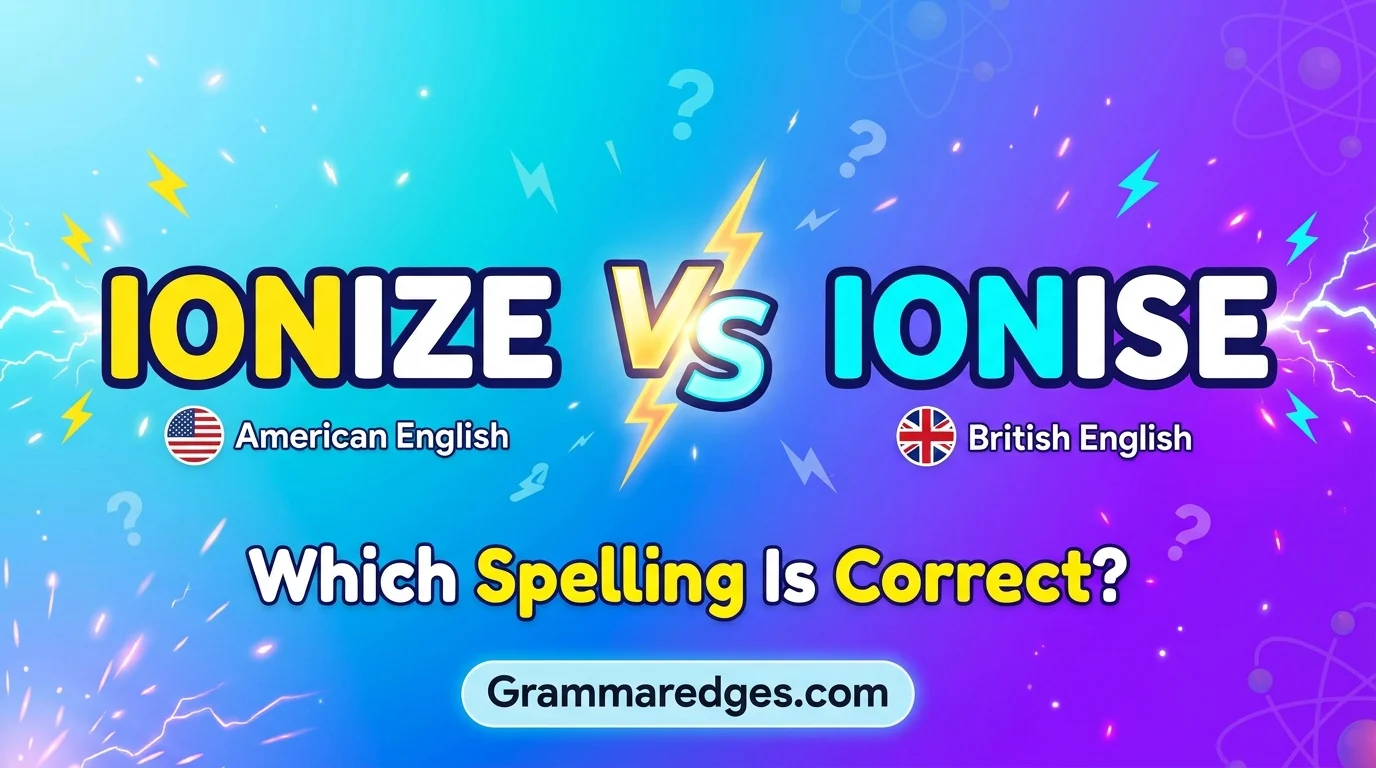
Ionize vs ionise is a common spelling question for writers, students, and science learners who want to know which version is correct. Both words have the same meaning, but their spelling depends on the type of English you use.
Ionize is the preferred spelling in American English, while ionise is commonly used in British English. Both describe the scientific process of converting atoms or molecules into electrically charged ions.
But which spelling should you choose for your writing? In this guide, you’ll discover their meanings, American and British differences, simple sentence examples, and related word forms.
Key Takeaways
- Ionize is the preferred spelling in American English.
- Ionise is a common British English spelling.
- Both words describe the process of forming ions.
- The pronunciation and scientific meaning are the same.
- Related forms include ionized, ionised, ionizing, and ionising.
What Is the Difference Between Ionize and Ionise?
The main difference between ionize and ionise is their regional spelling. American English generally uses the letter z, whereas British English commonly uses s in this word.
Both spellings are grammatically correct. Neither changes the scientific meaning of the word. They describe the same process in chemistry and physics.
Here is a quick comparison:
| Feature | Ionize | Ionise |
|---|---|---|
| English variety | American English | British English |
| Spelling | Z | S |
| Meaning | Form or produce ions | Form or produce ions |
| Pronunciation | /ˈaɪənaɪz/ | /ˈaɪənaɪz/ |
| Word type | Verb | Verb |
| Related noun | Ionization | Ionisation |
| Example | Radiation can ionize gas. | Radiation can ionise gas. |
For example:
- American: Scientists use radiation to ionize atoms.
- British: Scientists use radiation to ionise atoms.
Both sentences communicate exactly the same information.
According to Cambridge Dictionary, ionize is the main spelling, with ionise commonly used in British English. English meaning – Cambridge Dictionary+1
What Does Ionize Mean?
Ionize is a verb that means to convert an atom or molecule into an ion by adding or removing one or more electrons.
An ion is an atom or molecule with an electrical charge. Normally, an atom has an equal number of protons and electrons, making it electrically neutral.
However, when an atom loses or gains electrons, it becomes electrically charged.
There are two basic possibilities:
- Losing electrons: An atom loses one or more negatively charged electrons and becomes a positive ion.
- Gaining electrons: An atom gains one or more electrons and becomes a negative ion.
For example, when radiation transfers enough energy to an atom, it may remove an electron. The atom then becomes a positively charged ion.
The word ionize is commonly used in chemistry, physics, biology, and other scientific fields.
Examples of Ionize in Sentences
Here are some natural examples showing how to use ionize correctly:
- High-energy radiation can ionize atoms in the atmosphere.
- Scientists studied how electric fields ionize different gases.
- Certain chemicals can ionize when dissolved in water.
- The equipment uses electrical energy to ionize the gas.
- Ultraviolet light can ionize some molecules.
- Researchers examined how quickly the particles ionize.
- The experiment showed that radiation could ionize the material.
Notice that ionize works as an action word in every example. It describes the process of creating ions.
What Does Ionise Mean?
Ionise has exactly the same meaning as ionize. It refers to the process of converting atoms or molecules into electrically charged particles called ions.
The spelling with s is especially common in British English and is often found in British educational materials, scientific publications, and technical writing.
For example, a British science textbook might explain how radiation can ionise gas particles. An American textbook would normally use ionize instead.
The spelling does not describe a different chemical reaction. Both versions refer to the same scientific process.
Examples of Ionise in Sentences
Here are some examples using the British spelling:
- Radiation can ionise the gas inside the chamber.
- Scientists observed how sunlight can ionise certain molecules.
- The electrical discharge may ionise the surrounding air.
- Some substances ionise when mixed with water.
- The research explains how particles ionise under specific conditions.
- High-energy particles can ionise atoms in the atmosphere.
- The laboratory tested the ability of the equipment to ionise gas.
These sentences are correct in British English. If you are writing for an American audience, replace ionise with ionize.
Ionize vs Ionise: American vs British English
American and British English often use different spellings for words ending in certain suffixes.
One common difference involves -ize and -ise. American English generally prefers the Z spelling in words such as organize, recognize, and ionize. British English commonly uses the S spelling in words such as organise, recognise, and ionise.
However, British spelling is not always limited to -ise. Some British dictionaries and publishers also accept or prefer -ize spellings.
| American English | British English |
|---|---|
| Ionize | Ionise |
| Ionized | Ionised |
| Ionizing | Ionising |
| Ionization | Ionisation |
| Ionizable | Ionisable |
| Ionizer | Ioniser |
Important: Some British scientific and academic publishers use -ize spellings as well. Oxford, for example, recognizes ionize while listing ionise as a British alternative. Therefore, the S spelling is common in Britain, but the Z spelling is not automatically incorrect in British writing. Oxford Learner’s Dictionaries+2
Which Spelling Is Used in the United States?
In the United States, ionize is the standard choice.
American dictionaries and educational materials generally use ionize, ionized, ionizing, and ionization.
Examples:
- The radiation can ionize the surrounding air.
- The scientist measured the ionization level.
- Ionizing radiation can affect living tissue.
If your article, school assignment, or research paper follows American English, use the Z spelling throughout.
Which Spelling Is Used in the United Kingdom?
In British English, ionise is a common spelling.
British writers may use ionise, ionised, ionising, and ionisation, particularly when following a house style that prefers -ise endings.
Examples:
- The radiation can ionise the surrounding air.
- The scientist measured the ionisation level.
- Ionising radiation can affect living tissue.
If you are following a British publication’s style guide, check whether it prefers -ise or -ize spellings before editing your work.
Ionize, Ionized, Ionizing, and Ionization: Related Forms
Understanding the related forms of ionize and ionise can help you avoid spelling mistakes in scientific writing.
These words belong to the same word family, but they perform different grammatical roles.
| Word | American English | British English |
|---|---|---|
| Base verb | Ionize | Ionise |
| Past tense | Ionized | Ionised |
| Present participle | Ionizing | Ionising |
| Noun | Ionization | Ionisation |
| Adjective | Ionizable | Ionisable |
| Person or device | Ionizer | Ioniser |
Here is how these forms work:
- Ionize/Ionise: The basic verb describing the formation of ions.
- Ionized/Ionised: Describes something that has undergone ionization.
- Ionizing/Ionising: Describes something that produces ions or causes ionization.
- Ionization/Ionisation: The noun describing the process of forming ions.
- Ionizable/Ionis able: Describes something capable of being ionized. The standard British form is ionisable.
- Ionizer/Ioniser: A device or agent that produces ions.
For example:
- American: The gas became ionized after exposure to radiation.
- British: The gas became ionised after exposure to radiation.
The spelling changes, but the grammatical function and meaning remain the same.
How Does Ionization Work in Science?
Ionization is an important process in chemistry and physics. It happens when an atom or molecule becomes electrically charged by gaining or losing electrons.
To understand the process, consider a simple example.
An ordinary atom contains positively charged protons and negatively charged electrons. When the number of these particles is equal, the atom has no overall electrical charge.
However, if the atom loses an electron, it becomes positively charged. If it gains an electron, it becomes negatively charged.
This process can happen through different methods, including:
- Radiation: High-energy radiation can remove electrons from atoms.
- Electrical energy: An electrical discharge can ionize gas particles.
- Chemical reactions: Certain substances form ions during chemical processes.
- Light energy: Photons with sufficient energy can cause photoionization.
The scientific term ionization is used to describe the generation of one or more ions. The International Union of Pure and Applied Chemistry (IUPAC) recognizes this process in its chemical terminology. ionization+1
Both ionize and ionise describe this same process. The choice depends on the spelling convention you follow, not on the type of scientific reaction.
Common Mistakes to Avoid
Although ionize and ionise are both correct, writers sometimes use them incorrectly when following different English spelling conventions.
Here are some common mistakes to watch for:
1. Mixing American and British spellings
Incorrect consistency:
- The gas was ionized by radiation.
- The ionisation process continued.
Better American English:
- The gas was ionized by radiation.
- The ionization process continued.
Better British English:
- The gas was ionised by radiation.
- The ionisation process continued.
2. Assuming ionise is always incorrect
Some American writers may think that ionise is a spelling mistake. However, it is a recognized British English variant.
3. Assuming the words have different meanings
Both words describe the formation of ions. Neither spelling refers to a separate chemical process.
4. Confusing ionization with ionization energy
Ionization and ionization energy are related scientific terms, but they are not interchangeable.
Ionization describes the formation of ions. Ionization energy refers to the energy required to remove an electron from an atom or ion in the relevant process.
5. Changing spellings unnecessarily
If you start a scientific paper using ionize, keep using ionized, ionizing, and ionization where appropriate. Consistency makes your writing easier to read and more professional.
Which Spelling Should You Use?
The right spelling depends on your target audience and the style guide you follow.
Use ionize if you are writing:
- American English articles.
- US school or university assignments.
- American science textbooks.
- US-based research reports.
- Content intended for American readers.
Use ionise if you are writing:
- British English articles.
- UK educational materials.
- British publications that prefer -ise endings.
- Content following a British house style that uses S spellings.
If you are writing for an international scientific journal, check its author guidelines. Some publishers accept both forms, while others require one consistent spelling.
For a US-focused grammar or spelling article, the best recommendation is simple: choose ionize as your primary spelling and explain ionise as the British alternative.
This approach gives readers a clear answer without suggesting that either spelling is scientifically wrong.
Frequently Asked Questions
1. Is it ionize or ionise?
Both spellings are correct. Ionize is the standard American English spelling, while ionise is commonly used in British English. Both words have the same meaning and pronunciation.
2. Which spelling is American English: ionize or ionise?
Ionize is the standard American English spelling. US dictionaries, science textbooks, and academic materials generally use ionize, ionized, ionizing, and ionization.
3. Is ionise British English?
Yes. Ionise is a common British English spelling. It is an alternative to ionize and describes the same scientific process of converting atoms or molecules into ions.
4. What does ionize mean in science?
In science, ionize means to convert an atom or molecule into an electrically charged particle by adding or removing electrons. This process is called ionization and is important in chemistry and physics.
5. What is the difference between ionization and ionisation?
There is no difference in meaning. Ionization is the standard American spelling, while ionisation is commonly used in British English. Both refer to the process of producing ions.
6. Is ionized or ionised correct?
Both are correct. Ionized is the preferred American spelling, while ionised is common in British English. Both describe an atom, molecule, or substance that has undergone ionization.
7. How do you pronounce ionize and ionise?
Both words have the same pronunciation: /ˈaɪənaɪz/. The spelling difference does not change how you say the word.
Conclusion
When comparing ionize vs ionise, the main difference is the spelling convention used in American and British English. Ionize is the preferred American spelling, while ionise is commonly used in British English.
Both words have the same scientific meaning and describe the process of converting atoms or molecules into electrically charged ions. Their related forms, including ionized, ionised, ionizing, and ionisation, follow similar spelling patterns.
If you are writing for an American audience, choose ionize and maintain the same spelling style throughout your content. For British readers, ionise is a suitable choice when following an -ise style guide. Understanding this simple difference will help you write more clearly and accurately.