
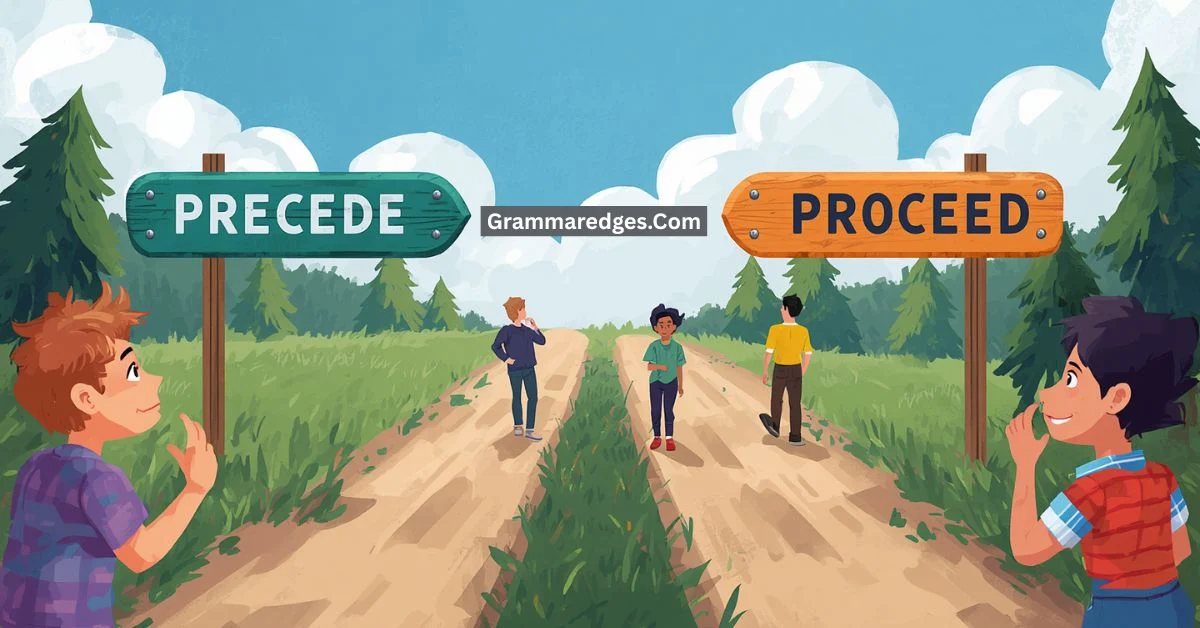
Have you ever stopped while writing and wondered whether to use precede or proceed? You’re not alone. These two words look and sound similar, which makes them easy to mix up. Many students, writers, professionals, and English learners search for precede vs proceed because they want to avoid embarrassing grammar mistakes in emails, essays, reports, and everyday conversations.
The confusion comes from their spelling and pronunciation. They differ by only one letter, but they have completely different meanings. Using the wrong one can change the meaning of your sentence and make your writing less clear.
The good news is that the difference is simple once you understand it. In this guide, you’ll learn the meaning of each word, where they came from, how to use them correctly, common mistakes to avoid, and practical examples. By the end, you’ll know exactly when to write precede and when to write proceed with confidence.
Precede vs Proceed – Quick Answer
The difference is simple:
- Precede means to come before something in time, order, or position.
- Proceed means to continue, move forward, or begin the next step.
Examples
Precede
- A short speech will precede the ceremony.
- Chapter 1 precedes Chapter 2.
- Heavy rain often precedes a storm.
Proceed
- You may now proceed to the next question.
- After lunch, we will proceed with the meeting.
- The officer told us to proceed carefully.
Easy memory trick:
- Precede = Before
- Proceed = Continue
The Origin of Precede vs Proceed
Although these words look alike, they have different roots and meanings.
Origin of “Precede”
The word precede comes from the Latin word praecedere.
- Prae means before.
- Cedere means to go.
Together, they mean to go before.
English adopted the word during the Middle English period, and its meaning has stayed almost the same ever since.
Origin of “Proceed”
The word proceed comes from the Latin word procedere.
- Pro means forward.
- Cedere means to go.
Together, they mean to go forward.
Over time, English speakers began using it to describe continuing an action or moving ahead.
Why the Confusion?
Both words:
- Share the same Latin root.
- Have similar spelling.
- Sound somewhat alike.
- Are often used in formal writing.
However, their meanings point in opposite directions:
- Precede = before
- Proceed = forward
British English vs American English Spelling
Unlike many English words, precede and proceed are spelled the same in both British and American English.
There are no spelling differences between the two varieties.
The only challenge is choosing the correct word based on its meaning.
| Feature | British English | American English |
|---|---|---|
| Precede spelling | precede | precede |
| Proceed spelling | proceed | proceed |
| Meaning | Same | Same |
| Pronunciation | Nearly identical | Nearly identical |
Examples
British English:
- The introduction will precede the discussion.
- Please proceed to Platform 3.
American English:
- Safety checks precede every flight.
- You may proceed with your presentation.
Which Spelling Should You Use?
Since both spellings are identical worldwide, your choice depends on the meaning, not your country.
Use precede if you mean:
- Come before
- Happen first
- Be earlier in order
Examples:
- Registration will precede orientation.
- Warm-up exercises precede the workout.
Use proceed if you mean:
- Continue
- Move forward
- Begin the next step
Examples:
- Please proceed with payment.
- We can proceed after approval.
Advice by Audience
For US writers
- Use precede for “comes before.”
- Use proceed for “continue.”
For UK writers
- The same rule applies.
For Australia, Canada, New Zealand, and other Commonwealth countries
- Use the same spellings and meanings.
For international writing
- These words are universally accepted with the same meanings.
Common Mistakes with Precede vs Proceed
Here are mistakes people often make.
Mistake 1
❌ Please precede to the exit.
✅ Please proceed to the exit.
Why?
You are moving forward, not coming before something.
Mistake 2
❌ Dessert will proceed dinner.
✅ Dessert will precede dinner.
Actually, dinner comes before dessert, so a better sentence is:
✅ Dinner will precede dessert.
Mistake 3
❌ The welcome speech will proceed the ceremony.
✅ The welcome speech will precede the ceremony.
Mistake 4
❌ We will precede with the project tomorrow.
✅ We will proceed with the project tomorrow.
Mistake 5
❌ The introduction proceeded Chapter One.
✅ The introduction preceded Chapter One.
Quick Check
Ask yourself:
Does it mean “before”?
→ Use precede.
Does it mean “continue”?
→ Use proceed.
Precede vs Proceed in Everyday Examples
Here are real-world examples.
In Emails
Precede
- The meeting agenda will precede the invitation.
Proceed
- Please proceed with the purchase.
- You may proceed after receiving approval.
In News
- A short ceremony preceded the event.
- Officials decided to proceed with construction.
In Social Media
- Coffee always precedes my morning posts.
- Let’s proceed with today’s challenge.
In Formal Writing
- The executive summary should precede the report.
- Researchers decided to proceed with the experiment.
In Everyday Conversation
- Breakfast usually precedes work.
- Shall we proceed?
Precede vs Proceed – Google Trends & Usage Data
Search interest for precede vs proceed stays steady throughout the year because people frequently confuse the two words while writing.
Where is this search popular?
- United States
- United Kingdom
- Canada
- Australia
- India
- Philippines
Why people search it
Most users want to know:
- Which word is correct?
- What’s the difference?
- Which one belongs in a sentence?
- How can they remember the meanings?
Where each word is commonly used
Precede
- Education
- Books
- Academic writing
- History
- Formal documents
Proceed
- Business
- Customer service
- Legal writing
- Instructions
- Travel
- Technology
Precede vs Proceed Comparison Table
| Feature | Precede | Proceed |
|---|---|---|
| Meaning | Come before | Continue or move forward |
| Part of speech | Verb | Verb |
| Main idea | Earlier | Next step |
| Memory trick | Before | Continue |
| Example | A warning preceded the storm. | Please proceed with payment. |
| Used in instructions | Rarely | Very often |
| Used for sequence | Yes | No |
| Used for action | No | Yes |
FAQs
Is it “precede” or “proceed” to the next step?
Use proceed because you are continuing to the next step.
What does “precede” mean?
It means to come before something in time, order, or position.
What does “proceed” mean?
It means to continue, move forward, or begin the next action.
Are precede and proceed interchangeable?
No. They have different meanings and cannot replace each other.
Is “please precede” correct?
Usually, no.
Most instructions should say:
Please proceed.
How do I remember the difference?
Remember:
- Precede = Before
- Proceed = Continue
This simple trick works in almost every situation.
Do British and American English use different spellings?
No. Both use precede and proceed with the same spelling and meaning.
Conclusion
Understanding precede vs proceed is easier than it first appears. Although the words look alike, they describe different ideas. Precede means something comes before another thing, while proceed means to continue or move forward. Keeping this simple distinction in mind will help you write more clearly and avoid common grammar mistakes.
Whenever you’re unsure, ask yourself one question: Am I talking about something happening first or moving on to the next step? If it’s about what comes first, choose precede. If it’s about continuing or taking the next action, choose proceed. This quick check works in emails, essays, business documents, news articles, and everyday conversations.
With regular practice and the examples in this guide, you’ll quickly build confidence and use both words correctly. Small improvements like this make your writing more professional, accurate, and easier for others to understand.