
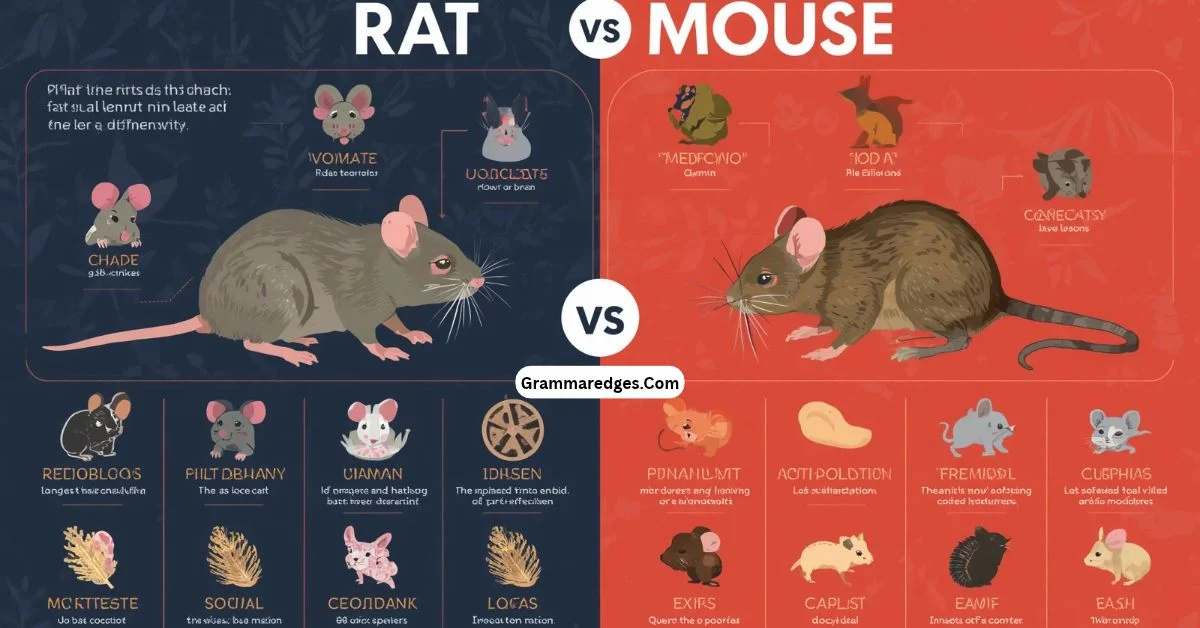
The main difference between a rat and a mouse is size and body shape. Rats are larger, heavier, and have thicker tails, broader heads, and smaller ears relative to their heads. Mice are smaller and slimmer, with pointed snouts, larger ears, and thin tails. Dropping size, gnaw marks, behavior, and nesting locations can provide additional clues.
Key Takeaways
- Rats are much larger and heavier than typical house mice.
- Rats usually have thicker tails, broader heads, and smaller ears relative to their heads.
- Mice have pointed snouts, larger ears, and slender tails.
- Rat droppings are much larger than mouse droppings and usually have blunter ends.
- Young rats can resemble mice, so identification should use several clues rather than size alone.
- If you find rodent signs, focus on food, water, shelter, entry points, and safe trapping.
Rat vs Mouse: What Is the Difference?
Rats and mice are both rodents, so it is easy to confuse them at first glance. If you see one quickly running across a floor, you may only get a second or two to notice its features.
The easiest clue is overall size. An adult rat is substantially larger and more robust than a typical house mouse. A mouse has a smaller, more delicate body and proportionally larger ears.
However, size should not be your only clue. A young rat can overlap with an adult mouse in apparent size. Looking at the head, ears, tail, body shape, droppings, and behavior together gives you a much better identification.
Rat vs Mouse at a Glance
| Feature | Rat | Mouse |
|---|---|---|
| Overall size | Large and heavy | Small and light |
| Body | Thick and robust | Small and slender |
| Head | Broad and heavier | Small and pointed |
| Snout | Usually blunt | Usually pointed |
| Ears | Smaller relative to head | Large and prominent |
| Tail | Thicker and scaly | Thin and slender |
| Droppings | Larger, often blunt-ended | Smaller, often pointed |
| Behavior | Often cautious | Generally more curious |
Common household rodents in the United States include the Norway rat, roof rat, and house mouse. Their appearance and habits are not identical, so identifying the specific animal can sometimes require more than a quick glance.
Rat vs Mouse Size and Appearance
What Rats Look Like
Rats have a noticeably heavier build. The head is broad, the body is muscular, and the tail is thicker than a mouse’s tail.
Two common pest rats are the Norway rat and roof rat. Norway rats are generally larger and more robust, while roof rats are slimmer and are known for climbing.
A rat’s ears usually look small compared with its head. Its snout is also less sharply pointed than a mouse’s.
If you see a large rodent with a thick body, heavy head, and substantial tail, a rat is more likely.
What Mice Look Like
House mice are much smaller. They have slender bodies, pointed noses, large ears, and relatively delicate tails.
Their small size is one reason mice can move through tiny spaces and establish nests in areas that may be difficult for people to inspect.
Mice may be found around kitchens, cabinets, pantries, walls, storage areas, and other locations close to food and shelter.
Why a Young Rat Can Be Confusing
This is an important exception to the simple rat vs mouse size rule.
A young rat can look surprisingly similar to a mouse. If you judge only by body length, you could identify it incorrectly.
Look at proportions instead. A young rat may have a more substantial head, larger feet, and a thicker-looking body and tail. Droppings and other signs can provide additional evidence.
For that reason, one clue is not always enough. Several matching clues make identification more reliable.
Rat vs Mouse Droppings
If you have not actually seen the rodent, droppings may be one of your most useful clues.
What Rat Droppings Look Like
Rat droppings are considerably larger than mouse droppings. They are commonly described as capsule-shaped or elongated, with ends that are more blunt than those of typical mouse droppings.
Norway rat droppings can be particularly large, while roof rat droppings are generally smaller than those of Norway rats.
What Mouse Droppings Look Like
Mouse droppings are much smaller and are often compared with grains of rice. They tend to be narrow and pointed at the ends.
You may find them in cabinets, drawers, pantries, behind appliances, along baseboards, or near food storage areas.
The CDC recommends regularly checking homes for rodent droppings and gnaw marks, because these are important signs that rodents may be present.
| Sign | Rat | Mouse |
|---|---|---|
| Dropping size | Larger | Much smaller |
| Typical appearance | Capsule-like or elongated | Small and rice-like |
| Ends | Often blunt | Often pointed |
| Common clue | Larger pellets | Tiny pellets |
Do not handle droppings with bare hands. Rodent waste can be associated with disease transmission, so cleanup should be performed carefully and according to public-health guidance.
Rat vs Mouse Behavior and Habitat
Behavior can help confirm what you are dealing with.
Where Rats Usually Go
Rats often use areas such as garages, crawl spaces, basements, wall voids, outdoor structures, and other sheltered locations. Depending on the species, they may also climb and use elevated areas.
Rats are generally more cautious about unfamiliar objects. This behavior can affect how quickly they approach traps. The CDC specifically notes that rats may fear new objects and recommends pre-baiting traps in some circumstances.
Where Mice Usually Go
Mice commonly stay close to food, water, and nesting materials. Inside homes, this can mean kitchens, pantries, cabinets, wall spaces, garages, and storage areas.
Because mice are small, they can use very narrow openings to enter buildings.
How Their Behavior Differs
A simple comparison is:
Rats: larger, heavier, generally more cautious, and capable of causing more substantial gnawing damage.
Mice: smaller, more lightweight, and able to exploit very small spaces.
Behavior alone is not enough to identify a rodent, but it becomes useful when combined with physical evidence.
Rat vs Mouse Signs in Your Home
You do not always need to see the animal to know rodents are around.
Gnaw Marks
Both rats and mice gnaw. Their teeth continue growing, so gnawing helps maintain them.
You may notice damage to food packaging, wood, plastic, or other materials. Larger or more forceful marks can suggest rat activity, although gnaw marks alone cannot always identify the species.
The CDC lists gnaw marks and droppings among important signs of rodent presence.
Scratching and Movement
Scratching sounds in walls, ceilings, attics, or other enclosed areas may indicate rodent activity.
However, sound is not a reliable way to distinguish a rat from a mouse. Use it as a supporting clue rather than proof.
Nests and Food Damage
Rodents may use shredded paper, fabric, insulation, or other soft materials to build nests.
Food damage is another clue. Torn packaging, missing food, scattered crumbs, and droppings near stored food can indicate activity.
If you repeatedly find fresh signs after cleaning an area, that can indicate continuing rodent activity.
What Should You Do If You Find a Rat or Mouse?
Identifying the rodent is useful, but the next step is addressing the conditions that allow it to remain.
Remove Food and Water Sources
Store food in secure containers and clean up spills and crumbs. Do not leave pet food available for long periods when rodents are active.
Also look for water sources such as leaks or standing water.
Seal Entry Points
Inspect both the inside and outside of the building for holes and gaps.
Pay particular attention to areas around pipes, doors, vents, foundations, roofs, and utility openings. Sealing possible entry points helps prevent new rodents from entering.
The CDC recommends removing food, water, and shelter opportunities and sealing openings as part of rodent prevention.
Use Traps Safely
If you use traps, place them where rodent activity has been observed and follow the manufacturer’s instructions.
Keep traps and bait away from children and pets. The CDC recommends continuing to trap while rodent evidence remains and checking for new droppings, urine spots, or gnawing.
If you are dealing with extensive activity, inaccessible nesting areas, or recurring signs, professional pest-control assistance may be appropriate.
Frequently Asked Questions
Is a rat just a large mouse?
No. Rats and mice are different animals, although both are rodents. Rats are generally much larger and have different body proportions, including broader heads and thicker tails. Common household species also have different behaviors and habitats.
Can a baby rat look like a mouse?
Yes. A young rat can be similar in apparent size to an adult mouse. That is why body size alone can sometimes be misleading. Compare the head, feet, tail thickness, body shape, droppings, and other evidence before deciding.
Which is easier to identify from droppings?
Dropping size is often a useful clue. Mouse droppings are much smaller and commonly resemble tiny rice grains, while rat droppings are substantially larger and often have more blunt ends. Very young rats can create confusion, so use several signs when possible.
Can rats and mice live in the same house?
Yes. A building can have more than one type of rodent. Finding one does not automatically prove that another species is absent. Identification should be based on the individual signs you observe.
Are rats and mice dangerous?
Rodents can carry diseases that may spread to people through contact with rodents or their urine, droppings, saliva, and contaminated materials. This is why safe cleanup and prevention are important when rodent activity is discovered.
Conclusion
When comparing a rat vs mouse, start with the simplest clues: size, body shape, head, ears, and tail. Then look for supporting evidence such as droppings, gnaw marks, nesting materials, and where the activity is occurring.
A rat is generally larger, heavier, and more robust, while a mouse is smaller, slimmer, and has larger ears relative to its head. Droppings can also provide a useful clue when the animal is not visible.
Remember that young rats can resemble mice, so avoid relying on one characteristic. If you find repeated droppings, gnaw marks, or other signs, focus on removing food and water sources, sealing entry points, and using traps safely.