
Do or Die is more than just a common English phrase; it describes moments when everything seems to depend on one important decision or final effort.
Whether you’re facing a tough exam, competing in a championship, chasing a career goal, or dealing with a major life challenge, this expression captures the pressure to succeed when failure is not an option.
But what does do or die really mean, and how can you use it correctly in everyday conversations? In this guide, you’ll discover its simple meaning, real-life examples, synonyms, and common uses so you can understand and use this powerful idiom confidently.
Key Takeaways
- Do or die describes a situation where success feels essential and failure carries serious consequences.
- It is a common English idiom used to express determination, urgency, and commitment.
- The expression does not always refer to actual life-or-death danger.
- It can describe important decisions, final opportunities, competitions, and personal challenges.
- Do-or-die is hyphenated when used as an adjective before a noun.
What Does Do or Die Mean?
The expression do or die means you must try your hardest to achieve something because there may be no second opportunity. It describes an all-or-nothing situation where the outcome matters greatly.
In simple English, it means giving everything you have to succeed, even when the situation is difficult or risky.
For example, imagine a student who has failed several exams. The final examination is their last opportunity to pass the course. They might say:
“It’s do or die for me this semester. I need to pass this exam.”
This sentence means the student understands how important the examination is and feels determined to succeed.
The phrase can also describe a business trying to avoid closing, an athlete competing in a final match, or someone working toward an important personal goal.
Literal and Figurative Meaning
The expression has two possible interpretations:
- Literal meaning: A situation where someone’s life may genuinely depend on what happens.
- Figurative meaning: A difficult or important situation where someone must succeed to avoid serious consequences.
In modern American English, the figurative meaning is much more common in everyday conversations.
Is Do or Die an Idiom?
Yes, do or die is an English idiom. Its meaning is not limited to the individual words “do” and “die.” Instead, the complete expression communicates urgency, determination, and the importance of succeeding.
It is also used as an adjective in the hyphenated form do-or-die.
Compare these examples:
| Expression | Example |
|---|---|
| Do or die | It’s do or die for our team. |
| Do-or-die moment | This is a do-or-die moment. |
| Do-or-die effort | She made a do-or-die effort to succeed. |
| Do-or-die situation | The company faces a do-or-die situation. |
The expression is useful when ordinary words such as “important” or “difficult” do not fully communicate the pressure of a situation.
Origin and Background of Do or Die
The expression has a long history in English literature and public speech. It reflects the idea that a person must act courageously when facing a serious challenge.
One famous literary use appears in Robert Burns’s 1793 poem Robert Bruce’s March to Bannockburn, which includes the words “Let us do or die.” The expression later became associated with determination and the willingness to face danger rather than surrender. Wiktionary, the free dictionary+1
Another well-known historical use came from Mahatma Gandhi in 1942. During India’s Quit India Movement, Gandhi used “Do or Die” as a call for determined action toward independence. In that context, the expression carried a serious political and historical meaning. Wiktionary, the free dictionary
Today, people use the phrase in much broader situations. It can describe anything from an important sports match to a challenging business decision.
How to Use Do or Die in Everyday English
You can use this expression when describing a situation that requires immediate action, serious commitment, or maximum effort.
Here are some common situations where it sounds natural.
1. Do or Die at Work
In professional settings, the phrase can describe a major deadline, business decision, or project that could affect a company’s future.
Examples:
- Tomorrow is do or die for our new business project.
- The sales team considers this presentation a do-or-die opportunity.
- We have one week to complete the project. It’s do or die now.
- This new contract could be a do-or-die moment for the company.
These examples communicate that the outcome is important and that everyone needs to make a serious effort.
2. Do or Die in School and Education
Students may use the expression when preparing for final exams, completing important assignments, or trying to achieve academic goals.
Examples:
- It’s do or die for me because my final exam is tomorrow.
- She studied all night because this was a do-or-die situation.
- Our last project is a do-or-die opportunity to improve our grades.
- He knows this examination is his final chance to pass the course.
The phrase adds urgency and shows how much the result matters to the student.
3. Do or Die in Sports
Sports are among the clearest examples of do-or-die situations. A team may need to win a particular game to remain in a competition or reach the next round.
Examples:
- Tonight’s basketball game is do or die for both teams.
- The players entered the final match with a do-or-die attitude.
- It was a do-or-die moment for the goalkeeper.
- The team must win this game or lose its chance to reach the final.
In sports, the expression often describes elimination games, knockout rounds, and decisive matches.
4. Do or Die in Personal Life
The expression can also describe personal struggles and major decisions. Someone might use it when trying to change their habits, overcome difficulties, or achieve something important.
Examples:
- I have worked too hard to give up now. It’s do or die.
- This is a do-or-die moment in my journey toward success.
- She made a do-or-die effort to save her relationship.
- He decided to take the opportunity because it was now or never.
These examples show determination rather than necessarily suggesting physical danger.
Do or Die vs. Now or Never

Do or die and now or never are similar expressions, but they communicate slightly different ideas.
“Do or die” emphasizes the need to succeed despite serious consequences. “Now or never” emphasizes that an opportunity may disappear if someone does not act immediately.
| Do or Die | Now or Never |
|---|---|
| Focuses on success or failure. | Focuses on a limited opportunity. |
| Suggests serious consequences. | Suggests urgency and timing. |
| Often expresses determination. | Often encourages immediate action. |
| It’s do or die in the final match. | It’s now or never to apply for the job. |
| We must succeed or face failure. | We must act before the opportunity disappears. |
Example: If a football team must win to stay in a tournament, it is a do-or-die situation. If someone has one final day to apply for a job, it is a now-or-never opportunity.
Both expressions can communicate urgency, but they are not always interchangeable.
Do or Die Example Sentences
Here are 15 simple examples showing how to use the phrase naturally in American English.
- It’s do or die for our team in tonight’s championship game.
- I have one final opportunity to prove myself, so it’s do or die.
- The company is facing a do-or-die business decision.
- She showed a do-or-die attitude during the competition.
- Tomorrow’s interview is a do-or-die opportunity for him.
- We need to finish this project before the deadline. It’s do or die.
- The players knew they had to win the match.
- This is a do-or-die moment for our entire organization.
- He made a do-or-die effort to achieve his dream.
- The final examination feels like a do-or-die situation.
- The team played with a do-or-die mentality.
- They knew failure was not an option.
- It was a do-or-die decision that could change her career.
- We have reached the final stage, and now it’s do or die.
- She refused to quit and decided to give it everything she had.
These examples demonstrate that the expression works in casual conversations, motivational statements, and discussions about high-pressure situations.
Synonyms and Alternatives for Do or Die
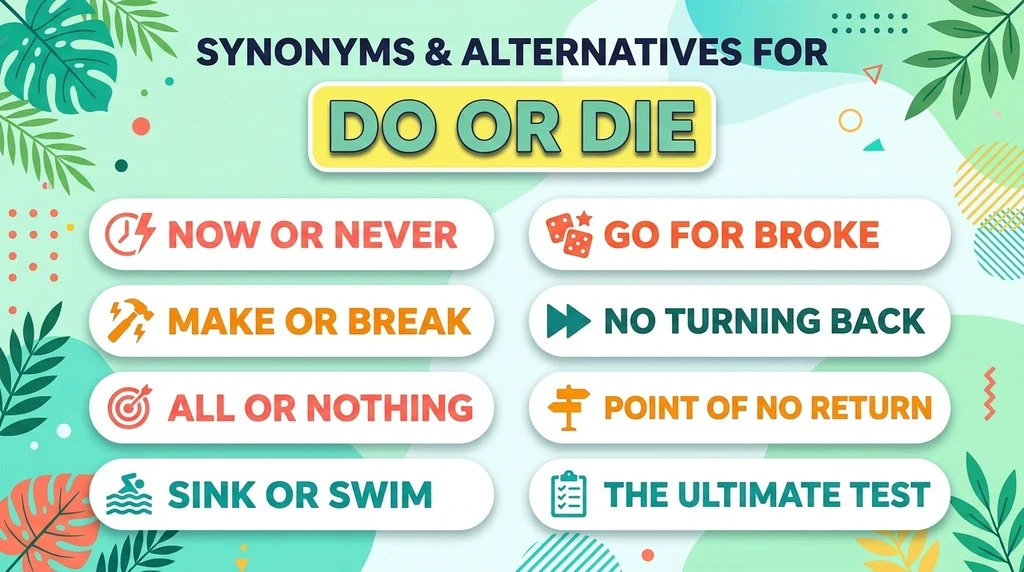
Sometimes, you may want to express the same idea without using the exact phrase. Several English expressions communicate similar meanings.
| Synonym or Alternative | Meaning |
|---|---|
| All or nothing | Complete success or failure |
| Now or never | A final opportunity to act |
| Make or break | Something that determines success or failure |
| Last chance | The final opportunity |
| Sink or swim | Succeed independently or fail |
| Going for broke | Taking a major risk to succeed |
| Fight to the finish | Continue trying until the end |
| Give it your all | Make your greatest effort |
| No turning back | Continue without reversing the decision |
| Last-ditch effort | A final attempt to prevent failure |
Which alternative should you choose?
- Use all or nothing when there are two possible outcomes.
- Use make or break when an event will determine someone’s future success.
- Use now or never when time is running out.
- Use give it your all when encouraging someone to try their hardest.
- Use last-ditch effort when describing a final attempt to solve a problem.
Common Mistakes to Avoid
Although do or die is a simple expression, people sometimes misunderstand its grammar and meaning.
1. Thinking it always means physical death
Incorrect understanding: The phrase can only describe a dangerous situation.
Correct understanding: It commonly describes figurative challenges, such as important exams, sports competitions, and business decisions.
2. Using incorrect hyphenation
When the expression comes before a noun and works as an adjective, use hyphens.
- Correct: It was a do-or-die decision.
- Correct: It was do or die for the company.
- Less appropriate: It was a do or die decision.
3. Using it for unimportant situations
The phrase carries a strong sense of urgency. Using it for a small, ordinary task can sound exaggerated.
For example, saying “It’s do or die because I need to choose a movie” may sound humorous rather than serious.
4. Confusing it with now or never
Both expressions suggest urgency, but do or die focuses more on the consequences of failure, while now or never focuses on a limited opportunity.
Frequently Asked Questions
1. What does do or die mean in simple words?
Do or die means you must try your hardest to succeed because failure could have serious consequences. It describes a situation where someone feels they have no other choice but to make a strong effort. It is often used for important challenges, competitions, and major life decisions.
2. Is do or die positive or negative?
Do or die can have both positive and negative meanings. Positively, it shows courage, determination, and the willingness to overcome challenges. Negatively, it can describe pressure, desperation, or a situation where failure could cause serious problems. Its meaning depends on the context.
3. What is an example of a do-or-die situation?
A football team’s final elimination match is a good example. If the team loses, it leaves the competition. If it wins, it continues. This makes the match a do-or-die situation because the result determines what happens next.
4. What is another word for do or die?
Common alternatives include all or nothing, make or break, now or never, sink or swim, and going for broke. The best alternative depends on the situation. For example, make or break works well for career opportunities, while now or never describes a final chance to act.
5. What does do or die mean in sports?
In sports, do or die describes a game or competition in which a team or player must win to avoid elimination or achieve an important goal. It usually refers to a high-pressure match where the result has major consequences for the competition.
6. Can you use do or die in a sentence?
Yes. For example: “It’s do or die for our company because we must complete this important project before the deadline.” The sentence shows that success is essential and failure could create serious consequences.
Conclusion
Understanding do or die helps you recognize and use one of the most expressive English idioms. It describes a high-pressure situation where someone must make a serious effort to succeed because failure could have significant consequences.
Whether you are discussing sports, education, business, or personal challenges, the expression communicates determination and urgency. Remember that it does not always refer to actual life-or-death danger.
It often describes figurative situations involving important decisions and final opportunities. You can also use alternatives such as “all or nothing,” “make or break,” and “now or never” when they better fit your message. Use the phrase naturally, and you will communicate the importance of a challenging moment more clearly.