Have you ever wondered whether to write etc. or ect. in an email, text message, school assignment, or professional document? These two spellings look similar, but only one is the standard abbreviation in English. Many people accidentally type “ect” because the letters in “etc.” can be confusing, especially when writing quickly.
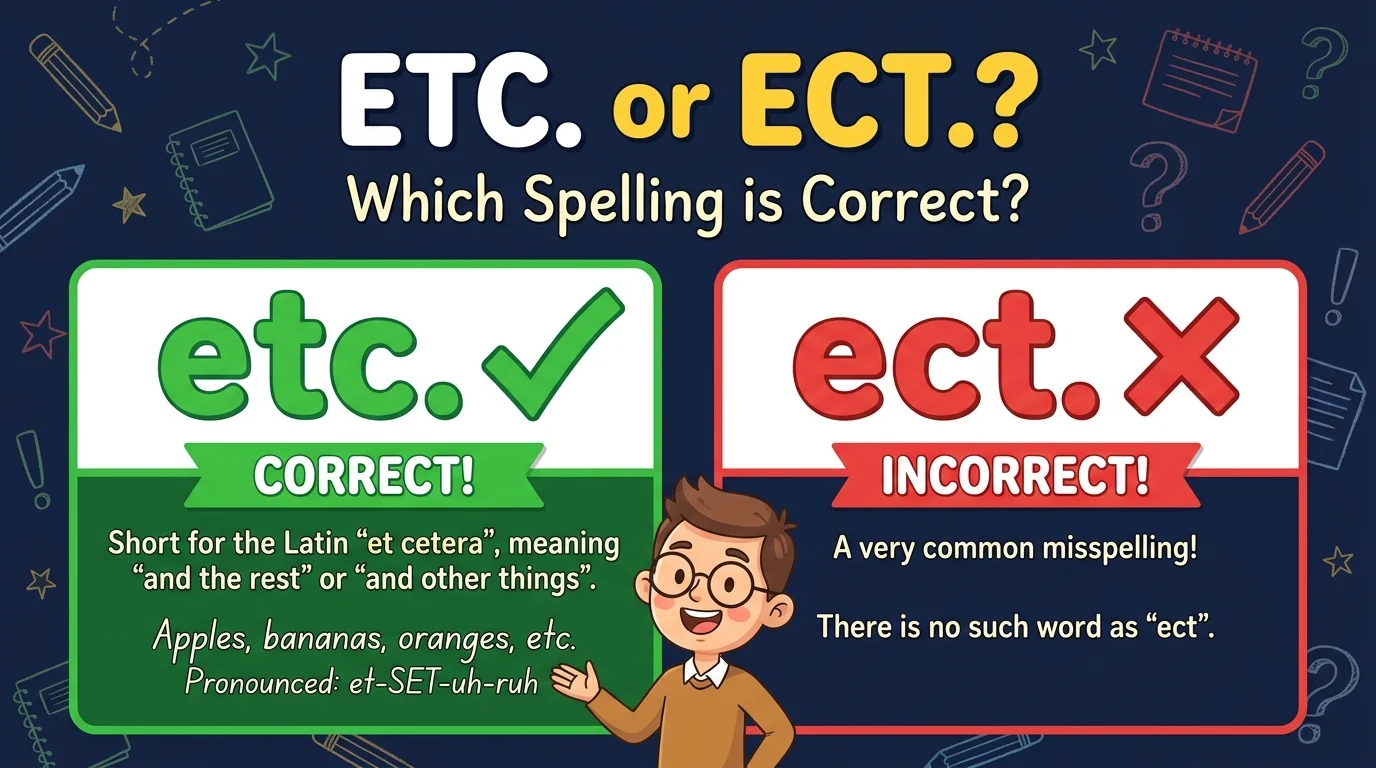
The correct spelling is etc., which stands for the Latin phrase et cetera, meaning “and other things” or “and so on.” It helps writers shorten lists when they want to indicate that additional similar items could be included. For example, “Bring pens, pencils, notebooks, etc.” suggests that other school supplies may also be useful.
Although “ect” is a common typing mistake, it is not the correct abbreviation for this purpose. Understanding the difference can help you improve your spelling, write more clearly, and avoid mistakes in professional and academic communication. This guide explains the meanings, origins, uses, alternatives, and common misconceptions surrounding “etc.” and “ect.”
Meaning and Definition of Etc. or Ect
The main difference between “etc.” and “ect.” is that etc. is correct, while ect. is usually a spelling error when someone intends to write “et cetera.”
What Does Etc. Mean?
“Etc.” is an abbreviation of the Latin expression et cetera. The expression combines et, meaning “and,” with cetera, meaning “the remaining things” or “the others.”
In everyday English, it means “and so on” or “and other similar things.” Writers use it when they provide examples but do not want to list every possible item.
Examples:
- I bought apples, oranges, bananas, etc.
- Please bring your books, notebooks, pens, etc.
- The store sells shoes, shirts, jackets, etc.
- We discussed grammar, punctuation, spelling, etc.
In each sentence, “etc.” indicates that the list could continue with other related items.
What Does Ect Mean?
“Ect” is not the standard English abbreviation for “and so on.” It commonly appears because people reverse the final two letters of “etc.”
For example:
Incorrect: I need paper, pencils, rulers, ect.
Correct: I need paper, pencils, rulers, etc.
Although readers can often understand the intended meaning of “ect,” it should be corrected in formal writing, educational work, and professional communication.
Quick Answer: Etc. vs. Ect
| Word | Meaning | Correct usage |
|---|---|---|
| Etc. | And so on; and other things | Standard abbreviation |
| Ect. | Usually a misspelling of etc. | Incorrect for this meaning |
Easy tip: Remember that “etc.” ends with the letters t-c, not c-t.
Background and Origin of Etc.
The abbreviation “etc.” comes from the Latin phrase et cetera, which has been used for centuries to indicate that a list contains additional items beyond those explicitly mentioned.
Latin has influenced English vocabulary, particularly in education, law, science, religion, and formal writing. Many English expressions and abbreviations have Latin origins, and “etc.” remains one of the most familiar examples.
How Did Etc. Become Common?
As written communication developed, writers needed convenient ways to shorten repeated expressions. Instead of writing “and other similar things” every time they presented a list, they could use “etc.” to communicate the same general idea more efficiently.
The abbreviation became common in books, letters, academic documents, business writing, and everyday correspondence.
For example, a writer describing office supplies might say:
“The office needs paper, folders, staplers, etc.”
This wording communicates that the list is incomplete without naming every possible supply.
Why Do People Write Ect Instead?
The mistake usually happens because people remember the sound of the expression rather than its exact spelling. When speaking quickly, the letters may be difficult to distinguish mentally, leading writers to reverse “tc” into “ct.”
Other reasons include:
- Typing too quickly on a keyboard or phone.
- Learning the abbreviation through speech rather than reading.
- Repeatedly seeing the incorrect spelling online.
- Relying on autocorrect without checking the final text.
- Confusing the abbreviation with other technical terms.
The best way to avoid the error is to remember the original expression: et cetera. Its opening letters appear in the same order in “etc.”
Is Etc. Still Relevant Today?
Yes. Despite the growth of texting, messaging apps, and social media, “etc.” remains widely useful. It saves space and makes lists easier to read when the omitted items are predictable.
However, it should not replace useful details. In instructions, legal documents, or technical writing, an incomplete list can sometimes create confusion. Writers should decide whether “etc.” provides enough information for the reader.
Usage in Different Contexts: Chat, Social Media, and Professional Writing
The abbreviation “etc.” appears in many forms of communication. Its basic meaning stays the same, but the best way to use it depends on the situation.
1. Everyday Conversation
People often use “etc.” when discussing familiar groups of things.
Examples:
- “We need snacks, drinks, plates, etc.”
- “I enjoy reading novels, biographies, mysteries, etc.”
- “She packed clothes, shoes, toiletries, etc.”
It allows speakers and writers to avoid naming every item.
2. Academic Writing
Students may use “etc.” when listing examples in notes or informal explanations. However, academic writing often benefits from precise examples rather than vague lists.
For instance:
Less precise: The study examined social factors, etc.
Clearer: The study examined income, education, employment, and housing.
Use “etc.” only when the remaining examples are obvious and relevant. Follow your teacher’s or institution’s style requirements.
3. Professional Emails
In workplace communication, “etc.” can help shorten routine lists.
Example:
“Please bring the meeting agenda, previous reports, budget estimates, etc.”
However, if employees need a complete list to perform a task, specify every required item instead of relying on “etc.”
4. Business and Marketing
Businesses may use the abbreviation in product descriptions, internal notes, or informal presentations.
Example:
“Our store offers bags, accessories, travel organizers, etc.”
For advertising and product pages, detailed lists may be more effective because customers need to know exactly what is available.
5. Formal Reports
In reports, “etc.” should be used carefully. It is acceptable when the omitted examples are obvious, but repeated use can make writing seem vague.
A useful rule is to replace “etc.” with specific examples whenever precision matters.
Across all these contexts, the distinction remains simple: write “etc.” when you mean “and so on,” and avoid “ect.” as a substitute.
What Does Etc. Mean in Chat, WhatsApp, Instagram, and TikTok?
In online conversations, “etc.” generally means the same thing as it does in standard English: “and other things” or “and so on.” It is not usually a special slang term.
Etc. in Text Messages
People use “etc.” to shorten messages and avoid listing every example.
Example:
“I need to clean my room, wash clothes, organize my desk, etc.”
The sender means there are more tasks to complete.
Etc. on WhatsApp
On WhatsApp, “etc.” may appear in personal chats, group messages, and work conversations.
Example:
“Bring food, drinks, cups, etc. for the party.”
The abbreviation indicates that the list includes other relevant items.
Writing “ect” in this message would usually be understood as a typo, not a different expression.
Etc. on Instagram
Instagram users may use “etc.” in captions, comments, or direct messages.
Example:
“Coffee, books, music, weekend walks, etc. That’s my kind of day.”
Here, “etc.” suggests other activities or interests that fit the same theme.
Etc. on TikTok
On TikTok, users may write “etc.” in video descriptions, comments, or captions when referring to a list of trends, activities, or examples.
Example:
“Editing videos, choosing sounds, adding captions, etc.”
The abbreviation is simply a convenient way to summarize related activities.
Does Etc. Have a Hidden Meaning in Dating Apps?
Usually, no. On dating apps, “etc.” has its ordinary meaning unless the surrounding conversation suggests something else.
For example:
“I like hiking, traveling, trying new restaurants, etc.”
This means the person enjoys those activities and others like them.
If someone writes “ect,” it is generally a spelling mistake rather than a recognized dating abbreviation. The surrounding message matters more than the typo.
Etc. in Physics, Medical, and Aircraft Terminology
Although “etc.” is a general abbreviation rather than a specialized scientific term, readers sometimes encounter similar letter combinations in technical fields. Understanding the context helps prevent confusion.
1. Physics
In physics, “etc.” can appear in textbooks, laboratory notes, and explanations when a writer lists examples of related objects, processes, or measurements.
Example:
“The equipment included sensors, cables, meters, etc.”
Here, it simply means that additional equipment was included.
“ECT” can also appear as an acronym in technical material, depending on the specific subject. Its meaning must be determined from the document or field rather than assumed to be “et cetera.”
For example, technical abbreviations may refer to a particular instrument, test, or scientific process. There is no single universal physics meaning for every occurrence of “ECT.”
2. Medical Terminology
In medical contexts, “etc.” may be used in general explanatory writing to indicate additional examples.
Example:
“Symptoms may include tiredness, headaches, dizziness, etc.”
However, medical professionals should avoid vague lists when precise information is necessary for diagnosis, treatment, or patient instructions.
ECT is also an established medical acronym for electroconvulsive therapy, a treatment used for certain serious mental health conditions under medical supervision.
This is different from “etc.” The two expressions should not be confused simply because their letters are similar.
3. Aircraft and Aviation
In aviation documents, “etc.” can appear in general descriptions or informal lists.
Example:
“The maintenance team inspected cables, panels, fasteners, etc.”
In safety-critical aviation instructions, a complete and precise list is often preferable to an open-ended abbreviation.
The letters “ECT” may also appear as part of a technical abbreviation, system label, or organization-specific terminology. Their meaning depends on the particular aircraft, document, and operating context.
Therefore, never assume that “ECT” means the same thing in every technical field. Check the relevant glossary or documentation when it appears as an acronym.
Common Misconceptions About Etc. and Ect
Several misunderstandings contribute to the frequent confusion between these spellings.
Misconception 1: Ect. Is an Alternative Spelling
Some people believe “ect.” is simply another accepted way to write “etc.” This is incorrect when the intended meaning is “and so on.”
The standard abbreviation is “etc.”
Misconception 2: Etc. Means Exactly the Same as Et Al.
Both expressions have Latin origins, but they are used differently.
- Etc. means “and other things.”
- Et al. means “and other people” or “and others,” often in references to authors.
Example: “We purchased books, pens, etc.” refers to additional things.
Example: “Smith et al. published the study” refers to Smith and other authors.
Misconception 3: Etc. Can Follow Any List
Although “etc.” can shorten many lists, it is not always useful. If the reader needs a complete set of instructions, naming only a few items and adding “etc.” may cause confusion.
For example, a safety checklist should identify all required checks rather than leaving essential steps unspecified.
Misconception 4: Etc. Is Always Necessary After Examples
Writers sometimes add “etc.” even when words such as “including” or “such as” already make it clear that the list provides examples.
For instance:
“The shop sells items such as hats, scarves, and gloves.”
This sentence already introduces examples. Adding “etc.” may be unnecessary.
Misconception 5: Etc. Should Be Repeated
Using “etc., etc.” is usually redundant. One occurrence is enough to indicate that the list continues.
The key lesson is to use “etc.” when it genuinely improves clarity, not simply because it is familiar.
Similar Terms and Alternatives to Etc.
Several expressions can replace “etc.” depending on the sentence and the intended meaning.
| Alternative | Meaning | Example |
|---|---|---|
| And so on | The list continues | Bring paper, pens, and so on. |
| And so forth | Similar items continue | The course covers grammar, spelling, and so forth. |
| Among others | Additional people or things are included | The event featured writers, among others. |
| Such as | Introduces examples | We sell products such as bags and wallets. |
| Including | Identifies items within a group | The package includes cables and adapters. |
| And others | Additional people or entities | The project involved Smith and others. |
When Should You Use And So On?
“And so on” is a natural alternative in everyday conversation.
Example: “We talked about movies, books, music, and so on.”
It is especially useful when you want a straightforward, conversational tone.
When Should You Use And So Forth?
“And so forth” has a slightly more formal feel in some contexts.
Example: “The report covers staffing, budgets, schedules, and so forth.”
It communicates that the list continues with similar items.
When Should You Avoid Etc.?
Avoid “etc.” when the missing information is important, when the list must be complete, or when readers might not understand what other items belong in the category.
In technical instructions, contracts, medical guidance, and safety procedures, specific wording is often more appropriate.
How to Respond When Someone Writes Ect
If someone uses “ect” instead of “etc,” your response should depend on the situation. In most cases, the mistake is minor and does not require a correction.
1. In Casual Chats
If a friend writes “ect” in a message, you can usually understand what they mean and continue the conversation.
Example:
Friend: “We need snacks, drinks, ect.”
You: “Sure, I’ll bring some snacks.”
There is no need to interrupt the conversation unless the person asks about spelling.
2. In School Assignments
If you are reviewing a classmate’s work, politely explain the correct spelling.
You could say:
“Just a small spelling correction: it should be ‘etc.’ rather than ‘ect.’”
This gives helpful feedback without making the person feel embarrassed.
3. In Professional Communication
If the error appears in an email draft or report, correct it before sending or publishing the document.
If you are editing someone else’s writing, make the correction according to your normal proofreading process.
4. When You Are Unsure What Someone Means
If “ECT” appears in a technical document or medical discussion, do not automatically assume it is a spelling mistake. Ask for clarification or check the relevant terminology.
For everyday English, however, the intended expression is usually obvious when “ect” follows a list.
A respectful approach is best: correct errors when necessary, avoid embarrassing others over minor typos, and focus on clear communication.
Differences Between Etc., Ect., Et Al., and Other Expressions
These terms can look or sound similar, but their meanings are not interchangeable.
| Expression | Correct meaning or use | Example |
|---|---|---|
| Etc. | And other things | We bought fruit, bread, etc. |
| Ect. | Usually an incorrect spelling of etc. | Avoid using ect. for “and so on.” |
| Et al. | And other people or authors | Jones et al. studied the results. |
| E.g. | For example | Bring supplies, e.g., paper and pens. |
| I.e. | That is; in other words | The meeting is virtual, i.e., held online. |
| And so on | A plain-English alternative to etc. | We discussed books, films, and so on. |
Etc. vs. Ect.
“Etc.” is the correct abbreviation for “and so on.” “Ect.” is normally a spelling mistake when used with that meaning.
Etc. vs. E.g.
“E.g.” introduces examples, while “etc.” suggests that additional similar items remain in the list.
Example: “Pack warm clothes, e.g., sweaters and coats.”
You might use “etc.” later if you want to indicate further related items, but the sentence should remain clear.
Etc. vs. I.e.
“I.e.” clarifies or restates something, while “etc.” indicates that a list continues.
Example: “Bring one form of identification, i.e., a passport or driver’s license.”
This explains what is meant by identification rather than simply adding more examples.
Why Does Punctuation Matter?
In standard American English, “etc.” is conventionally written with a period because it is an abbreviation. If it appears at the end of a sentence, one period is generally sufficient.
Correct: “We need folders, labels, pens, etc.”
Avoid adding unnecessary punctuation or repeating the abbreviation.
Relevance in Online Conversations and Dating Apps
The distinction between “etc.” and “ect.” remains relevant because people write quickly across messaging platforms, social networks, forums, and dating apps.
In digital communication, minor spelling mistakes rarely prevent understanding. However, correct spelling can make a message easier to read and help the writer appear more careful, especially when introducing themselves to someone new or communicating professionally.
In Personal Messages
A message such as “I enjoy cooking, traveling, movies, etc.” gives a quick overview of several interests without listing every activity.
In Dating Profiles
Someone might write, “I love coffee shops, outdoor adventures, live music, etc.” The abbreviation signals that these are examples of broader interests.
However, listing specific hobbies can be more engaging than ending with “etc.” A detailed profile gives readers more opportunities to find shared interests and start a conversation.
In Social Media Captions
“Weekend plans: friends, food, music, etc.” is a compact way to describe a range of activities.
The abbreviation works well when the audience can easily understand what other items might belong in the list.
In Online Professional Communication
Correct spelling is particularly helpful in job applications, business messages, client correspondence, and public posts. A single typo is rarely disastrous, but proofreading improves the overall quality of your writing.
Ultimately, “etc.” is a practical abbreviation, not internet slang with a hidden meaning. “Ect” is generally just a letter-order mistake unless the context establishes it as a separate acronym.
Conclusion
Understanding etc. or ect is simple once you remember that “etc.” is the correct abbreviation for et cetera, meaning “and so on” or “and other things.” The spelling “ect” is usually an error when someone intends to communicate that meaning. This small distinction matters in school assignments, professional emails, social media captions, online chats, and other forms of written communication.
Use “etc.” when you want to indicate that a list contains additional similar items, but avoid it when readers need a complete and precise list. In technical fields, remember that capitalized “ECT” may have a separate meaning, such as electroconvulsive therapy in medicine. Always consider the context before correcting it.
The easiest way to remember the correct spelling is to think of the original Latin phrase, et cetera. Its first letters form “etc.” With this simple memory trick, you can avoid a common spelling mistake and communicate more confidently in everyday and professional writing.