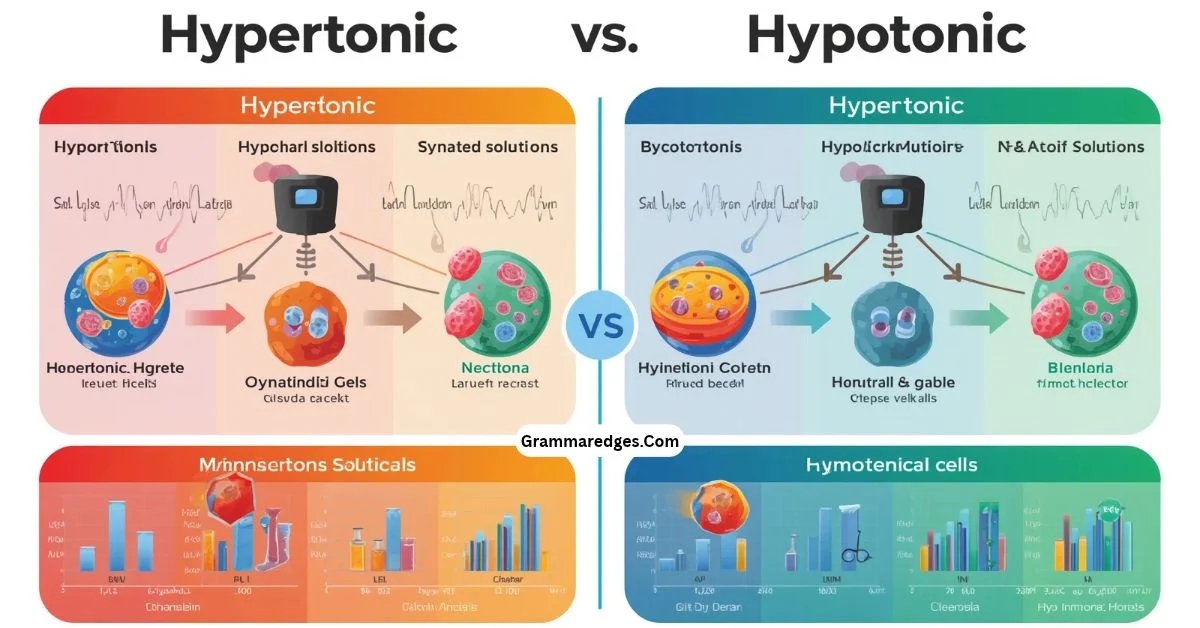
Hypertonic and hypotonic describe how a solution’s effective solute concentration compares with that inside a cell. In a hypertonic solution, water moves out of the cell, causing it to shrink. In a hypotonic solution, water moves into the cell, causing it to swell. This water movement occurs through osmosis.
Key Takeaways
- Hypertonic = more effective solute outside the cell → water moves out.
- Hypotonic = less effective solute outside the cell → water moves in.
- Hypertonic solutions can make animal cells shrink.
- Hypotonic solutions can make animal cells swell or burst.
- Isotonic solutions produce no net movement of water and usually maintain cell volume.
What Does Hypertonic vs Hypotonic Mean?
The terms hypertonic and hypotonic are used in biology and medicine to describe the effect a solution has on a cell.
The key process behind this comparison is osmosis. Osmosis is the net movement of water across a selectively permeable membrane. In a basic cell example, water moves toward the side with the greater concentration of solutes that cannot freely cross the membrane.
Think of a cell as a small water-filled space surrounded by a selective barrier. If the solution outside the cell has a different effective solute concentration than the cell’s interior, water can move across the membrane.
Hypertonic Solution
A hypertonic solution has a higher concentration of effective, nonpenetrating solutes than the cell.
As a result, water moves out of the cell. The cell loses water and becomes smaller.
Easy way to remember:
Hyper = higher solute outside → water goes out.
For example, if a red blood cell is placed in a sufficiently hypertonic solution, it loses water and becomes shrunken or crenated.
Hypotonic Solution
A hypotonic solution has a lower concentration of effective solutes outside the cell than inside the cell.
Water therefore moves into the cell. The cell gains water and becomes larger.
Easy way to remember:
Hypo = lower solute outside → water goes in.
A red blood cell in a sufficiently hypotonic solution can swell and eventually rupture because animal cells do not have a rigid cell wall.
Hypertonic vs Hypotonic: Key Differences
The easiest way to understand the difference is to focus on where the water goes.
| Feature | Hypertonic | Hypotonic |
|---|---|---|
| Solute concentration outside the cell | Higher | Lower |
| Relative water concentration | Lower | Higher |
| Net water movement | Out of the cell | Into the cell |
| Effect on animal cells | Shrink | Swell |
| Possible red blood cell effect | Crenation | Hemolysis if severe |
| Main process | Osmosis | Osmosis |
| Memory clue | Hyper = higher solute | Hypo = lower solute |
The comparison is always relative to the cell or reference solution. A solution is not simply “hypertonic” or “hypotonic” in isolation; its tonicity depends on what it is being compared with and which solutes can cross the membrane.
What Happens to a Cell in a Hypertonic Solution?
When a cell enters a hypertonic environment, the surrounding solution contains a higher concentration of effective solutes.
Water moves from the cell toward the surrounding solution. As the cell loses water, its volume decreases.
Animal Cells
Animal cells can shrink in a hypertonic environment because they do not have a rigid cell wall.
A red blood cell is a common textbook example. In a hypertonic solution, it loses water and develops a shrunken, irregular appearance called crenation.
Plant Cells
Plant cells also lose water in hypertonic conditions, but their response looks different because they have a rigid cell wall.
As water leaves, the plasma membrane and cytoplasm can pull away from the cell wall. This condition is known as plasmolysis.
What Happens to a Cell in a Hypotonic Solution?
In a hypotonic environment, the surrounding solution contains fewer effective solutes than the cell interior.
Water moves into the cell, increasing its volume.
Animal Cells
An animal cell can swell substantially in a hypotonic solution. If enough water enters, the membrane can rupture. In red blood cells, this rupture is called hemolysis.
Plant Cells
Plant cells also take in water in a hypotonic environment. However, their rigid cell walls help prevent them from simply bursting.
Water entering the plant cell increases turgor pressure, which helps support the plant’s structure. This is one reason adequate water is important for healthy plant cells.
Hypertonic vs Hypotonic vs Isotonic
There is a third important term: isotonic.
An isotonic solution has approximately the same effective solute concentration as the cell. Water continues moving in both directions, but there is no net movement that changes the cell’s overall volume.
| Solution | Solute outside cell | Net water movement | Cell response |
|---|---|---|---|
| Hypertonic | Higher | Out | Shrinks |
| Isotonic | Similar | None overall | Stays about the same |
| Hypotonic | Lower | In | Swells |
A useful sequence to memorize is:
Hypertonic → water out → cell shrinks
Isotonic → no net water shift → cell stays stable
Hypotonic → water in → cell swells
This pattern is one of the most useful shortcuts for biology exams and basic physiology questions.
Easy Examples of Hypertonic and Hypotonic Solutions
Imagine a cell containing a certain concentration of dissolved salts and other substances.
If the surrounding solution has more effective solute, it is hypertonic relative to the cell. Water tends to leave the cell.
If the surrounding solution has less effective solute, it is hypotonic relative to the cell. Water tends to enter the cell.
Example 1: Hypertonic environment
A cell is placed in a concentrated salt solution. If the salt acts as a nonpenetrating solute in the situation being considered, water moves out of the cell. The cell shrinks.
Example 2: Hypotonic environment
A cell is placed in a dilute solution. If the outside solution has fewer effective solutes than the cell, water moves into the cell. The cell swells.
Example 3: Isotonic environment
The outside solution has a similar effective solute concentration to the cell. Water moves in and out, but there is no net change in cell volume.
One important point is that tonicity is not exactly the same thing as osmolarity. Osmolarity describes the total concentration of dissolved particles, while tonicity considers how solutes behave relative to a particular membrane. A solute that can readily cross the membrane may contribute to osmolarity without having the same lasting effect on tonicity.
Hypertonic vs Hypotonic in IV Fluids
The terms also appear in healthcare when discussing intravenous (IV) fluids.
Common saline examples include 0.45% sodium chloride, 0.9% sodium chloride, and 3% sodium chloride. In common clinical classifications, 0.45% saline is considered hypotonic, 0.9% saline is considered isotonic, and 3% saline is considered hypertonic relative to plasma.
| IV fluid example | Common classification |
|---|---|
| 0.45% sodium chloride | Hypotonic |
| 0.9% sodium chloride | Isotonic |
| 3% sodium chloride | Hypertonic |
These fluids can have very different effects on how water is distributed in the body. Their clinical use depends on the patient’s condition, electrolyte levels, fluid status, and treatment goals. For example, hypertonic saline may be used in specific neurological or sodium-related situations, while hypotonic fluids are not generally used for rapid volume resuscitation.
IV fluids should only be selected and administered according to appropriate clinical guidance. The fact that a solution is called hypertonic or hypotonic does not by itself determine whether it is appropriate for a particular patient.
How to Remember the Difference
If you frequently confuse these two words, use this simple memory trick:
HYPER = HIGHER
A hypertonic solution has a higher effective solute concentration outside the cell.
Water leaves → cell shrinks.
HYPO = LOWER
A hypotonic solution has a lower effective solute concentration outside the cell.
Water enters → cell swells.
You can also remember the three terms as a simple chain:
Hyper → out → shrink
Iso → balanced → stable
Hypo → in → swell
Once you connect the prefixes with water movement, the comparison becomes much easier.
Common Questions About Hypertonic and Hypotonic Solutions
Is hypertonic higher or lower?
Hypertonic means higher effective solute concentration relative to the reference solution or cell. When a cell is placed in a hypertonic environment, water generally moves out of the cell, causing the cell to lose volume.
Is hypotonic more water?
In a basic cell comparison, a hypotonic solution has lower effective solute concentration and therefore relatively more water than the cell interior. Water moves into the cell, which can cause the cell to swell.
Does water move into or out of a hypertonic solution?
Water moves toward the hypertonic side when the relevant solutes cannot cross the membrane. For a cell in a hypertonic solution, that means water moves out of the cell and into the surrounding solution.
Which solution makes a cell swell?
A hypotonic solution makes a cell gain water and swell. In animal cells, excessive swelling can eventually cause the membrane to rupture.
Which solution makes a cell shrink?
A hypertonic solution makes a cell lose water and shrink. Red blood cells can become crenated in a sufficiently hypertonic environment.
What is the difference between hypertonic and isotonic?
A hypertonic solution has a higher effective solute concentration than the cell and causes net water movement out of the cell. An isotonic solution has a similar effective concentration and produces no net water movement that changes cell volume.
Conclusion
The simplest way to understand hypertonic vs hypotonic is to follow the water. A hypertonic solution has a higher effective solute concentration outside the cell, so water moves out and the cell shrinks.
A hypotonic solution has a lower effective solute concentration, so water moves into the cell and it swells. An isotonic solution falls between these two conditions and produces no net change in cell volume.
Remembering “hyper = water out” and “hypo = water in” makes this common biology comparison much easier to recall.