Person place or thing is a simple grammar concept that helps children and English learners understand nouns.
If you are completing a school worksheet, improving your writing, or learning basic English, knowing how to identify these words makes grammar much easier.
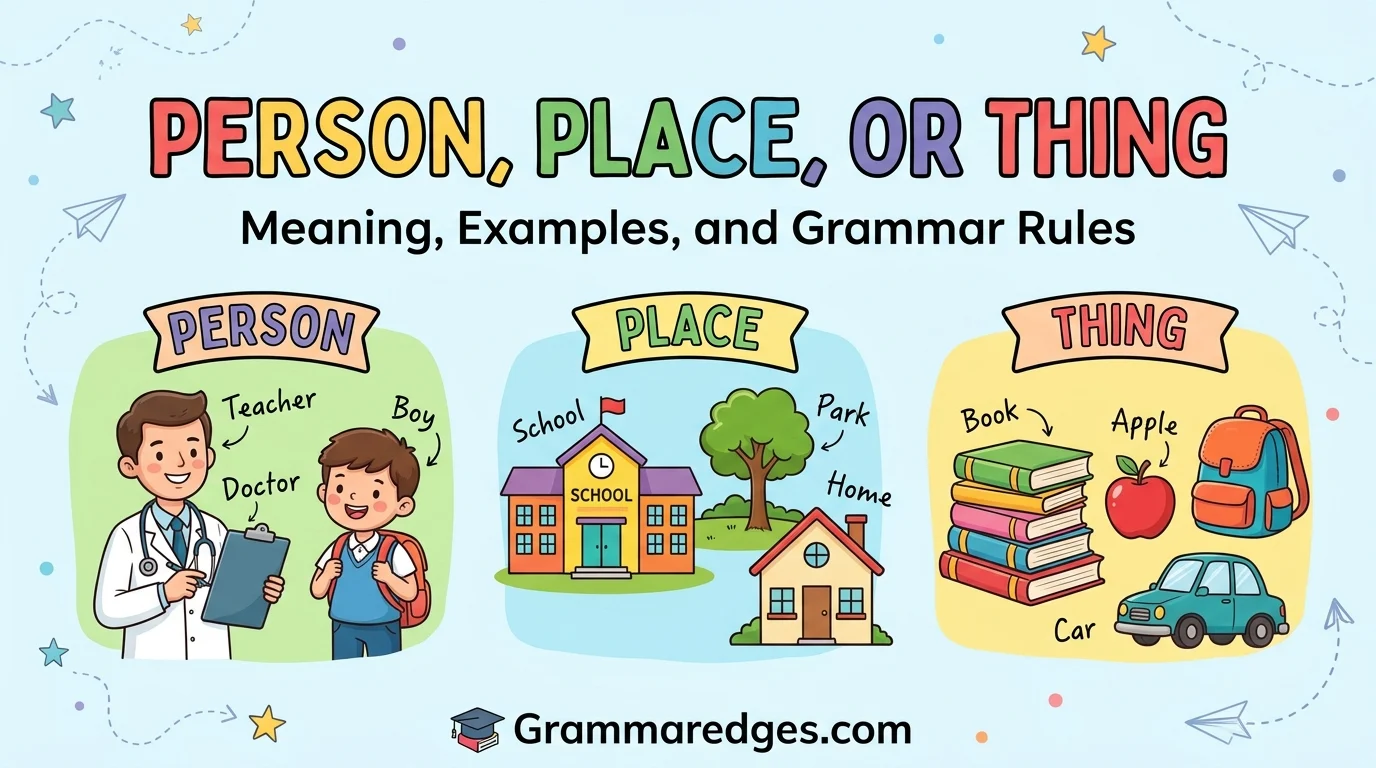
A person can be a teacher, doctor, or friend. A place can be a school, park, or city. A thing can be a book, phone, or chair. But are animals and feelings nouns too? Yes! This guide explains the meaning of person, place, or thing with easy examples, simple sentences, and helpful grammar rules.
Key Takeaways
- A noun names a person, place, thing, animal, or idea.
- People include teachers, doctors, parents, and friends.
- Places include schools, parks, cities, and houses.
- Things include books, phones, tables, and pencils.
- Common nouns name general items, while proper nouns identify specific names.
What Does Person, Place or Thing Mean?
The phrase person, place, or thing is a basic definition used to explain nouns to students and English learners. It helps readers understand that many words are names of people, locations, and objects.
In grammar, these naming words are called nouns. You use nouns every day when talking, reading, writing, or describing something.
For example:
- Person: A teacher explains a lesson.
- Place: The school is near my house.
- Thing: I bought a new notebook.
In these examples, teacher, school, and notebook are nouns because they name someone, somewhere, or something.
However, nouns are not limited to these three categories. They can also name animals, feelings, ideas, events, and experiences.
Examples of a Person, Place or Thing
The easiest way to understand nouns is to look at examples from everyday life. Here are different words grouped into their correct categories.
Examples of People
A person noun identifies a human being. It can describe someone’s job, family relationship, role, or name.
Here are 15 examples:
- Teacher
- Doctor
- Student
- Mother
- Father
- Brother
- Sister
- Police officer
- Farmer
- Nurse
- Singer
- Pilot
- Friend
- Chef
- Child
Example sentences:
- The teacher helped the students.
- My mother prepared dinner.
- The doctor checked the patient.
- A pilot flies an airplane.
Each highlighted naming concept identifies a person.
Examples of Places
A place noun names a location, building, area, or geographical destination. It can describe somewhere nearby or somewhere far away.
Here are 15 examples:
- School
- Hospital
- Park
- Library
- Restaurant
- Beach
- Airport
- City
- Country
- Museum
- Farm
- Office
- Garden
- Church
- Stadium
Example sentences:
- We visited the museum yesterday.
- My brother works in an office.
- The children are playing in the park.
- She traveled to New York.
These words identify different locations, so they are nouns.
Examples of Things
A thing noun names an object, material, or item. Many things are physical objects that people can see, touch, use, or hold.
Here are 15 examples:
- Book
- Pencil
- Table
- Chair
- Computer
- Phone
- Bottle
- Car
- Ball
- Clock
- Bag
- Apple
- Television
- Door
- Bicycle
Example sentences:
- I left my phone on the table.
- She bought a new book.
- The bicycle is outside.
- He picked up a pencil.
The words phone, table, book, bicycle, and pencil name objects.
Examples of Animals
Animals are also included in the noun category. Although the simple definition often says person, place, or thing, animals have their own category in many beginner grammar lessons.
Here are 10 examples:
- Dog
- Cat
- Horse
- Lion
- Elephant
- Rabbit
- Monkey
- Bird
- Cow
- Butterfly
For example, in the sentence “The dog chased the ball,” both dog and ball are nouns.
Is a Person, Place or Thing a Noun?
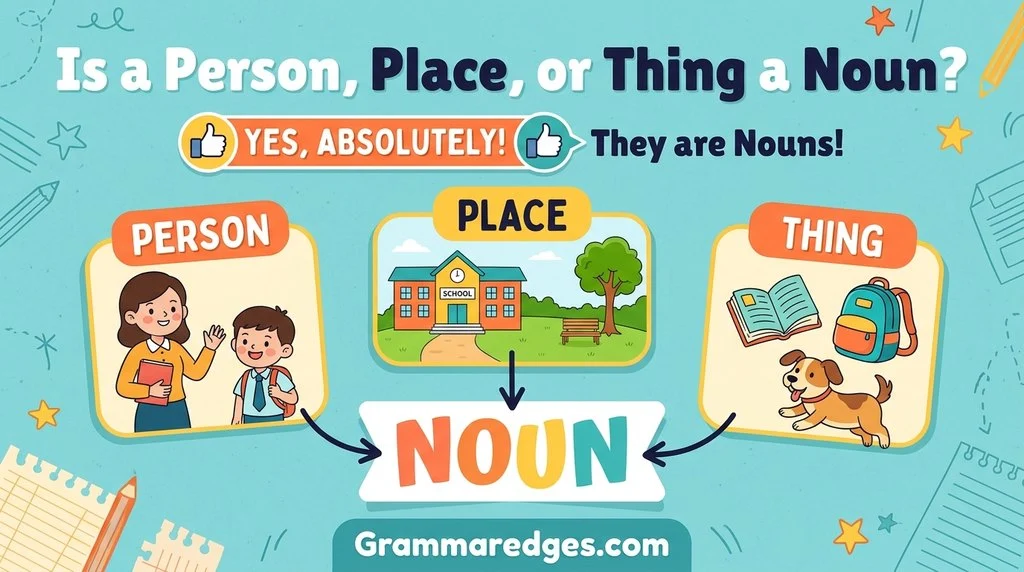
Yes. A person, place, or thing is generally represented by a noun in English grammar.
A noun is one of the main parts of speech. It names something and can perform different roles in a sentence.
Consider these examples:
| Category | Noun | Example |
|---|---|---|
| Person | Doctor | The doctor arrived. |
| Place | Hospital | The hospital is busy. |
| Thing | Chair | The chair is comfortable. |
| Animal | Cat | The cat is sleeping. |
| Idea | Freedom | Freedom matters. |
Nouns can appear at the beginning, middle, or end of a sentence.
For example, in “Sarah bought a beautiful dress,” Sarah and dress are nouns. The word beautiful describes the dress, while bought tells what Sarah did.
This distinction helps students understand how different parts of speech work together.
Can an Idea or Feeling Be a Noun?
Yes. Not every noun represents something you can physically touch. Some nouns describe thoughts, emotions, qualities, and experiences.
These are called abstract nouns.
Examples include:
- Happiness
- Love
- Fear
- Courage
- Honesty
- Freedom
- Wisdom
- Kindness
- Anger
- Friendship
For example:
- Happiness makes life enjoyable.
- Honesty builds trust.
- Her courage inspired everyone.
- Friendship is important.
You cannot hold happiness or touch courage like a book or a chair. However, these words still name ideas and feelings, making them nouns.
This is an important grammar rule because beginners sometimes assume that every noun must be a physical object.
Common Nouns vs. Proper Nouns
Nouns can be divided into different types. Two important types are common nouns and proper nouns.
A common noun identifies a general person, place, animal, or thing. A proper noun identifies a specific person, place, animal, or thing and normally begins with a capital letter.
| Common Noun | Proper Noun |
|---|---|
| Boy | Michael |
| Girl | Sarah |
| City | Chicago |
| Country | America |
| School | Lincoln High School |
| River | Mississippi River |
| Dog | Max |
| Company | Microsoft |
For example:
- Common noun: I live in a city.
- Proper noun: I live in Chicago.
The word city refers to a general location, while Chicago identifies one particular city.
Remember that proper nouns need capital letters in standard English writing. Common nouns generally do not need capitalization unless they begin a sentence or appear in a title.
How to Identify a Person, Place or Thing in a Sentence
Finding nouns becomes easier when you know what to look for. You can use these simple steps to identify them.
Step 1: Read the complete sentence.
Understand what the sentence is describing before choosing a word.
Step 2: Look for naming words.
Find words that name people, places, objects, animals, or ideas.
Step 3: Ask what the word represents.
Is it someone’s name, a location, an object, or an idea?
Step 4: Check how the word works in the sentence.
A noun may act as a subject, direct object, or object of a preposition.
Here are some examples:
| Sentence | Noun | Category |
|---|---|---|
| The teacher is kind. | Teacher | Person |
| We visited the zoo. | Zoo | Place |
| I lost my pencil. | Pencil | Thing |
| The baby likes milk. | Baby, milk | Person, thing |
| My dog loves playing. | Dog | Animal |
| Her happiness is clear. | Happiness | Idea |
Practice exercise:
Identify whether each bold word represents a person, place, thing, animal, or idea.
- My brother plays football.
- We went to the beach.
- She opened her bag.
- The rabbit is eating.
- Kindness makes people happy.
Answers:
- Brother – Person
- Beach – Place
- Bag – Thing
- Rabbit – Animal
- Kindness – Idea
Practicing with everyday sentences is a simple way to improve grammar skills.
Common Mistakes to Avoid
Students sometimes make mistakes when learning how to identify nouns. Understanding these differences can make grammar easier.
1. Thinking every noun must be touchable
This is incorrect. Words like love, peace, and happiness are abstract nouns.
2. Forgetting that animals are nouns
Animals have their own category in many elementary grammar exercises. Words like dog, cat, and horse are nouns.
3. Confusing nouns with verbs
A noun names something, while a verb usually describes an action or state.
Example:
- The boy runs.
- Boy is a noun.
- Runs is a verb.
4. Confusing common and proper nouns
A city is a common noun, while Los Angeles is a proper noun. Specific names normally begin with capital letters.
5. Assuming every word describes a thing
Words such as quickly, beautiful, and jump have different grammatical roles. They are not automatically nouns just because they appear near a noun.
Frequently Asked Questions
1. What is a person, place, or thing in grammar?
A person, place, or thing is a basic description of a noun. Nouns name people, locations, objects, animals, and ideas. Examples include teacher, school, pencil, dog, and happiness.
2. What are 10 examples of a person, place, or thing?
Here are 10 simple examples:
- Teacher (person)
- Doctor (person)
- School (place)
- Hospital (place)
- Park (place)
- Book (thing)
- Pencil (thing)
- Computer (thing)
- Chair (thing)
- Phone (thing)
3. Is an animal a person, place, or thing?
An animal is a noun, but it is usually placed in a separate category when teaching basic grammar. Examples include dog, cat, horse, and elephant.
4. Is an idea a person, place, or thing?
An idea is not a physical person, place, or object. However, it is still a noun. Words such as freedom, honesty, love, and happiness are examples of abstract nouns.
5. What are five examples of nouns?
Five examples are teacher, school, book, dog, and happiness. These words represent a person, place, thing, animal, and idea.
6. What is the difference between a common noun and a proper noun?
A common noun names something generally, such as a boy, city, or school. A proper noun identifies something specific, such as James, Boston, or Lincoln High School. Proper nouns normally begin with capital letters.
7. How can children learn to identify nouns?
Children can learn nouns by naming objects around them, reading simple sentences, sorting words into categories, and completing grammar worksheets. Practicing with familiar examples makes the concept easier to understand.
Conclusion:
Understanding the meaning of person, place, or thing is one of the easiest ways to begin learning English grammar. These words describe nouns, which are used in almost every sentence.
A teacher is a person, a school is a place, and a book is a thing. Animals and abstract ideas can also be nouns, even though they are not always included in the basic three-category explanation. Once you understand these examples, identifying nouns becomes much easier.
Practice with everyday words, read simple sentences, and try sorting nouns into different groups. These small activities can help children, students, and English learners build stronger grammar skills.