
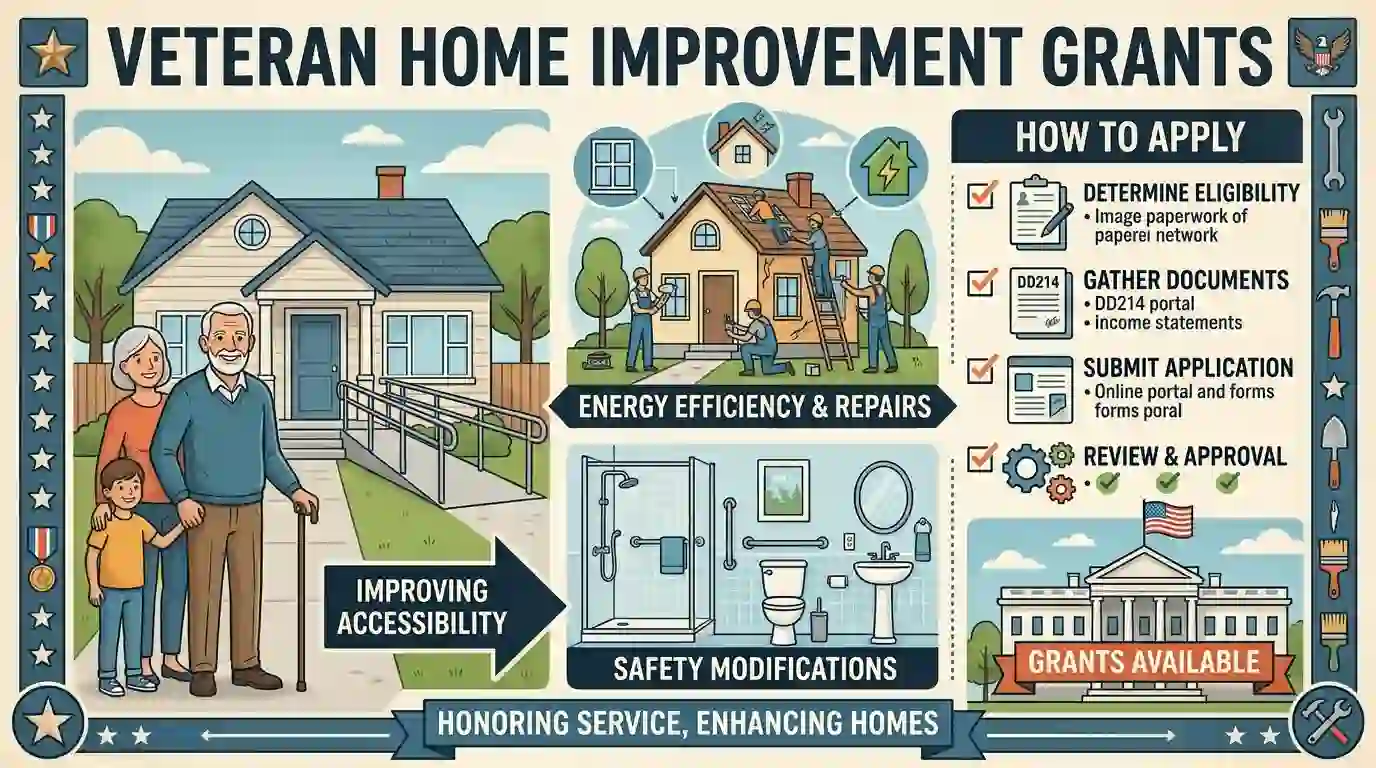
Veteran home improvement grants help eligible former service members pay for necessary home repairs, accessibility upgrades, and safety improvements. Programs from the Department of Veterans Affairs (VA), USDA, and local organizations may cover modifications such as wheelchair ramps, accessible bathrooms, roofing repairs, and other essential improvements. Eligibility and funding amounts vary by program.
Key Takeaways
- The VA offers several grants to help eligible veterans modify their homes.
- SAH and SHA grants primarily support veterans with qualifying service-connected disabilities.
- The HISA program helps pay for medically necessary home improvements.
- USDA and local nonprofit programs may provide additional repair assistance.
- Veterans should verify eligibility and current funding before starting a project.
Veteran Home Improvement Grants
Introduction
Owning a home can bring unexpected expenses, especially when repairs involve a damaged roof, unsafe flooring, plumbing problems, or accessibility improvements. For veterans living on a fixed income or dealing with service-connected disabilities, these costs can become difficult to manage.
Fortunately, veteran home improvement grants can help eligible former service members make important changes to their homes without relying entirely on personal savings. Federal agencies, state governments, and nonprofit organizations offer different forms of housing assistance.
However, not every program covers every type of repair. Some focus on disability-related modifications, while others help eligible homeowners address essential health and safety problems. This guide explains the major programs, eligibility requirements, application steps, and practical ways veterans can find financial assistance.
What Do Veteran Home Improvement Grants Mean?
Veteran home improvement grants are financial assistance programs that help eligible veterans repair, adapt, or improve their primary residences. Unlike traditional home improvement loans, grants generally do not require monthly repayments, although some programs have specific repayment conditions.
These programs come from different sources, including the VA, USDA, state housing agencies, and nonprofit organizations. They may support accessibility improvements, essential repairs, and changes that help veterans live safely and independently.
One important distinction: not every home repair grant is specifically for veterans. Some programs are open to all qualifying homeowners, including veterans who meet income, age, disability, or location requirements.
Why Should Veterans Look for Home Improvement Assistance?
Home repairs can become expensive, particularly when a veteran needs changes related to a disability or limited mobility.
Financial assistance can help veterans:
- Reduce the cost of essential home repairs.
- Install wheelchair ramps and accessible entrances.
- Improve bathroom and kitchen accessibility.
- Address dangerous electrical or plumbing problems.
- Make their homes safer and easier to navigate.
- Maintain independent living without taking on unnecessary debt.
Choosing the right program matters because each organization has different rules about eligible repairs, household income, disability status, and property ownership.
10 Best Veteran Home Improvement Grants and Assistance Programs
The following programs are worth exploring. Some provide direct grants, while others offer loans or free repair services. They are not all veteran-exclusive programs.
1. Specially Adapted Housing (SAH) Grant
The Specially Adapted Housing (SAH) Grant helps eligible veterans with certain severe service-connected disabilities purchase, build, or modify a home.
Veterans may use the funding for major accessibility improvements, such as wider doorways, accessible bathrooms, and other structural changes.
2026 maximum benefit: Up to $126,526.
Best for: Veterans with qualifying disabilities who need significant home adaptations.
Eligibility: Applicants must meet VA disability requirements and own or plan to own the home.
The VA allows eligible recipients to use the benefit up to six times during their lifetime, subject to program rules and the applicable maximum. Veterans Affairs+1
2. Special Home Adaptation (SHA) Grant
The Special Home Adaptation (SHA) Grant helps veterans with certain service-connected disabilities adapt a home to support independent living.
It can help pay for modifications that address specific physical needs. The veteran or an eligible family member must own or plan to own the property where the veteran will live.
2026 maximum benefit: Up to $25,350.
Best for: Veterans who meet the SHA disability requirements and need home adaptations.
Qualifying conditions include certain severe burns, respiratory injuries, and loss or loss of use of both hands. Veterans Affairs
3. Home Improvements and Structural Alterations (HISA) Grant
The Home Improvements and Structural Alterations (HISA) program helps eligible veterans pay for medically necessary changes to their homes.
Examples include installing ramps, widening doorways, and modifying bathrooms to improve access to essential facilities.
Unlike SAH and SHA, HISA can cover qualifying service-connected and non-service-connected disabilities.
Funding limits: Generally, up to $6,800 for qualifying service-connected disabilities and $2,000 for non-service-connected disabilities.
Best for: Veterans who need medically necessary accessibility or structural improvements.
A VA healthcare provider must establish and document the medical need. Ask your VA care team about current requirements before arranging construction.
4. USDA Section 504 Home Repair Program
The USDA Section 504 Home Repair Program helps eligible low-income homeowners in rural communities repair, improve, or modernize their homes.
Although it is not specifically designed for veterans, former service members can apply if they meet the program’s requirements.
The program offers:
- Loans of up to $40,000.
- Grants of up to $10,000 for eligible homeowners aged 62 or older.
- Combined loan and grant assistance of up to $50,000.
The loans carry a fixed 1% interest rate and generally have a 20-year repayment term. Grant funding is intended to remove health and safety hazards, and repayment may be required if the home is sold within three years.
Best for: Very-low-income veteran homeowners in eligible rural areas who need essential repairs.
Applicants must own and occupy their homes and be unable to obtain affordable credit elsewhere. Rural Development+1
5. Rebuilding Together Veterans at Home
Rebuilding Together operates its Veterans at Home initiative to help veterans and their families maintain safe, healthy homes.
Depending on local affiliate availability, assistance may include:
- Home accessibility modifications.
- Safety improvements.
- Essential home repairs.
- Whole-home rehabilitation.
Some services are provided at no cost to qualifying homeowners.
Best for: Veterans who need practical home repairs or accessibility improvements but cannot comfortably afford them.
Availability, eligibility, and services depend on the participating local affiliate. Rebuilding Together
6. Habitat for Humanity Veteran Home Repair Programs
Local Habitat for Humanity affiliates sometimes offer home repair programs for veterans.
Depending on the location and available funding, services may include roof repairs, electrical safety improvements, window replacement, accessibility modifications, and other essential work.
Some affiliates require applicants to meet income guidelines, own and occupy their homes, and participate in the repair process when possible.
Best for: Veterans looking for local nonprofit repair assistance.
Contact your nearest affiliate to learn whether it currently accepts veteran applications. Programs and funding differ by community. San Diego Habitat for Humanity
7. State and Local Veterans Housing Assistance
Many states and local governments offer housing assistance through veterans affairs departments, housing agencies, and community development programs.
Depending on the location, available support may include accessibility improvements, emergency home repairs, rehabilitation assistance, or referrals to nonprofit organizations.
Best for: Veterans who need assistance beyond federal VA programs.
Contact your state Department of Veterans Affairs and local housing department. Ask specifically about veteran home repair grants, disability modifications, and emergency housing assistance.
8. Local Community Development Block Grant Assistance
The Community Development Block Grant (CDBG) program, administered by the U.S. Department of Housing and Urban Development (HUD), provides funding to eligible communities for housing and community development activities.
Some cities and counties use their funding for homeowner rehabilitation, accessibility improvements, and health and safety repairs.
Veterans may qualify through local programs, but CDBG is not a direct federal grant that every veteran can claim.
Best for: Low- and moderate-income homeowners who need essential repairs in participating communities.
Contact your city or county housing department to check whether its rehabilitation program accepts applications.
9. Veterans Housing Rehabilitation and Modification Assistance
The HUD Veterans Housing Rehabilitation and Modification Pilot Program is a federal initiative focused on helping eligible veterans with housing rehabilitation and accessibility needs.
Its purpose is to support improvements that make homes safer and more suitable for veterans.
However, assistance is generally delivered through selected organizations rather than through a direct application to HUD. Veterans should check the program’s current participating organizations and funding availability before relying on it.
Best for: Veterans seeking specialized rehabilitation or accessibility support through participating organizations.
10. Local Veteran Nonprofit and Charitable Assistance
Several community organizations, veteran support groups, and charitable foundations help former service members facing housing difficulties.
Depending on the organization, assistance may include donated construction materials, volunteer labor, emergency repairs, or financial support for essential home improvements.
Best for: Veterans who do not qualify for a federal grant or need additional help covering repair expenses.
Start with local veterans service organizations and established charities. Confirm that the organization is legitimate before sharing personal information or paying any application fees.
Who Qualifies for Veteran Home Improvement Grants?
Eligibility depends on the program. A veteran may qualify for one type of assistance but not another.
Common requirements include:
- Veteran status: Some programs require proof of military service or an eligible discharge.
- Service-connected disability: VA housing grants generally require specific qualifying disabilities.
- Homeownership: Many programs require applicants to own and occupy the property.
- Household income: USDA and local assistance programs may impose income limits.
- Property location: Rural housing programs require the home to be in an eligible rural area.
- Medical necessity: HISA requires a documented medical reason for the proposed improvements.
Veterans should check each program’s requirements before spending money on contractors or construction materials.
How to Apply for Veteran Home Improvement Grants
Applying for assistance becomes easier when you prepare your documents and understand the application process.
Follow these steps:
1. Identify the right program.
Decide whether you need disability-related modifications, essential home repairs, or general housing rehabilitation. This helps narrow down the available options.
2. Confirm your eligibility.
Review the program’s military service, disability, income, age, and homeownership requirements.
3. Gather your documents.
Depending on the program, you may need:
- DD Form 214 or other military service documentation.
- VA disability rating information.
- Proof of homeownership.
- Household income records.
- Medical documentation for accessibility modifications.
- Contractor estimates and repair descriptions.
4. Contact the responsible organization.
For VA grants, contact the VA or your VA healthcare provider. For USDA assistance, contact your local Rural Development office. And for nonprofit programs, contact the organization directly.
5. Submit your application.
Complete the required forms and provide supporting documents. Some organizations may also arrange a property inspection or medical assessment.
6. Wait for approval before starting work.
Do not assume that a repair will qualify for reimbursement. Confirm funding approval and follow the program’s instructions before hiring contractors or beginning construction.
How to Avoid Veteran Home Improvement Grant Scams
Unfortunately, scammers sometimes target veterans by advertising fake government grants or promising guaranteed home repair funding.
The USAGov warns that websites and advertisements offering free government money for home repairs can be misleading or fraudulent. USAGov
Protect yourself by following these precautions:
- Use official government websites ending in
.govwhen researching federal programs. - Never pay someone who guarantees a government grant.
- Avoid sharing your Social Security number through unverified websites.
- Verify nonprofit organizations before submitting an application.
- Read eligibility requirements and repayment conditions carefully.
- Contact the VA or USDA directly if an offer seems suspicious.
Remember that legitimate programs do not guarantee approval to every applicant.
Frequently Asked Questions
1. Can veterans get free home improvement grants?
Yes. Eligible veterans may receive grants through VA disability housing programs, HISA, and certain nonprofit initiatives. However, each program has specific requirements. Some assistance is limited to disability-related improvements, while other programs focus on essential repairs and household income.
2. Does the VA pay for home repairs?
The VA provides several housing benefits, including SAH, SHA, and HISA. These programs primarily support accessibility and medically necessary modifications. They generally do not cover ordinary maintenance such as replacing an aging roof or repainting a home.
3. What is the maximum VA home improvement grant in 2026?
The maximum SAH grant is $126,526 for fiscal year 2026, while the maximum SHA grant is $25,350. HISA offers separate lifetime benefits of up to $6,800 or $2,000, depending on eligibility. These are different programs, and their funds cannot be treated as interchangeable.
4. Can veterans get grants for roof replacement?
Some local housing rehabilitation programs and nonprofit organizations may help eligible veterans with roof repairs. USDA Section 504 loans may also cover eligible roofing work. However, VA’s HISA program does not cover routine roof replacement.
5. Can a veteran receive home improvement assistance without a disability?
Yes. Veterans without service-connected disabilities may qualify for certain USDA loans, local housing rehabilitation programs, or nonprofit repair services. These programs may consider income, age, homeownership, and property condition rather than VA disability status.
6. Are there home repair grants for disabled veterans?
Yes. Disabled veterans may qualify for SAH, SHA, and HISA benefits. These programs can help pay for accessibility improvements, including permanent ramps, wider doorways, and accessible bathrooms. The required disability criteria differ between programs.
7. Can veterans get home repair assistance through USDA?
Yes. Eligible veterans can apply for the USDA Section 504 Home Repair Program if they meet its rural location, income, and homeownership requirements. Eligible applicants aged 62 or older may also qualify for grant assistance to address health and safety hazards.
8. Where can veterans find home repair grants near them?
Start with VA.gov, your state Department of Veterans Affairs, and your local USDA Rural Development office. You can also contact Rebuilding Together and nearby Habitat for Humanity affiliates. Ask about current application openings, local eligibility rules, and available repair funding.
Conclusion
Finding the right veteran home improvement grants can make essential repairs and accessibility improvements more affordable. The best option depends on your circumstances, including disability status, household income, age, homeownership, and location.
Veterans with qualifying service-connected disabilities should explore VA’s SAH and SHA programs. Those who need medically necessary modifications can also ask about HISA. Meanwhile, low income homeowners in eligible rural communities may benefit from USDA Section 504 assistance.
Nonprofit organizations and local housing departments are additional places to look, especially when federal programs do not cover a particular repair.
Before applying, compare the requirements, confirm available funding, and prepare the necessary documents. A little research can help you find legitimate assistance and avoid unnecessary expenses.

