Choosing between past or passed can be confusing because these two words sound exactly the same but have different meanings and grammatical uses. Whether you are writing an email, posting on social media, completing schoolwork, or having a casual conversation, knowing which word to use helps you communicate clearly. The confusion often occurs in sentences such as “I walked past the store” and “I passed the store.” Although both sentences can describe similar situations, the words perform different grammatical roles.
The main difference is simple: past usually refers to time, a position beyond something, or an earlier event, while passed is the past tense and past participle of the verb pass. Understanding their definitions, spelling rules, and sentence structures makes it easier to choose the correct word. In this guide, you will learn how to use both words in everyday English, professional writing, online conversations, and specialized contexts, with practical examples that help you avoid common mistakes.
1. Past or Passed: Meaning and Definition
The words past and passed are homophones. This means they have the same pronunciation but different spellings, meanings, and grammatical functions.
Although they can sometimes appear in similar sentences, you cannot always substitute one for the other.
What Does Past Mean?
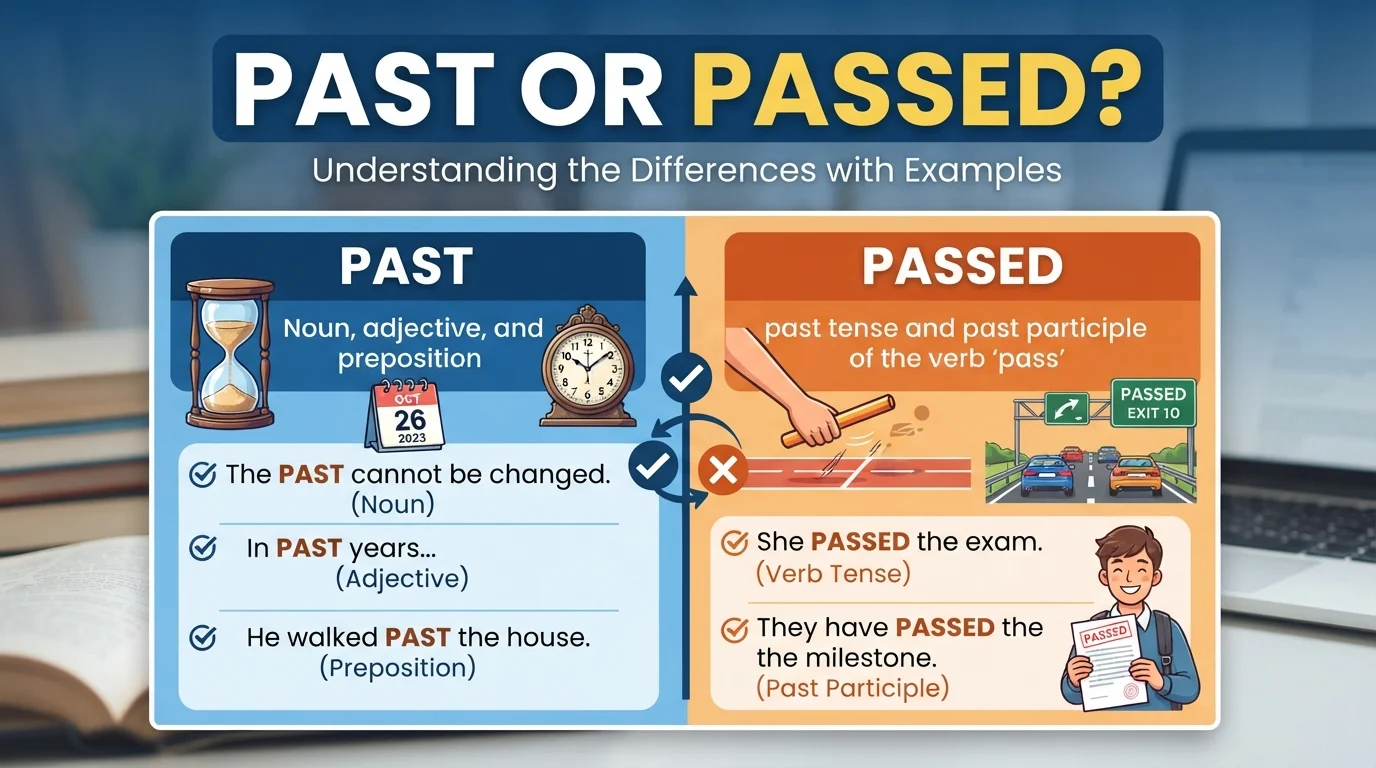
Past can function as a noun, adjective, preposition, or adverb. It commonly describes something that happened before the present, an earlier period, or a position beyond a particular point.
Examples:
- Noun: We cannot change the past.
- Adjective: She discussed her past experiences.
- Preposition: He walked past the library.
- Adverb: The bus drove past without stopping.
In each example, past refers to an earlier time or movement beyond a location.
What Does Passed Mean?
Passed is the past tense and past participle of the verb pass. It describes an action that has already happened, such as moving beyond something, completing an examination successfully, transferring an object, or allowing time to go by.
Examples:
- She passed her driving test.
- He passed the ball to his teammate.
- The train passed our station.
- Several hours passed before we received a reply.
In these sentences, passed describes an action or event.
Quick Comparison
| Word | Meaning | Example |
|---|---|---|
| Past | Earlier time | The past was different. |
| Past | Beyond a place | Walk past the gate. |
| Passed | Succeeded in a test | I passed my exam. |
| Passed | Moved beyond something | The car passed us. |
| Passed | Time went by | Two days passed. |
Easy rule: If you are describing an action performed by someone or something, passed may be correct. If you mean an earlier time or a position beyond something, past is often the right choice.
Always check the complete sentence because past and passed can describe similar situations while serving different grammatical roles.
2. Background and History of Past and Passed
The difference between past and passed comes from their historical development in English. Both words are connected to the broader idea of movement, time, or something going beyond a particular point, but they developed different grammatical roles.
The Origin of Past
The word past developed from forms associated with the idea of passing beyond or going by. Over time, it became established as a word for an earlier period, a previous condition, or a location beyond a reference point.
Today, English speakers use it in many expressions:
- In the past
- Past experience
- Past mistakes
- Half past five
- Walk past the building
These expressions show how past can describe both time and physical position.
The Origin of Passed
The word passed developed as the regular past-tense form of the verb pass. English commonly forms the past tense of regular verbs by adding -ed.
For example:
- Pass → Passed
- Walk → Walked
- Talk → Talked
- Help → Helped
The verb pass can refer to movement, success, transfer, or the progression of time. Its past-tense form describes these actions as completed or occurring in the past.
Examples include “She passed the exam,” “He passed the message along,” and “The afternoon passed quickly.”
Why Do People Confuse Them?
The primary reason is pronunciation. In ordinary speech, past and passed sound alike in most English accents. When people write what they hear, they may choose the wrong spelling.
Autocorrect and spell-checking tools do not always identify the mistake because both words are correctly spelled English words. A sentence can therefore look correct to a spelling checker while still being grammatically wrong.
For example:
Incorrect: I past my examination.
Correct: I passed my examination.
Incorrect: We walked passed the school.
Correct: We walked past the school.
Learning the grammatical role of each word is more reliable than trying to distinguish them by sound.
3. Usage in Different Contexts
Both words appear frequently in everyday conversations, education, business communication, and formal writing. Choosing the right one depends on what you want to express.
Everyday Conversations
In casual speech, people use past to talk about earlier events or locations and passed to describe completed actions.
Examples:
- “That happened in the past.”
- “I passed your house this morning.”
- “We walked past the restaurant.”
- “The deadline has passed.”
Notice that the first and third examples use past, while the second and fourth use passed.
Academic and Educational Writing
Students often encounter these words when writing essays, describing historical events, or discussing examination results.
Examples:
- The past influenced modern society.
- The student passed the final examination.
- Several years passed between the two discoveries.
- The author compared past and present educational systems.
In academic writing, accuracy matters because using the wrong word can change the meaning of a sentence.
Professional Emails and Workplace Communication
Professional writing frequently uses passed when discussing deadlines, approvals, documents, and completed tasks. The word past often describes previous experience or a time that has already gone by.
Examples:
- “The submission deadline has passed.”
- “Please do not repeat past mistakes.”
- “The proposal passed the initial review.”
- “We are past the original delivery date.”
The final example uses past to describe a position beyond the expected date.
News and Formal Reports
Writers may use passed to report the passage of legislation, the movement of an object, or the death of a person. Meanwhile, past commonly describes historical events or previous conditions.
Examples:
- The bill passed both chambers.
- The storm passed through the region.
- The report examines past economic trends.
- The deadline passed without an extension.
Context helps determine which meaning is intended.
4. Past or Passed in Chat, WhatsApp, Instagram, and TikTok
Online communication often involves short messages, captions, comments, and quick replies. Because people type quickly, spelling mistakes involving homophones are common.
However, past and passed do not have special meanings on WhatsApp, Instagram, TikTok, or other social platforms. Their standard English meanings remain the same.
Meaning in Chat Messages
In private messages, past often refers to memories, relationships, or previous events.
Examples:
- “I want to leave the past behind.”
- “Let’s not talk about the past.”
- “That happened a long time in the past.”
Passed is used when describing actions or changes.
Examples:
- “I passed my driving test!”
- “The weekend passed so quickly.”
- “I passed by your house yesterday.”
Meaning on WhatsApp
WhatsApp messages are usually informal, but correct word choice still helps prevent confusion.
Examples:
- “Have you passed your exam?”
- “We drove past your office.”
- “The time has passed so quickly.”
- “Let’s forget the past and move forward.”
If someone writes “I past my test,” the intended meaning is usually clear, but the correct form is “I passed my test.”
Meaning on Instagram and TikTok
On Instagram and TikTok, these words may appear in captions, comments, video descriptions, or personal stories.
Examples:
- “Leaving the past behind and starting fresh.”
- “I finally passed my driving test!”
- “A look at my past adventures.”
- “The opportunity has passed, but new ones are coming.”
A creator discussing personal growth may use past to describe previous experiences. Someone celebrating an achievement may use passed to announce success.
Common Online Mistakes
| Incorrect sentence | Correct sentence |
|---|---|
| I past my test. | I passed my test. |
| We walked passed the shop. | We walked past the shop. |
| Let the passed go. | Let the past go. |
| Time has past. | Time has passed. |
The key is to focus on meaning rather than the platform where the words appear.
5. Meaning in Physics, Medical, and Aircraft Terminology
The words past and passed can also appear in technical discussions. Their meanings generally follow standard English grammar, although specialized contexts may make their intended meaning more precise.
In Physics
In physics, past can describe a position or point that an object has moved beyond. It may appear in explanations of motion, velocity, and the movement of particles or other objects.
Examples:
- The particle moved past the reference point.
- The object traveled past the sensor.
- The ball passed through the detector.
The first two examples use past as a preposition, while the third uses passed as a verb.
In a motion experiment, you might write, “The cart passed the marker after three seconds.” Here, passed describes the cart’s completed movement beyond the marker.
Neither word is a special physics unit or a standalone scientific formula.
In Medical Terminology
In medical communication, past commonly appears in the phrase past medical history. This refers to previous illnesses, surgeries, treatments, or other relevant health events.
Examples:
- The doctor reviewed the patient’s past medical history.
- The patient passed the screening examination.
- Several hours passed before the symptoms improved.
The phrase passed away is also a widely used expression meaning that a person has died. In medical or clinical writing, the more precise wording depends on the circumstances and the document’s purpose.
Medical professionals should avoid confusing historical information with a completed action, particularly in formal records.
In Aircraft and Aviation Terminology
In aviation, past can describe an aircraft’s position relative to a runway, landmark, or other reference point.
Examples:
- The aircraft flew past the observation tower.
- The plane passed the designated waypoint.
- The aircraft continued past the planned reference point.
In the first example, past describes the aircraft’s position or movement beyond the tower. In the second and third, passed describes the action of moving beyond a point.
The word passed may also describe successfully completing an inspection or test, depending on the sentence.
For example: “The component passed its inspection.”
Important distinction: In physics, medicine, and aviation, these words do not acquire a completely different grammatical meaning. Their specialized interpretation comes from the technical context in which they are used.
6. Common Misconceptions About Past and Passed
Several misunderstandings make these words difficult for English learners and native speakers alike. Recognizing them can help you avoid repeated mistakes.
Misconception 1: They Mean Exactly the Same Thing
Although past and passed can describe related situations, they are not interchangeable in every sentence.
Correct: We walked past the museum.
Correct: We passed the museum.
Both sentences can describe walking beyond a museum, but the grammar differs. In the first sentence, past is a preposition. In the second, passed is the main verb.
Misconception 2: Passed Is Always the Correct Word for the Past
Some writers assume that any reference to an earlier time requires passed. This is incorrect.
Correct: My past experiences taught me a lesson.
Incorrect: My passed experiences taught me a lesson.
The word past describes previous experiences. Passed is a verb form and does not serve as the correct adjective in this sentence.
Misconception 3: Past Is Only About Time
Although past frequently refers to time, it can also describe movement beyond a place.
Examples:
- Walk past the entrance.
- Drive past the traffic lights.
- The ball rolled past the goalkeeper.
These sentences refer to location or movement rather than an earlier period.
Misconception 4: Spell-Check Will Always Catch the Error
Spell-checkers often accept both words because they are spelled correctly individually. They may not recognize that a particular word is inappropriate for the sentence.
For example, “The deadline has past” contains a grammatical error even though both past and has are legitimate words.
The correct sentence is “The deadline has passed.”
Misconception 5: The Difference Depends on British or American English
The basic distinction between these words is the same in standard American and British English. Neither variety normally uses past as a substitute for passed in “I passed the exam.”
Regional accents may influence pronunciation, but they do not eliminate the grammatical difference.
7. Similar Terms and Alternatives
Understanding related words can make your writing more precise. However, alternatives should be chosen according to the intended meaning.
Alternatives for Past
When past refers to time, possible alternatives include:
- Previous
- Earlier
- Former
- Historical
- Bygone
- Prior
Examples:
- Past experience → Previous experience
- Past events → Historical events
- Past mistakes → Earlier mistakes
When past refers to movement beyond a location, alternatives may include beyond or by, depending on the sentence.
Example: “The road runs past the school” could become “The road runs by the school.”
Alternatives for Passed
When passed describes movement, possible alternatives include:
- Went beyond
- Moved beyond
- Went by
- Traveled past
Example: “The car passed the truck” could become “The car went beyond the truck.”
When passed means success in an examination, alternatives include succeeded in or met the requirements for.
Example: “She passed the exam” could become “She succeeded in the exam,” although “She succeeded in the examination” may sound more natural in some contexts.
When passed describes time, alternatives include went by or elapsed.
Example: “Three hours passed” could become “Three hours elapsed.”
Related Expressions
| Expression | Meaning | Example |
|---|---|---|
| In the past | During an earlier period | I lived there in the past. |
| Past due | Later than the required date | The payment is past due. |
| Passed away | Died | Her grandfather passed away. |
| Passed out | Lost consciousness | He passed out from the heat. |
| Passed on | Died or transferred something, depending on context | She passed on the news. |
| Past one’s prime | Beyond the period of greatest success or ability | The athlete was past his prime. |
These expressions show why learning complete phrases can be as useful as memorizing individual definitions.
8. How to Respond When Someone Uses Past or Passed Incorrectly
If someone uses past or passed incorrectly, your response should depend on the situation. In most casual conversations, the intended meaning is more important than correcting every spelling mistake.
In Casual Chats
If a friend writes, “I past my exam,” you can simply respond to the news:
“Congratulations! That’s great news.”
There is usually no need to correct the spelling unless the person asks for help or is learning English.
When Someone Asks for Correction
If someone wants to improve their writing, explain the rule briefly and provide the corrected sentence.
For example:
Original: “Time has past so quickly.”
Correction: “Time has passed so quickly.”
Explanation: Use passed because it is the past participle of the verb pass, which follows the auxiliary verb has.
In Professional Communication
When editing an email, report, or formal document, correct the word without making the issue personal.
Original: “The application past the review stage.”
Corrected: “The application passed the review stage.”
This keeps the focus on accuracy and clarity.
When the Meaning Is Unclear
Sometimes the wrong word creates ambiguity. Instead of assuming what the writer intended, ask a short clarification question.
For example:
“Do you mean that you went beyond the building or that the event happened earlier?”
This is especially useful in technical reports, academic assignments, and workplace communication.
A Simple Correction Strategy
- Identify whether the sentence describes a time, position, or action.
- Check whether the word functions as a noun, adjective, preposition, adverb, or verb.
- Replace the incorrect form.
- Read the entire sentence again to ensure the meaning remains clear.
Respectful correction helps people learn without turning a small spelling mistake into an unnecessary argument.
9. Differences Between Past, Passed, and Other Similar Words
The confusion does not end with past and passed. Other English words can also create uncertainty because they have related meanings or similar spellings.
Past vs. Passed
The primary distinction is grammatical.
- Past: an earlier time or a position beyond something.
- Passed: the past tense or past participle of pass.
Examples:
- We discussed the past.
- We passed the entrance.
- Walk past the entrance.
Past vs. Previous
Both words can refer to an earlier period, but their use differs.
- Past: My past experiences were valuable.
- Previous: My previous job was in sales.
Previous often identifies something that came immediately before another event, item, or situation. Past can refer more broadly to earlier time or history.
Passed vs. Past Participle
Passed is itself the past-tense form and past participle of pass.
Examples:
- Simple past: She passed the test.
- Present perfect: She has passed the test.
- Past perfect: She had passed the test before the interview.
The grammatical structure changes, but the spelling passed remains the same.
Past vs. Ago
These words both refer to earlier time, but they are used differently.
- The event happened in the past.
- The event happened two years ago.
Ago normally follows a period of time, such as “three days ago” or “five years ago.” Past can be used as a noun, adjective, preposition, or adverb.
Passed vs. Past Due
These expressions are particularly easy to confuse.
- The payment date has passed.
- The payment is past due.
In the first sentence, passed describes an event or time moving forward. In the second, past due means that the payment is late.
Remembering the grammatical structure of each expression is more effective than relying on sound alone.
10. Relevance in Online Conversations and Dating Apps
On dating apps and social platforms, past and passed may appear in conversations about previous relationships, personal experiences, plans, and life changes. Their meanings remain standard, but the surrounding conversation influences how a message is understood.
Talking About Past Relationships
People often use past to refer to former relationships or experiences.
Examples:
- “I’ve learned a lot from my past relationships.”
- “I don’t want to bring past problems into a new relationship.”
- “My past helped me understand what I need.”
Here, past describes earlier experiences or circumstances.
Describing Completed Actions
Passed is appropriate when discussing something that happened or was completed.
Examples:
- “I passed my driving test last week.”
- “A few days passed before we matched.”
- “I passed by your favorite coffee shop yesterday.”
These examples describe completed actions or the progression of time.
Understanding Dating-App Messages
Consider these two messages:
“I want to move beyond my past.”
This means the person wants to stop focusing on earlier experiences and move forward.
“I passed your profile earlier.”
This means the person came across or moved beyond the profile earlier, although a more natural message might be “I saw your profile earlier.”
The wording can affect clarity, particularly when short messages lack additional context.
Should You Correct Someone on a Dating App?
Usually, there is no need to correct a minor grammar mistake unless it changes the meaning or the other person asks for help. Focus on the conversation rather than treating every message as a writing test.
However, if you are writing your own dating profile, using the correct word can make your profile appear more polished.
For example:
Incorrect: “I learned from my passed relationships.”
Correct: “I learned from my past relationships.”
Correct word choice supports clear communication without making informal conversations unnecessarily formal.
Conclusion
Understanding past or passed becomes much easier when you focus on meaning and grammar instead of pronunciation. Both words sound alike, but they perform different jobs in a sentence. Past usually refers to an earlier time, previous experiences, or movement beyond a particular point. Passed is the past tense and past participle of the verb pass, describing actions such as completing an examination, moving beyond something, transferring an object, or allowing time to go by.
Whether you are writing an academic assignment, sending a WhatsApp message, creating an Instagram caption, or preparing a professional email, the same basic rule applies. Ask yourself whether you mean an earlier period or a completed action. Then check how the word functions in your sentence. With regular practice and attention to context, you can avoid this common English mistake and communicate more confidently. Remember: you walked past the building, but you passed your examination.