
Have you ever wondered whether to write patient or patience? These two words look almost identical, sound similar, and share a connection to waiting calmly. However, they have different meanings and grammatical roles. Choosing the wrong word can change the meaning of your sentence and make your writing confusing.
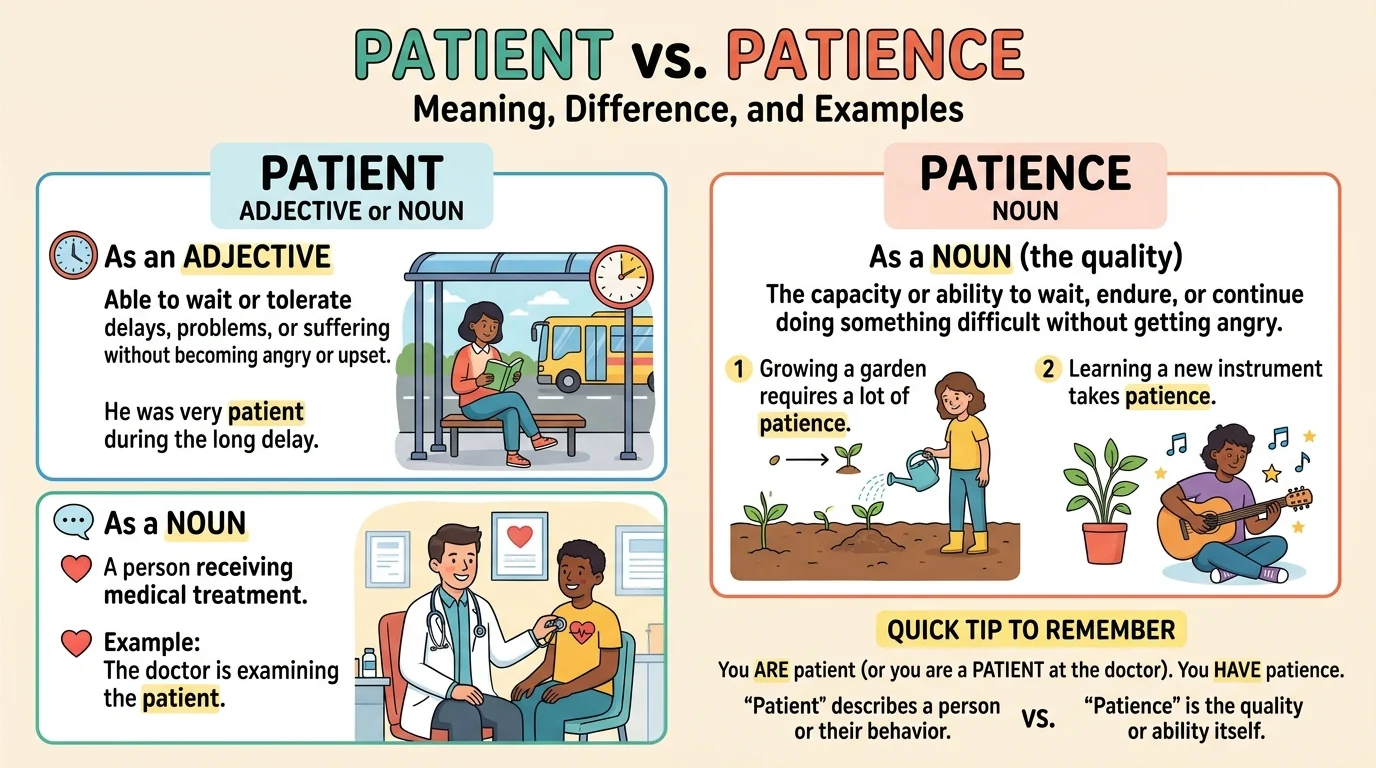
The word patient usually describes someone who can wait without becoming upset. It can also refer to a person receiving medical care. In contrast, patience is the ability to remain calm while dealing with delays, difficulties, or frustrating situations.
Understanding the difference is useful for students, English learners, professionals, and anyone who wants to improve their grammar. It also helps when writing text messages, social media captions, emails, and everyday conversations.
In this guide, you will learn the definitions, pronunciation, spelling differences, and practical examples of both words. You will also discover common mistakes, related expressions, and easy ways to remember when to use each word correctly.
1. Patient or Patience: Meaning and Definition
Although patient and patience are closely related, they serve different purposes in English. The easiest way to understand them is to remember that one can describe a person, while the other names a quality.
What Does Patient Mean?
Patient is an adjective that describes someone who can wait, listen, or deal with difficulties without becoming angry or frustrated.
Examples:
- My teacher is very patient with beginners.
- Please be patient while I check your information.
- She remained patient during the long journey.
- A patient parent listens carefully to a child.
Patient is also a noun used in healthcare. It refers to someone who receives medical examination, treatment, or care.
Examples:
- The doctor examined the patient.
- The hospital admitted three new patients.
- Every patient deserves respectful treatment.
What Does Patience Mean?
Patience is a noun that describes the ability to remain calm while waiting or facing difficult circumstances.
Examples:
- Learning a new language requires patience.
- Thank you for your patience during the delay.
- He showed patience while teaching his younger brother.
- Success often takes time and patience.
Unlike patient, the word patience does not normally describe a person directly. Instead, it identifies a personal quality that someone can possess or demonstrate.
Quick Comparison
| Word | Part of speech | Meaning | Example |
|---|---|---|---|
| Patient | Adjective | Able to wait calmly | She is patient. |
| Patient | Noun | Someone receiving medical care | The patient feels better. |
| Patience | Noun | The ability to wait calmly | He has patience. |
Easy rule: You can be patient or have patience. This simple distinction will help you choose the correct word in most everyday situations.
2. Background and Origin of Patient and Patience
The words patient and patience have a shared linguistic history. Both are connected to the Latin word pati, which means “to suffer,” “to endure,” or “to undergo.”
Over time, related forms developed in French and entered English. Their meanings gradually became associated with enduring difficulties, tolerating delays, and remaining calm when circumstances are challenging.
The word patient developed as a description of someone who can tolerate inconvenience or difficulty without reacting angrily. Its use as a medical noun also reflects the idea of a person undergoing treatment or care.
The word patience, meanwhile, came to represent the quality or ability that allows someone to endure uncomfortable situations calmly.
Why Do the Words Look So Similar?
Their shared origin explains much of their similarity in spelling and meaning. Both words relate to the idea of enduring something, but English uses them differently.
Consider these examples:
- Patient: The coach is patient with inexperienced players.
- Patience: The coach shows patience with inexperienced players.
The first sentence describes the coach. The second identifies the quality the coach demonstrates.
Why Is the Difference Important?
English contains many related words that share a root but have different grammatical functions. For example, confident describes a person, while confidence names a quality. Similarly, different is an adjective, while difference is a noun.
Understanding these word relationships makes it easier to recognize patterns in English grammar.
You do not need to memorize the complete history of either word to use it correctly. Remembering their shared connection to endurance and their different grammatical roles is enough for everyday communication.
3. Usage in Different Contexts
The correct choice between patient and patience depends on what you want to communicate. Both words appear in everyday conversations, education, workplaces, healthcare, and formal writing.
Everyday Conversations
Use patient when describing someone’s behavior.
- Please be patient; dinner will be ready soon.
- My little brother is surprisingly patient.
- Try to be patient with yourself.
Use patience when discussing the ability to remain calm.
- I need more patience when driving in traffic.
- Thank you for your patience.
- Parenting requires patience and understanding.
Academic and Educational Writing
Students and teachers frequently use both words when discussing learning and personal development.
Examples:
- A patient teacher can help struggling students.
- Developing writing skills requires patience.
- Students should be patient when learning difficult concepts.
- Scientific research often demands patience.
Professional Communication
In business emails, customer service, and workplace discussions, both terms are useful.
Examples using patient:
- Please be patient while our team reviews your request.
- Our manager is patient when explaining new procedures.
Examples using patience:
- We appreciate your patience while we resolve this issue.
- Thank you for your continued patience and cooperation.
The noun patience is especially common in polite professional expressions because it acknowledges that someone has waited or tolerated an inconvenience.
Healthcare Settings
In medicine, patient has an additional meaning as a noun.
- The patient is waiting for the test results.
- The nurse explained the treatment to the patient.
- The doctor showed patience while answering questions.
Notice that the final example uses patience to describe the doctor’s behavior, not the person receiving treatment.
Quick Grammar Test
Ask yourself what the sentence needs:
- If it describes someone’s behavior, use patient.
- If it names the quality of waiting calmly, use patience.
- If it refers to someone receiving medical care, use patient as a noun.
These three rules cover most situations in which people confuse the words.
4. Patient or Patience in Chat, WhatsApp, Instagram, and TikTok
In digital communication, people often write quickly and may confuse words that look or sound similar. The distinction between patient and patience remains the same in text messages, comments, captions, and direct messages.
Neither word has a special, separate meaning simply because it appears on a social media platform.
Meaning in Chat and WhatsApp
In a private conversation, patient usually asks someone to remain calm or describes someone who can wait.
Examples:
- “Be patient, I’m almost there.”
- “She’s so patient with me.”
- “Please be patient while I finish this.”
Patience refers to the ability to tolerate waiting or difficulties.
Examples:
- “Thanks for your patience ❤️”
- “I have no patience for drama today.”
- “My patience is running out 😂”
The meaning comes from the sentence, not from the messaging application.
Meaning on Instagram
Instagram users may include either word in captions, comments, and personal messages.
Examples:
- “Be patient with your progress. 🌱”
- “Growth takes time and patience.”
- “A patient heart can handle difficult days.”
The first and third examples describe a person or their behavior. The second identifies a quality.
Meaning on TikTok
TikTok videos often discuss self-improvement, relationships, personal growth, and life lessons. Both words can appear in spoken videos, on-screen text, and captions.
Examples:
- “Be patient. Your time will come.”
- “Patience is part of the journey.”
- “Learning to be patient changed my life.”
These expressions communicate related ideas but use different grammatical forms.
Common Online Mistakes
Some users write “Thanks for your patient” when they mean “Thanks for your patience.” In this context, the second version is correct because the sentence refers to the quality of waiting calmly.
Similarly, “I have no patient” is incorrect when the writer means they cannot tolerate a situation. The correct expression is “I have no patience.”
Remember: Social media slang does not change standard spelling. Unless someone is deliberately making a joke or using unusual wording, the same grammar rules apply online and offline.
5. Patient or Patience in Physics, Medical, and Aircraft Terminology
The words may appear in specialized fields, but their meanings depend on the subject and grammatical context. It is important not to assume that every technical use has a unique scientific definition.
In Physics
Neither patient nor patience is a standard fundamental physics quantity like force, energy, velocity, or acceleration.
However, both words can appear in explanations about learning physics or conducting experiments.
Examples:
- A patient student may need several attempts to understand a complex equation.
- Conducting careful experiments often requires patience.
- Scientists must sometimes exercise patience while collecting reliable measurements.
In these examples, the words describe people or personal qualities. They are not physics terms.
In Medical Terminology
The word patient has an established medical meaning: a person receiving healthcare, assessment, diagnosis, or treatment.
Examples:
- The patient reported a headache.
- The doctor discussed the patient’s treatment plan.
- Nurses monitored the patients after surgery.
The word patience is not a medical diagnosis or a type of treatment. It describes a quality that may be important when healthcare professionals explain procedures, answer questions, or support people during recovery.
For example:
– The nurse showed patience when explaining the medication schedule.
Here, patient refers to the person receiving care, while patience describes the nurse’s behavior.
In Aircraft and Aviation Terminology
Neither word is a standard aircraft component or a basic aviation technical term.
However, patient and patience may appear in discussions about pilot training, aviation education, or passenger experiences.
Examples:
- A patient instructor gives student pilots time to develop their skills.
- Learning complex flight procedures requires patience.
- Passengers may need to be patient during weather-related delays.
In aviation, specialized terminology includes words such as altitude, airspeed, runway, and cockpit. The words patient and patience retain their ordinary English meanings when used in this field.
What Should You Remember?
| Field | Patient | Patience |
|---|---|---|
| Physics | A person who waits calmly | The ability to wait calmly |
| Medicine | A person receiving care | Calmness when facing delays or difficulties |
| Aviation | A person who remains calm | The ability to tolerate waiting or challenges |
These examples demonstrate that context may change the subject of a sentence, but it does not change the basic distinction between the two words.
6. Common Misconceptions About Patient and Patience
Several misunderstandings make these words difficult for English learners. Correcting them can improve both writing and speaking.
Misconception 1: Both Words Mean Exactly the Same Thing
Although they are related, they are not interchangeable.
Incorrect: “Thank you for your patient.”
Correct: “Thank you for your patience.”
The corrected sentence uses a noun because it refers to someone’s willingness to wait.
Misconception 2: Patient Only Refers to Someone in a Hospital
The word patient has two common meanings. It can refer to a person receiving medical care or describe someone who can wait calmly.
Examples:
- The patient is recovering.
- My sister is patient with children.
Both sentences use the word correctly, but its grammatical role changes.
Misconception 3: Patience Means Doing Nothing
Patience does not necessarily mean remaining inactive or accepting every situation without question. It means managing frustration and allowing enough time for something to happen.
For example, a patient student may continue practicing instead of giving up. A patient employee may follow up professionally rather than reacting angrily to a delay.
Patience can involve effort, persistence, and thoughtful action.
Misconception 4: One Word Is More Formal Than the Other
Neither word is inherently more formal. Both are appropriate in casual and professional English.
For example:
- Casual: “Be patient!”
- Professional: “Please be patient while we review your application.”
- Casual: “I need patience.”
- Professional: “We appreciate your patience during this process.”
The formality comes from the complete sentence and situation.
Misconception 5: Pronunciation Alone Always Makes the Difference Clear
The two words have similar pronunciations, so they may be difficult to distinguish in fast speech. Their final sounds differ, but listeners may not always notice the distinction.
For this reason, grammar and sentence meaning are more reliable than pronunciation alone.
A useful test is to replace the word with a simple alternative. If you mean “calm while waiting,” patient may fit. If you mean “the ability to wait calmly,” patience is likely correct.
7. Similar Terms and Alternatives
Learning related words can help you expand your vocabulary and express yourself more precisely. However, not every synonym works in every sentence.
Alternatives for Patient
When patient describes a person who can wait calmly, possible alternatives include:
- Calm: Not easily upset or excited.
- Tolerant: Willing to accept differences or difficulties.
- Understanding: Willing to consider another person’s situation.
- Composed: Calm and in control of your emotions.
- Long-suffering: Able to endure prolonged difficulties without complaining much.
Examples:
- She is patient with new employees.
- She is understanding toward new employees.
- He remained calm during the delay.
These words overlap in meaning but are not identical. For example, being tolerant does not always mean being willing to wait.
When patient refers to someone receiving medical care, alternatives depend on context. Terms such as individual receiving treatment may work in formal explanations, but they are not always as concise as patient.
Alternatives for Patience
Depending on the situation, related words and expressions include:
- Tolerance: The ability to accept something difficult or unpleasant.
- Perseverance: Continued effort despite challenges.
- Self-control: The ability to manage reactions and emotions.
- Forbearance: Restraint when dealing with provocation or difficulty.
- Calmness: A state of being relaxed and not agitated.
Examples:
- Learning a language requires patience and perseverance.
- The discussion required patience and self-control.
- Thank you for your patience and understanding.
Patient vs. Patience vs. Tolerance
| Word | Main idea | Example |
|---|---|---|
| Patient | Describes someone who waits calmly | He is patient. |
| Patience | The quality of waiting calmly | He has patience. |
| Tolerance | Acceptance of something difficult or different | She showed tolerance. |
| Perseverance | Continuing despite obstacles | Her perseverance paid off. |
Choosing the right alternative depends on whether you want to describe someone’s personality, their ability to wait, their acceptance of differences, or their determination to continue.
8. How to Respond When Someone Uses Patient or Patience
The appropriate response depends on what the other person means. They might be asking you to wait, thanking you for waiting, or discussing a personal quality.
When Someone Says “Be Patient”
This usually means they want you to wait calmly or give them more time.
Possible responses:
- “Sure, take your time.”
- “No problem. I’ll wait.”
- “Okay, thanks for letting me know.”
- “I understand. Just keep me updated.”
If the delay affects your plans, you can remain polite while asking for a timeframe.
Example:
“Of course. Could you let me know approximately how long it will take?”
When Someone Says “Thanks for Your Patience”
This expression acknowledges that you have waited or tolerated a delay.
Possible responses:
- “You’re welcome!”
- “No worries.”
- “Happy to help.”
- “I understand that these things take time.”
In professional communication, a simple “You’re welcome” is often enough.
When Someone Talks About Patience
If someone says, “I need more patience,” they may be describing a personal challenge.
You could respond:
- “It takes practice. You’ll get better.”
- “I understand. Some situations are frustrating.”
- “Taking things one step at a time can help.”
A supportive response is usually more appropriate than correcting their personality or criticizing their frustration.
When You Need to Correct a Grammar Mistake
If someone writes “Thanks for your patient,” the intended meaning is probably “Thanks for your patience.”
Whether you should correct the mistake depends on the situation. In a formal document or an English lesson, a gentle correction may be useful. In a casual conversation, correcting every small error may distract from the message.
Focus on communication first, and correct grammar when it is helpful.
9. Differences From Similar Words
The distinction between patient and patience becomes easier when you compare them with other word pairs that follow similar grammatical patterns.
Patient vs. Patience
- Patient describes someone or refers to a person receiving healthcare.
- Patience names the quality of remaining calm while waiting.
Examples:
- She is patient with her students.
- She has patience with her students.
Both sentences are correct, but their structures differ.
Patience vs. Patients
These two words are especially easy to confuse because they sound almost identical in many accents.
- Patience means the ability to wait calmly.
- Patients is the plural form of patient, meaning people receiving medical care.
Examples:
- The nurse showed patience.
- The nurse treated several patients.
A helpful memory trick is to associate the letter combination in patients with people in a medical setting.
Patient vs. Impatient
Impatient is the opposite of patient when describing someone’s ability to wait calmly.
Examples:
- She is patient while waiting for the results.
- She becomes impatient when the results take too long.
Patience vs. Impatience
Impatience is the opposite of patience.
Examples:
- Patience helps him handle delays.
- Impatience makes delays more frustrating.
Comparison Table
| Word | Meaning | Example |
|---|---|---|
| Patient | Able to wait calmly | Be patient with yourself. |
| Patience | Ability to wait calmly | Patience takes practice. |
| Patients | People receiving medical care | The patients are resting. |
| Impatient | Unable or unwilling to wait calmly | He became impatient. |
| Impatience | Lack of patience | Her impatience was obvious. |
Understanding these related forms will help you avoid mistakes in schoolwork, workplace communication, and everyday writing.
10. Relevance in Online Conversations and Dating Apps
Patience is often important in online communication because people do not always reply immediately. They may be working, studying, traveling, or simply taking time away from their phones.
In these situations, patient and patience can communicate different but related ideas.
Using Patient in Dating Conversations
When someone says, “I’m trying to be patient,” they may mean that they are allowing a relationship to develop naturally.
Examples:
- “I’m patient when getting to know someone.”
- “Let’s be patient and see how things develop.”
- “I’m trying to be patient while we figure things out.”
These statements can express understanding, but the surrounding conversation determines the exact intention.
Using Patience in Dating Conversations
Patience is often used when discussing communication, trust, timing, or relationship development.
Examples:
- “Building trust takes patience.”
- “Thank you for your patience while I’ve been busy.”
- “A healthy relationship requires patience and communication.”
These expressions suggest that people may need time to understand one another and manage differences.
Does Patience Mean Someone Is Not Interested?
Not necessarily. A delayed reply alone does not prove that someone has lost interest. People have different schedules and communication habits.
At the same time, patience does not require you to accept repeated disrespect, unclear expectations, or one-sided communication. It is reasonable to express your needs and ask for clarity.
For example:
“I understand you’re busy, but consistent communication matters to me. Can we talk about what works for both of us?”
This message is calm, direct, and respectful.
How to Use the Words Correctly Online
- “I’m patient with people I care about.” — Correct.
- “Healthy relationships require patience.” — Correct.
- “Thanks for your patient.” — Incorrect in the intended meaning.
- “Thanks for your patience.” — Correct.
In dating apps and other online spaces, clear language helps reduce misunderstandings. Using patient and patience correctly makes your messages easier to understand and more natural.
Conclusion
Understanding patient or patience is a simple but valuable step toward better English. Although the words share a common origin and relate to enduring difficulties, they serve different grammatical purposes.
Patient describes someone who can wait calmly or refers to a person receiving medical care. Patience is the ability to remain calm while waiting, learning, or dealing with challenging situations.
Remember the easy rule: you can be patient, have patience, or visit a patient in a medical setting. These examples show how the correct word depends on the sentence’s meaning.
Whether you are writing an email, sending a WhatsApp message, creating an Instagram caption, or communicating professionally, choosing the right word helps you express yourself clearly.
Practice with the examples in this guide, and the difference will soon become natural. With a little patience, your grammar skills can improve one word at a time.