

The phrase “red pill or blue pill” is a popular expression used to describe a choice between two different ways of seeing the world. It became widely known through the 1999 science-fiction movie The Matrix, in which the main character, Neo, must choose between learning an uncomfortable truth and continuing to live in a familiar illusion. Since then, the phrase has become a common reference in online conversations, social media posts, memes, and discussions about relationships, politics, and personal beliefs.
People search for “red pill or blue pill” to understand its meaning, origin, symbolism, and use in everyday communication. Depending on the context, it can represent truth versus comfort, awareness versus ignorance, or a decision that changes someone’s perspective.
However, the expression does not always carry the same meaning. Some people use it humorously, while others connect it to serious ideological debates. Understanding the context helps you interpret the phrase correctly and respond appropriately in conversations.
1. Red Pill or Blue Pill: Meaning and Definition
The phrase “red pill or blue pill” describes a choice between two different perspectives, experiences, or realities. In its original movie context, the red pill represents discovering the truth, even when it is difficult to accept. The blue pill represents remaining in a familiar, comfortable reality without discovering the hidden truth.
In everyday language, people often use the expression when discussing decisions that could change how someone thinks or understands a situation.
What Does the Red Pill Mean?
The red pill generally symbolizes awareness, discovery, and a willingness to question accepted beliefs. Choosing the red pill means being open to information that may challenge your current understanding.
For example:
- Someone discovers that a trusted friend has been dishonest.
- A person learns how a particular industry operates behind the scenes.
- Someone questions a popular opinion after examining new evidence.
- A person recognizes a difficult truth about a relationship.
In these situations, taking the red pill suggests accepting reality rather than ignoring uncomfortable information.
What Does the Blue Pill Mean?
The blue pill generally symbolizes comfort, familiarity, and choosing not to confront a potentially disturbing truth. It can represent staying with what feels safe rather than questioning everything.
For example:
- Someone avoids an argument because they want to maintain peace.
- A person chooses not to investigate an upsetting rumor without good reason.
- Someone prefers a familiar routine instead of making a difficult change.
The blue pill does not necessarily mean that a person is foolish or dishonest. Sometimes, choosing peace, privacy, or emotional stability can be reasonable.
Red Pill vs. Blue Pill at a Glance
| Feature | Red Pill | Blue Pill |
|---|---|---|
| Main symbolism | Truth and awareness | Comfort and familiarity |
| General idea | Question what you believe | Keep your current perspective |
| Emotional effect | May be uncomfortable | May feel reassuring |
| Common association | Discovery and change | Stability and acceptance |
| Online usage | Awareness or ideological beliefs | Familiar thinking or an opposing viewpoint |
Ultimately, the meaning depends on the situation. The phrase is a metaphor, not a rule that every difficult belief is true or every comfortable belief is false.
2. Background and Origin of the Red Pill or Blue Pill Phrase
The phrase became famous through The Matrix, a science-fiction film released in 1999. The movie presents a world in which ordinary people believe they are living in reality, while the truth is far more complicated.
The main character, Neo, meets Morpheus, who offers him two pills. This choice becomes a turning point in Neo’s journey because it determines whether he will discover the hidden nature of his world or continue living without that knowledge.
The Original Meaning in The Matrix
In the film, the red pill represents an opportunity to uncover reality, while the blue pill represents returning to a familiar life. Morpheus presents the decision as a choice about knowledge and personal awareness.
The scene became memorable because it raises a question many people recognize: Would you rather know a difficult truth or remain comfortable without knowing it?
The film does not suggest that knowledge is always easy to handle. Instead, it explores the relationship between truth, freedom, control, and personal responsibility.
How the Phrase Entered Internet Culture
As internet communities grew, users began applying the metaphor to subjects beyond science fiction. People started using it to describe moments when they believed they had discovered something important or questioned an accepted explanation.
The expression eventually appeared in discussions about politics, economics, personal development, relationships, and gender roles.
Over time, certain online communities adopted “red pill” as a label for particular ideological viewpoints. In some men’s online communities, for example, it refers to beliefs about dating, masculinity, and relationships. These uses can differ considerably from the original movie symbolism.
The phrase also became a popular meme format. Users frequently ask, “Red pill or blue pill?” to present two choices, sometimes serious and sometimes completely ridiculous.
Why the Phrase Remains Popular
The metaphor is memorable because it turns an abstract idea into a simple decision. Rather than explaining a complicated change in perspective, someone can say they have “taken the red pill.”
However, discovering new information does not automatically mean discovering the truth. Reliable evidence, careful reasoning, and a willingness to consider opposing viewpoints are still necessary.
The movie’s symbolism remains the foundation of the expression, but its modern meaning depends heavily on who uses it and what they are discussing.
3. Usage in Different Contexts: Chat, Social Media, and Professional Fields
The expression appears in many types of communication. Its meaning can range from a simple joke to a serious statement about someone’s beliefs.
In Everyday Conversation
People may use the phrase when discussing a surprising discovery or a difficult decision.
Examples:
- “I finally learned how expensive owning a car can be. Red pill moment!”
- “Would you rather know the truth or stay happy without knowing?”
- “That documentary was my red pill moment about food waste.”
These examples use the expression to describe new knowledge or a change in perspective.
On Social Media
On social platforms, the phrase often appears in memes, short videos, polls, and debates. A post might present a choice between two lifestyles, opinions, or hypothetical situations.
For example:
- Red pill: Know what everyone really thinks about you.
- Blue pill: Never find out.
- Red pill: Work for yourself.
- Blue pill: Keep a stable job.
These examples are informal and depend on the creator’s intended message.
Some social media posts also use the phrase to attract attention or encourage people to join a particular ideological discussion. Therefore, it is helpful to examine the full post rather than interpreting the words alone.
In Professional Settings
The phrase can sometimes appear in workplace discussions, especially when employees talk about organizational problems, industry practices, or unexpected discoveries.
For example, someone might say, “Learning how the hiring process works was a red pill moment.”
However, the phrase is informal and can sound politically charged in some environments. In a professional report, presentation, or business email, clearer expressions are usually better.
Consider these alternatives:
- “A surprising discovery”
- “A change in perspective”
- “A clearer understanding of the situation”
- “An unexpected insight”
- “A reality check”
These phrases communicate the idea without relying on a culturally loaded metaphor.
In Education and Personal Development
Students and learners may use the expression when they encounter information that challenges what they previously believed. A person might describe studying history, economics, or psychology as a red pill experience.
The important distinction is that questioning existing beliefs can be useful, but rejecting established knowledge without evidence is not the same as becoming informed.
In every context, the surrounding conversation determines whether the phrase is humorous, reflective, critical, or ideological.
4. Red Pill or Blue Pill Meaning in Chat, WhatsApp, Instagram, and TikTok
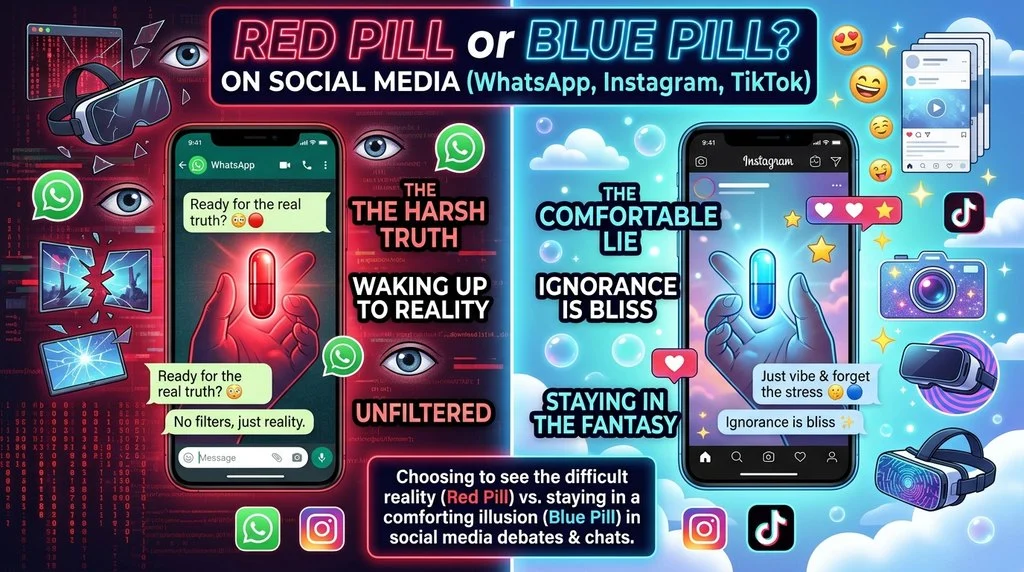
In online messaging, “red pill or blue pill” is usually a metaphorical question. Someone may ask it to start a conversation, create a poll, share a meme, or invite another person to choose between two possibilities.
The exact meaning depends on the message, the people involved, and the topic being discussed.
Meaning in Chat Messages
In a private chat, the phrase can introduce a hypothetical choice or a discussion about honesty.
Example:
Person A: “Would you want to know what people really say about you?”
Person B: “Red pill. I’d rather know the truth.”
Here, the red pill represents a preference for knowing something, even if the information might hurt.
Another example:
Person A: “Red pill or blue pill: know your future or let life surprise you?”
Person B: “Blue pill. I like surprises!”
In this case, the expression is simply a playful conversation starter.
Meaning on WhatsApp
On WhatsApp, someone might send the phrase in a group chat, status update, forwarded meme, or personal message.
For example:
- “Red pill or blue pill? Would you change one decision from your past?”
- “Blue pill today. I don’t need any more stress!”
- “Red pill: learn the truth, even if it hurts.”
These messages generally encourage discussion or express a personal attitude. If someone sends only the phrase without explanation, it is reasonable to ask what they mean.
Meaning on Instagram
Instagram users may include the phrase in Reels, captions, Stories, or polls. A creator might use it to compare two lifestyles, reveal an unexpected fact, or discuss a relationship issue.
For example, a Reel could ask whether someone would rather discover a partner’s hidden feelings or remain unaware of them.
The phrase can also appear in content about fashion, fitness, money, self-improvement, or popular culture. Not every use is political or connected to dating ideology.
Meaning on TikTok
On TikTok, the expression may appear in skits, reaction videos, fictional scenarios, and opinion-based content. Creators sometimes use it as a dramatic way to introduce a controversial claim or an unexpected conclusion.
For example, a video might present two hypothetical choices and ask viewers to comment “red pill” or “blue pill.”
Because short videos often remove context, viewers should distinguish between entertainment, personal opinion, and factual information. A confident creator is not necessarily a reliable source.
How to Understand the Intended Meaning
When you encounter the phrase online, consider three things:
- The topic: Is the conversation about a movie, a relationship, a political belief, or a joke?
- The tone: Is the person being serious, sarcastic, playful, or confrontational?
- The explanation: Does the person provide evidence or simply present a personal opinion?
These clues help you understand the message without assuming that every use has the same meaning.
5. Meaning in Physics, Medical, and Aircraft Terminology
Although “red pill or blue pill” is a recognizable cultural expression, it is not a universal technical term in physics, medicine, or aviation. Its interpretation in these fields requires attention to the specific situation.
Red Pill or Blue Pill in Physics
In physics, the phrase does not have a standard scientific definition. Red and blue may represent different things in diagrams, experiments, or educational illustrations, but the colors alone do not establish a universal meaning.
For example, red and blue may be used to distinguish positive and negative values, different energy levels, magnetic field directions, or separate objects in a diagram. The intended meaning depends on the legend, notation, and scientific model.
In optics and astronomy, red and blue light are associated with different wavelengths. Blue light has shorter wavelengths than red light in the visible spectrum. In astronomy, redshift and blueshift describe changes in the observed wavelength of light, often related to relative motion or the expansion of the universe.
However, these scientific concepts are separate from the movie metaphor. Choosing a red pill or blue pill is not a recognized physics experiment or general scientific principle.
Red Pill or Blue Pill in Medicine
In medicine, red and blue pills do not have universal meanings. Medication colors vary by manufacturer, dosage, formulation, and product design. Two pills with the same color may contain entirely different substances.
For example, a red tablet might be one type of medication, while another red tablet might contain a completely different ingredient. Color alone cannot safely identify a medicine.
The phrase may also appear in health-related jokes, educational discussions, or informal conversations about difficult medical decisions. In such cases, it is usually a metaphor rather than an official medical term.
Important: Never take an unidentified tablet based on its color or an online description. Use the labeled packaging and consult a pharmacist or qualified healthcare professional if you are unsure about a medication.
Red Pill or Blue Pill in Aircraft Terminology
In aviation, “red pill or blue pill” is not a standard aircraft component, flight procedure, or universally recognized technical expression.
Aircraft systems do use color coding in some displays, warning indicators, controls, and diagrams. However, those colors have meanings defined by the specific system and applicable procedures.
For example, a red warning indicator may signal a serious condition, while blue may identify a particular system or status on some aircraft displays. The precise meaning varies by aircraft design and manufacturer.
Pilots and maintenance personnel must follow the aircraft’s approved documentation and training rather than interpret an indicator based on a general color association.
Why Context Matters in Technical Fields
The cultural expression is useful as a metaphor, but it should not replace established technical terminology. In scientific, medical, and aviation settings, the correct interpretation comes from verified definitions, system documentation, and the situation in which the colors appear.
6. Common Misconceptions About the Red Pill or Blue Pill
Several misunderstandings surround the expression because its original meaning differs from some modern online uses.
Misconception 1: The Red Pill Always Represents the Truth
The red pill symbolizes discovering what someone believes to be the truth. However, a person can accept incorrect information and still believe they have uncovered a hidden reality.
A claim should be evaluated using reliable evidence, not simply because it is presented as secret or controversial.
Misconception 2: The Blue Pill Means Being Weak
Choosing the blue pill does not automatically make someone weak, unintelligent, or dishonest. In the original metaphor, it represents remaining in a familiar reality.
In real life, people may reasonably choose privacy, emotional boundaries, or a peaceful approach to a situation. They do not have to investigate every uncomfortable question.
Misconception 3: The Phrase Is Only About Dating
Dating discussions are one important modern use, particularly in certain online communities. However, the phrase also appears in conversations about movies, politics, economics, philosophy, personal growth, and everyday decisions.
Its meaning should be understood from the context rather than assumed in advance.
Misconception 4: Taking the Red Pill Makes Someone More Intelligent
The phrase can describe a change in perspective, but it is not proof of intelligence or expertise. Learning requires questioning claims, examining evidence, recognizing uncertainty, and correcting mistakes.
A person who challenges a popular opinion is not automatically right. Similarly, an accepted belief is not automatically wrong.
Misconception 5: Red Pill and Blue Pill Are Official Psychological Categories
These expressions are cultural metaphors, not universal psychological diagnoses or scientifically established personality types. They may be used to describe attitudes, but they should not be treated as formal mental-health classifications.
Misconception 6: Everyone Uses the Phrase in the Same Way
Meaning changes across communities. A movie fan may use it as a reference to The Matrix, a social media user may use it in a meme, and a member of an ideological community may use it to describe a specific worldview.
The best way to interpret the phrase is to examine the speaker’s explanation, the surrounding discussion, and the evidence behind any factual claims.
7. Similar Terms and Alternatives
Several expressions communicate ideas similar to the red pill or blue pill metaphor. However, they are not exact synonyms because each has a slightly different meaning.
| Expression | Meaning | Typical Use |
|---|---|---|
| Wake-up call | An event that makes someone recognize a problem | Work, health, relationships |
| Eye-opener | Something that reveals surprising information | Education and everyday life |
| Reality check | Information that corrects unrealistic expectations | Personal decisions and work |
| Hard truth | A fact that may be difficult to accept | Serious conversations |
| Rose-colored glasses | A tendency to see things too positively | Relationships and expectations |
| Rabbit hole | A topic or investigation that becomes increasingly involved | Internet research and hobbies |
| Paradigm shift | A major change in the way something is understood | Science, business, and philosophy |
| Seeing the light | Realizing or understanding something | Everyday conversation |
| Confirmation bias | Favoring information that supports existing beliefs | Psychology and critical thinking |
Which Alternative Should You Use?
Use “eye-opener” when an experience teaches you something unexpected.
Example: “That documentary was a real eye-opener.”
Use “reality check” when someone needs to reconsider unrealistic expectations.
Example: “The cost of repairs gave us a reality check.”
Use “hard truth” when the information is difficult to accept.
Example: “The hard truth was that the project needed more time.”
Use “paradigm shift” when describing a substantial change in a person’s understanding or an established framework.
Example: “The new research led to a paradigm shift in the field.”
These alternatives are particularly useful in professional writing because they can communicate the intended idea without the ideological associations that “red pill” sometimes carries.
8. How to Respond to “Red Pill or Blue Pill?”

Your response should depend on what the other person means. The phrase can be a harmless question, a philosophical prompt, a dating-related statement, or an attempt to start a controversial debate.
If Someone Asks Casually
Keep your answer simple and friendly.
Examples:
- “Red pill. I prefer knowing the truth.”
- “Blue pill. Sometimes peace matters more.”
- “It depends on the situation!”
- “What are the two choices in this case?”
The final response is especially useful when the person has not explained the options.
If Someone Sends It as a Joke
You can respond with humor.
Examples:
- “Can I choose a third option?”
- “I’ll take the one that comes with coffee!”
- “Depends on whether either option includes a nap.”
- “I need the terms and conditions first.”
These replies work well in casual chats, group messages, and social media comments.
If Someone Uses It in a Dating Conversation
If the question concerns relationships, explain your values without making the conversation unnecessarily confrontational.
Examples:
- “I’d rather have honesty and mutual respect.”
- “I believe in judging people by their actions.”
- “Truth matters, but assumptions aren’t facts.”
- “I’d choose an honest conversation over guessing.”
These responses focus on communication rather than treating relationships as a competition between two opposing groups.
If Someone Uses It to Promote a Controversial Claim
You do not have to accept the claim simply because it is described as a hidden truth.
You could say:
- “What evidence supports that idea?”
- “I understand your perspective, but I’d like to see reliable sources.”
- “Could there be another explanation?”
- “Let’s separate personal opinions from verifiable facts.”
If the conversation becomes insulting or hostile, it is reasonable to disengage. You can disagree without turning the discussion into an argument.
A Simple Rule for Responding
First, identify what the speaker is asking. Then decide whether you want to answer seriously, respond humorously, ask for clarification, or set a boundary.
There is no universally correct pill to choose. A thoughtful response depends on the question, the available evidence, and your own values.
9. Differences Between the Red Pill, Blue Pill, and Similar Concepts
Although the two pills are often presented as opposites, their meanings are more nuanced than a simple choice between intelligence and ignorance.
Red Pill vs. Blue Pill
The red pill generally represents a willingness to discover a different understanding of reality. The blue pill represents remaining with a familiar understanding.
In the movie, the distinction is central to the story. In ordinary conversation, however, people may use the terms loosely or humorously.
Neither label guarantees that a person’s beliefs are accurate.
Red Pill vs. Wake-Up Call
A red pill moment is often described as a change in perspective. A wake-up call is usually a specific event or warning that makes someone recognize a problem.
For example, learning about a company’s hidden practices might be described as a red pill moment, while receiving a serious warning about poor performance might be called a wake-up call.
Blue Pill vs. Ignorance
The blue pill can symbolize remaining unaware in the original movie metaphor, but choosing not to investigate something is not always the same as ignorance.
People have limited time and energy. They can make reasonable decisions about which information deserves their attention.
Red Pill vs. Critical Thinking
Critical thinking means evaluating information carefully, examining evidence, and considering alternative explanations. The red pill is a metaphor for discovering a new perspective.
The two ideas are not interchangeable. A person may claim to have taken the red pill while rejecting evidence that challenges their preferred explanation.
Critical thinking is valuable precisely because it allows people to question both familiar beliefs and supposedly hidden truths.
The Main Difference
The red pill and blue pill describe a symbolic choice. Terms such as “critical thinking,” “confirmation bias,” and “reality check” describe more specific ideas or processes.
Understanding these distinctions makes it easier to use the phrase accurately and avoid oversimplifying complicated discussions.
10. Relevance in Online Conversations and Dating Apps
The red pill or blue pill metaphor remains recognizable in online culture because it provides an easy way to frame a choice. Dating apps, discussion forums, short-video platforms, and relationship communities often use it to invite reactions.
However, its meaning can change considerably depending on the community.
In Dating Apps
Someone might use the phrase in a profile prompt or opening message to ask about honesty, attraction, relationship expectations, or personal values.
For example:
“Red pill or blue pill: Would you rather hear an honest answer or a comforting answer?”
This question may help start a discussion about communication styles. A thoughtful reply could be:
“I value honesty, as long as it’s communicated with kindness.”
Another person might use the phrase to discuss gender roles, dating strategies, or relationship expectations. In that situation, it is worth asking what they mean instead of assuming their beliefs based on the phrase alone.
In Online Relationship Communities
Some online communities use “red pill” to describe a particular approach to dating, masculinity, or gender relations. These communities are not all identical, and their views can range from ordinary self-improvement advice to rigid or antagonistic claims about relationships.
The phrase can therefore carry more ideological weight than it does in a movie discussion or casual meme.
A useful approach is to evaluate the actual message. Does the person emphasize mutual respect, responsibility, and communication? Or do they rely on broad stereotypes and unsupported claims about entire groups?
The wording alone cannot answer these questions, but the surrounding content can provide important clues.
In Memes and Viral Discussions
Online creators frequently use the two pills to present exaggerated choices. These formats encourage users to comment, share opinions, and compare priorities.
For example, a meme might ask whether someone would rather have unlimited money or unlimited free time. The format is designed to encourage participation, not necessarily to make a serious philosophical point.
Why Understanding Context Matters
The phrase can be entertaining, thought-provoking, or controversial. On dating apps, it may reveal something about a person’s communication style, but one phrase is not enough to judge their entire character.
If the conversation matters to you, ask follow-up questions and look at how the person treats others. Respectful communication, consistency, and honesty are more meaningful indicators of relationship compatibility than a label alone.
Conclusion
The phrase “red pill or blue pill” began as a memorable choice in The Matrix and developed into a widely used expression about truth, awareness, comfort, and personal perspective.
Today, it appears in everyday conversations, WhatsApp messages, Instagram posts, TikTok videos, memes, professional discussions, and dating communities.
The red pill generally represents discovering information that may challenge existing beliefs, while the blue pill symbolizes remaining with a familiar perspective.
However, neither choice automatically determines whether someone is intelligent, informed, or correct. Modern online communities have also given the phrase additional meanings, particularly in discussions about dating, gender roles, and ideology.
When you encounter the expression, pay attention to the topic, the speaker’s intention, and the evidence behind any claims. You can respond seriously, humorously, or with a question if the meaning is unclear.
Ultimately, the most useful approach is to remain curious, think critically, and distinguish verified information from personal opinions.