
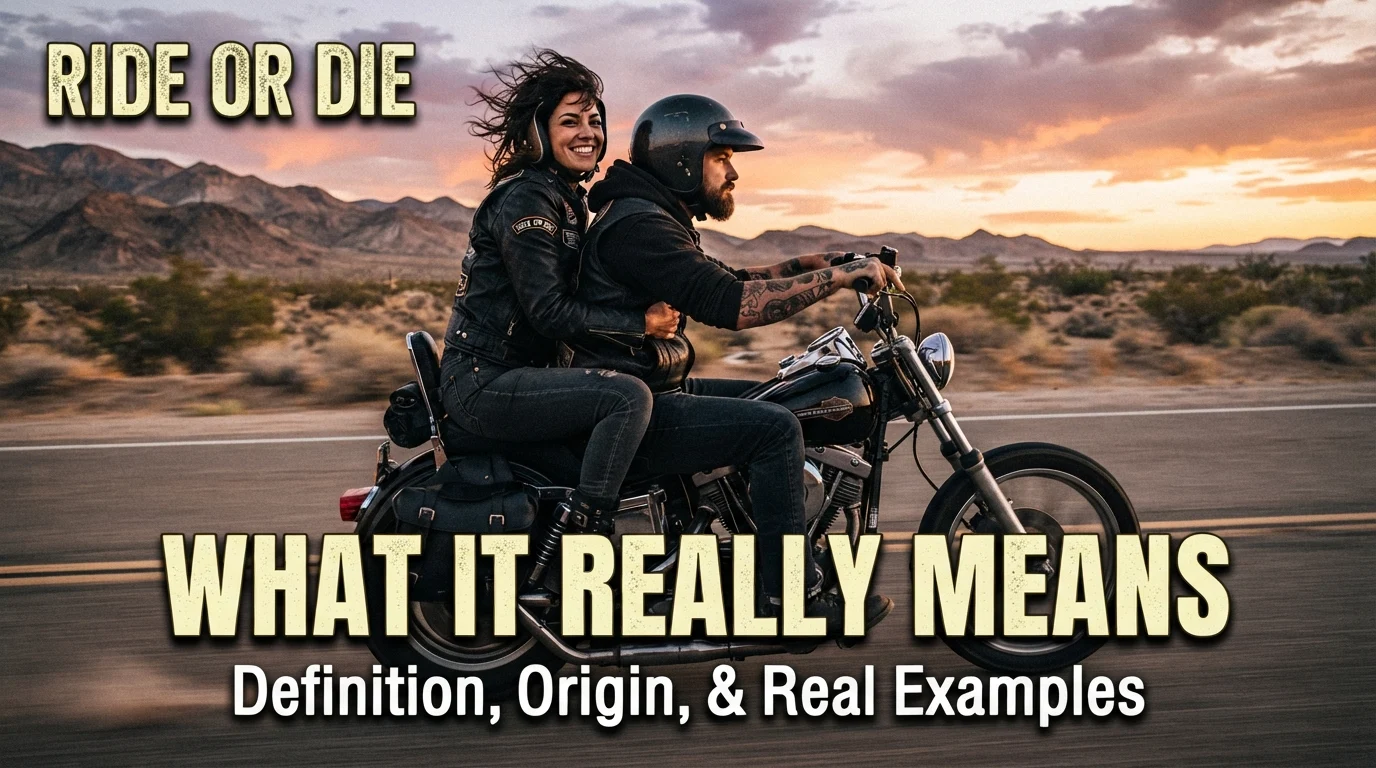
The phrase “ride or die” is a popular expression used to describe someone who stays loyal, supportive, and committed through both good times and bad. It often refers to a close friend, romantic partner, family member, or anyone who stands by another person when life becomes difficult. If someone calls you their “ride or die,” they are usually expressing trust, affection, and a strong emotional connection.
People frequently search for this phrase because they encounter it in text messages, Instagram captions, TikTok videos, relationship discussions, and everyday conversations. Although it sounds simple, its meaning can change slightly depending on the situation. In a friendship, it may describe a dependable best friend. In a romantic relationship, it can suggest a partner who remains faithful and supportive during challenges.
Understanding this expression helps you recognize the feelings behind it and respond appropriately. This guide explains its definition, background, online usage, relationship meaning, similar expressions, and common misunderstandings, with practical examples you can use in real conversations.
1. Meaning and Definition of Ride or Die
The expression “ride or die” describes a person who remains loyal to someone, even when circumstances become difficult. It communicates a willingness to offer support, stand together, and maintain a strong bond during challenges.
In simple words, a ride-or-die person is someone you can count on when things are going well and when everything seems to go wrong.
What Does Ride or Die Mean in Simple English?
It generally means a loyal person who stands by you through thick and thin. This person does not disappear when you face problems or need emotional support.
For example, imagine that you lose your job and feel discouraged. Your closest friend checks on you, listens to your worries, and helps you look for new opportunities. You might describe that friend as your ride or die because they support you when you need them most.
Examples of the Phrase
- Friendship: “Sarah is my ride or die. She has supported me since childhood.”
- Romantic relationship: “I finally found my ride-or-die partner.”
- Family: “My brother is my ride or die because he always has my back.”
- Social media: “My ride or die since day one! ❤️”
- Everyday conversation: “No matter what happens, we are ride or die.”
Does It Always Mean Romantic Love?
No. Although the phrase is common among couples, it is not limited to romantic relationships. People use it for best friends, siblings, parents, teammates, and other trusted individuals.
The central idea is loyalty rather than romance. The relationship determines whether that loyalty is expressed as friendship, love, family commitment, or mutual support.
It is also worth remembering that loyalty does not mean agreeing with every decision someone makes. A genuinely supportive person can disagree with you, offer honest advice, and encourage you to make better choices.
2. Background and Origin of the Expression
“Ride or die” has roots in American slang and is strongly associated with loyalty, solidarity, and commitment. The phrase combines two powerful ideas: continuing to ride alongside someone and being willing to face serious consequences rather than abandon them.
The word “ride” can suggest traveling together, staying alongside a companion, or remaining part of the same journey. The word “die” adds intensity by suggesting an extreme level of commitment. Together, the words communicate a bond that someone considers exceptionally strong.
How Did the Phrase Become Popular?
The expression has been associated with motorcycle culture, street culture, music, and entertainment. It became especially recognizable through hip-hop and R&B music, films, and discussions about relationships and personal loyalty.
Over time, its meaning expanded beyond its more intense associations. People began using it in everyday situations to describe their closest friends, dependable partners, and trusted companions.
Today, someone might use the phrase to describe a friend who helps them move apartments, a partner who supports their ambitions, or a sibling who stays by their side during a family crisis.
How Social Media Changed Its Meaning
Social media has helped make the expression more casual and widely recognizable. Instead of suggesting extreme sacrifice, it often communicates affection, trust, and a lasting connection.
For instance, a person might post a photograph with their best friend and write:
“My ride or die since high school. Nothing but love for you! ❤️”
In this example, the phrase expresses years of friendship rather than a literal willingness to face death.
Has Its Meaning Changed Over Time?
Its central meaning—strong loyalty—has remained recognizable, but its everyday use has become broader. It can now describe anything from a lifelong friendship to a partner who provides consistent emotional support.
The expression can also be used humorously. Someone might call their favorite coffee shop their “ride or die” because they visit it every morning.
The important point is context. The same phrase can express deep commitment, casual affection, or playful enthusiasm, depending on who says it and how they say it.
3. Usage in Different Contexts
The expression appears in many settings, but its tone depends on the relationship between the speakers and the situation.
In Friendships
Among friends, it describes someone dependable who remains present during difficult times. This might be the person who listens to your problems, celebrates your success, and tells you the truth when you need advice.
Example: “We’ve been friends for ten years. He’s my ride or die.”
Here, the speaker emphasizes a long-lasting friendship built on trust.
In Romantic Relationships
Couples use the expression to describe a partner who offers loyalty, affection, and commitment.
Example: “I want someone who will be my ride or die through every stage of life.”
The statement suggests a desire for a dependable relationship rather than one that exists only when life is easy.
However, the phrase alone does not prove that a relationship is healthy or permanent. Consistent behavior matters more than an affectionate label.
In Family Relationships
Family members may use the phrase to recognize the support they receive from relatives.
Example: “My sister is my ride or die. She always stands up for me.”
It can communicate appreciation for a family bond that remains strong despite disagreements or challenges.
In Professional Settings
The phrase is much more informal than standard workplace language. Coworkers might use it jokingly when discussing a trusted teammate, but it is usually unsuitable for formal reports, business proposals, or professional correspondence.
Example: “Jake is my ride or die on this project.”
Among close colleagues, this may mean that Jake is a dependable collaborator. In a formal email, however, “Jake is a reliable and trusted colleague” would communicate the same idea more professionally.
In Entertainment and Pop Culture
Movies, songs, and television shows often use the phrase to portray intense loyalty between friends, partners, or companions. In these settings, it may suggest that people will face danger or hardship together.
Its meaning can be dramatic, romantic, humorous, or serious depending on the story.
4. Meaning in Chat, WhatsApp, Instagram, and TikTok
In online conversations, “ride or die” is usually a quick way to express closeness and loyalty. Its informal tone makes it suitable for messages, captions, comments, and short videos.
Meaning in Chat Messages
When someone sends you this phrase in a message, they are often saying that you are important to them and that they value your relationship.
Examples:
- “You’re my ride or die.”
- “Best friends forever, ride or die.”
- “That’s my ride or die right there.”
- “Ride or die till the end ❤️”
Depending on the conversation, the message might be affectionate, playful, or emotionally serious.
Meaning on WhatsApp
On WhatsApp, the phrase commonly appears in private messages, group chats, and status updates.
For example:
“Thanks for always being there for me. You’re my ride or die! 🫶”
This message expresses gratitude and appreciation for someone’s continued support.
If a friend sends you the phrase unexpectedly, it usually signals that they consider your relationship meaningful. Still, the surrounding conversation can help you understand whether they mean it romantically or platonically.
Meaning on Instagram
On Instagram, people often use the phrase in captions for photographs with friends, partners, siblings, or other loved ones.
Example caption:
“My favorite person and my ride or die. ❤️🔐”
The combination of affectionate wording and heart emojis emphasizes closeness and loyalty.
It may also appear in comments such as “Ride or die forever!” or “That’s my girl!”
Meaning on TikTok
TikTok users may use the expression in videos about best friends, couples, relationship struggles, shared memories, or loyalty tests.
A video showing two friends supporting each other during a difficult experience might use the phrase as a caption. A couple may use it to describe their commitment to facing life’s challenges together.
The expression can also be humorous, such as calling a favorite snack or comfort show a ride or die.
Common Emojis Used With the Phrase
- ❤️ Red heart: love and affection.
- 🫶 Heart hands: appreciation and emotional closeness.
- 🔐 Locked: trust or commitment.
- 🤞 Crossed fingers: hope and support.
- 🥹 Pleading face: emotional appreciation.
Emojis help communicate tone, but they do not establish the exact nature of a relationship. The words and surrounding context remain important.
5. Meaning in Physics, Medical, and Aircraft Terminology
“Ride or die” is an informal expression, not a recognized technical term in physics, medicine, or aviation. Nevertheless, people may encounter the words “ride” or “die” separately in these fields.
Understanding the distinction helps prevent confusion when interpreting technical material.
Ride or Die Meaning in Physics
In physics, “ride or die” does not have an established scientific definition.
The word “ride” might appear in everyday descriptions of motion, transportation, or an object moving with another object. The word “die” has several unrelated meanings in engineering and manufacturing, where a die can be a tool used to shape, cut, or form materials.
For example, a manufacturing textbook might discuss a cutting die. That use has nothing to do with personal loyalty.
If someone uses “ride or die” in a physics discussion, it is probably a joke, metaphor, or casual expression rather than a technical concept.
Ride or Die Meaning in Medical Terminology
The phrase is not a standard medical diagnosis, treatment, procedure, or clinical term.
Medical professionals may discuss patients who need continuous support or family members who remain involved during treatment. Someone might informally call a supportive caregiver their ride or die, but that is ordinary conversational language.
For example: “My best friend came to every appointment. She’s my ride or die.”
This sentence describes emotional support. It does not identify a medical condition or treatment.
Ride or Die Meaning in Aircraft Terminology
In aviation, “ride or die” is not an official aircraft component, flight maneuver, navigation procedure, or standard safety term.
The word “ride” can refer informally to a flight or passenger experience. Meanwhile, “die” can appear in ordinary discussions about fatal accidents, but the combined phrase does not carry a defined aviation meaning.
Aviation professionals generally use precise terminology when discussing aircraft operations, passenger safety, equipment, and emergencies.
Why Context Matters
If you see this expression in a technical conversation, consider whether the speaker is using slang or discussing a separate technical meaning of one of its words.
Do not interpret the phrase as a scientific or professional term without supporting context. Its established everyday meaning concerns loyalty and commitment.
6. Common Misconceptions About Ride or Die
Although the expression sounds straightforward, people sometimes misunderstand what it communicates.
Misconception 1: It Always Refers to a Romantic Partner
This is incorrect. The phrase can describe a romantic partner, but it also applies to close friends, family members, and trusted companions.
For example, someone might call their childhood best friend their ride or die without any romantic feelings.
Misconception 2: It Means Supporting Every Decision
Loyalty does not require unconditional agreement. A trusted friend can care about you while disagreeing with your choices.
For example, if you are considering a harmful decision, a loyal person may challenge you and encourage you to choose a safer path.
Healthy support involves honesty as well as affection.
Misconception 3: It Requires Sacrificing Everything
The phrase can suggest intense commitment, but its everyday use is often figurative. Most people use it to express trust and dependability rather than a literal willingness to die.
A strong relationship should not require someone to endanger their life, ignore their needs, or abandon their personal boundaries.
Misconception 4: It Guarantees a Relationship Will Last Forever
Calling someone your ride or die communicates how you feel at that moment. It cannot guarantee that the relationship will never change.
Relationships develop through communication, mutual respect, trust, and consistent actions over time.
Misconception 5: It Always Has a Serious Meaning
Online, the phrase can be playful or exaggerated.
For example, “Pizza is my ride or die” simply means that the person loves pizza and depends on it for comfort or enjoyment.
The tone may be humorous rather than emotional.
The Healthier Interpretation
The most useful way to understand the expression is as a statement of strong loyalty and support. In a healthy relationship, that loyalty exists alongside honesty, independence, safety, and respect.
7. Similar Terms and Alternatives
Several expressions communicate ideas similar to “ride or die,” although their emotional intensity and everyday uses differ.
| Expression | Meaning | Example |
|---|---|---|
| Through thick and thin | Staying supportive during good and bad times | “We’ll stick together through thick and thin.” |
| Got your back | Being ready to help or defend someone | “Don’t worry; I’ve got your back.” |
| Day one | Someone who has been there since the beginning | “She’s been my friend since day one.” |
| Bestie | A close friend or best friend | “My bestie knows everything about me.” |
| Soulmate | Someone with whom you feel a deep connection | “I feel like he’s my soulmate.” |
| Loyal friend | Someone who remains trustworthy and supportive | “She’s a loyal friend.” |
| Partner in crime | A companion for fun, mischief, or shared activities | “You’re my partner in crime.” |
| Down for you | Willing to support or stand by someone | “I know you’re always down for me.” |
Which Alternative Should You Use?
Choose an expression based on what you want to communicate.
Use “I’ve got your back” when you want to reassure someone that you will help them. Choose “through thick and thin” when describing a relationship that has survived difficult experiences.
“Day one” works well for a longtime friend, while “partner in crime” is often more playful.
“Ride or die” is especially useful when you want to communicate a strong combination of affection, loyalty, and commitment.
In professional situations, alternatives such as “trusted colleague,” “reliable teammate,” or “dependable partner” are generally more appropriate.
8. How to Respond When Someone Calls You Their Ride or Die
Your response depends on who says it, the situation, and how you feel about the person.
If someone uses the phrase affectionately, you can respond warmly without making the conversation awkward.
If Your Best Friend Says It
You can acknowledge the friendship and return the affection.
Examples:
- “Always! You’ve got me.”
- “You’re my ride or die too! ❤️”
- “Best friends through thick and thin.”
- “Wouldn’t trade our friendship for anything.”
- “Day one and forever!”
These responses work well in casual messages and social media comments.
If Your Romantic Partner Says It
If you feel the same way, respond with affection and reassurance.
Examples:
- “And you’re mine, always. ❤️”
- “I’m grateful to have you by my side.”
- “Together through the good and the bad.”
- “You’re my person, and I appreciate you.”
- “We’re a team, no matter what.”
If you are unsure whether the person means it romantically, you do not have to assume. You can reply warmly and see how the conversation develops.
If Someone You Do Not Know Well Says It
A friendly, neutral response can help you acknowledge the comment without suggesting a deeper connection than you intend.
Examples:
- “Haha, that’s sweet of you!”
- “I appreciate that!”
- “You’re too kind.”
- “That’s a strong friendship statement!”
If You Do Not Feel the Same Way
You can be kind without promising a level of commitment you do not feel.
For example: “That means a lot. I’m glad we have a good connection.”
This recognizes the person’s feelings while allowing you to maintain your boundaries.
If You Want to Use Humor
Playful responses can work when the conversation is casual.
Examples:
- “Ride or die, but we’re stopping for snacks.”
- “As long as you pick the playlist!”
- “Loyalty confirmed. Snacks required.”
- “Best duo, no competition!”
The best response is one that feels natural and matches the relationship you actually have.
9. Differences Between Ride or Die and Similar Words
Although several expressions describe loyalty, they do not all mean exactly the same thing.
Ride or Die vs. Best Friend
A best friend is someone with whom you share a close friendship. A ride or die emphasizes the person’s loyalty and willingness to support you during difficult times.
A best friend may also be your ride or die, but the expressions highlight different qualities.
Ride or Die vs. Soulmate
A soulmate is generally someone you feel deeply connected to emotionally or romantically. A ride or die is someone you trust to stand by you.
The two expressions can describe the same person, but they are not interchangeable in every situation. A soulmate emphasizes a profound connection, while a ride or die emphasizes loyalty.
Ride or Die vs. Loyal
“Loyal” is a broad adjective that describes faithfulness, commitment, or dependable support. “Ride or die” is an informal expression that adds a sense of personal closeness and strong commitment.
For example, “He is loyal” is a straightforward description. “He’s my ride or die” sounds more personal and emotionally expressive.
Ride or Die vs. Partner in Crime
A partner in crime is usually a companion who joins you in fun activities, adventures, or harmless mischief. Despite the wording, it does not necessarily suggest criminal behavior.
A ride or die focuses more directly on standing together and remaining supportive.
Ride or Die vs. Through Thick and Thin
Both expressions communicate support during difficult periods. However, “through thick and thin” describes the experience of remaining together through different circumstances, while “ride or die” often labels the person who provides that support.
In short, these expressions overlap, but their emphasis differs. Choosing the right one helps communicate the exact feeling you want to express.
10. Relevance in Online Conversations and Dating Apps
The expression remains useful in digital communication because people often want short, memorable ways to describe loyalty and emotional closeness.
On dating apps, it may appear in profiles, prompts, or messages where someone describes the kind of partner they want.
For example:
“Looking for my ride or die: someone honest, caring, adventurous, and ready to build a life together.”
This suggests that the person values commitment and wants a partner who will remain supportive during life’s ups and downs.
However, the expression can mean different things to different people. One person may use it to describe emotional maturity and dependable support. Another may use it casually to sound romantic or playful.
What Does It Mean When Someone Uses It in a Dating Profile?
It often indicates that the person wants a close relationship based on trust, shared experiences, and loyalty. It may also suggest that they value a partner who is willing to work through disagreements rather than leave whenever problems arise.
Still, a dating profile is only an introduction. The phrase alone cannot tell you whether someone is emotionally available, honest, or compatible with you.
What Does It Mean When Someone Calls You Their Ride or Die While Dating?
The person may be expressing affection, showing appreciation, or indicating that they see you as an important part of their life.
If you want to understand their intentions, consider the overall relationship. Are they consistent? Do they respect your boundaries? Do their actions match their words?
A direct conversation can clarify what commitment means to both of you.
Can the Phrase Be a Red Flag?
Not necessarily. Used in a healthy way, it can express affection and dependable support.
However, it becomes concerning if someone uses loyalty as a reason to demand obedience, control your friendships, excuse harmful behavior, or pressure you into unsafe situations.
Healthy commitment allows both people to remain independent and express disagreement. You can care deeply about someone without accepting every demand they make.
Ultimately, the expression is most meaningful when it describes mutual respect and consistent actions rather than dramatic promises.
Conclusion
The phrase “ride or die” describes a person who remains loyal, supportive, and dependable through life’s challenges. It is commonly used for close friends, romantic partners, family members, and trusted companions. In text messages and on platforms such as WhatsApp, Instagram, and TikTok, it often communicates affection, appreciation, and a strong emotional bond.
Although the expression can sound intense, its everyday meaning is usually figurative rather than literal. It does not necessarily indicate romance, require agreement with every decision, or guarantee that a relationship will last forever. Instead, it highlights the value of having someone who stands beside you when life becomes difficult.
When you encounter this phrase, consider the speaker, the relationship, and the surrounding conversation to understand its intended meaning. Above all, remember that genuine loyalty includes honesty, mutual respect, personal boundaries, and care. A true ride-or-die connection is not just about making promises; it is about consistently showing up for one another in healthy and meaningful ways.