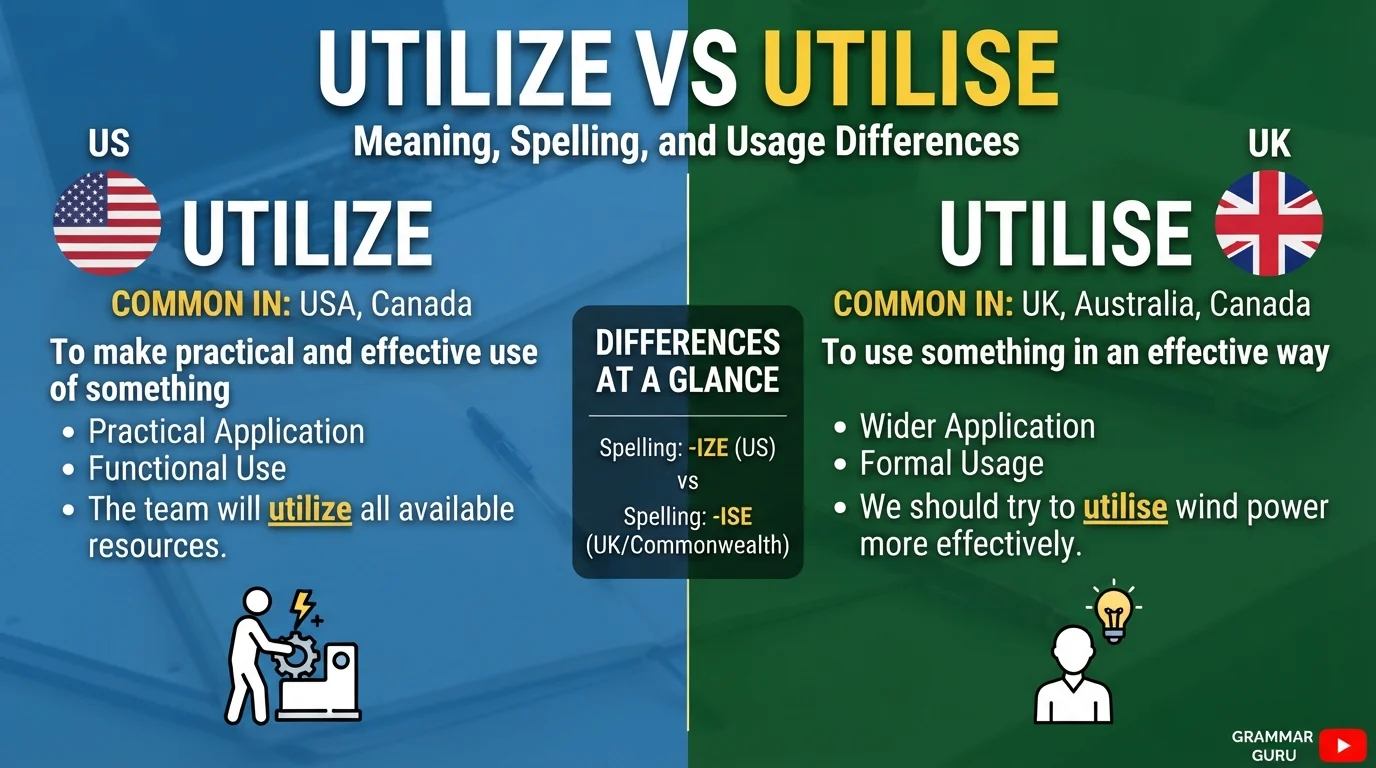
The difference between utilize vs utilise often confuses English learners, writers, students, and professionals. Both words have the same basic meaning: to use something for a particular purpose, especially in a practical or effective way. The main difference is regional spelling. Utilize is the preferred spelling in American English, while utilise is commonly used in British English and other varieties that follow British spelling conventions.
Understanding this difference can help you write more clearly in school assignments, business documents, professional emails, blog posts, and online conversations. Although both spellings are correct, choosing the appropriate version depends on your audience and the style guide you follow. Using consistent spelling throughout a document also makes your writing look more polished and professional.
In this guide, you will learn the definitions, origins, grammatical uses, regional differences, examples, common mistakes, and alternatives for both words. By the end, you will know which spelling to choose and how to use it naturally in different situations.
1. Meaning and Definition
The words utilize and utilise are verbs that mean to use something for a specific purpose or to make practical use of an available resource. They describe actions involving tools, information, skills, equipment, time, or opportunities.
The spelling changes, but the meaning does not.
What Does Utilize Mean?
Utilize is the standard American English spelling. It is commonly used when discussing the practical application of resources, technology, knowledge, or methods.
Examples:
- We should utilize our available resources wisely.
- The company utilizes modern technology to improve productivity.
- Students can utilize online tools to support their learning.
- The research team utilized several methods to collect data.
In these examples, the verb describes how something is put to use for a particular goal.
What Does Utilise Mean?
Utilise is the spelling commonly preferred in British English. It has exactly the same meaning as utilize and follows the spelling pattern found in words such as organise and recognise.
Examples:
- We should utilise our available resources wisely.
- The company utilises modern technology to improve productivity.
- Students can utilise online tools to support their learning.
- The research team utilised several methods to collect data.
The meaning of each sentence remains unchanged.
Quick Comparison
| Feature | Utilize | Utilise |
|---|---|---|
| Meaning | To make use of something | To make use of something |
| Preferred variety | American English | British English |
| Verb form | Utilize | Utilise |
| Past tense | Utilized | Utilised |
| Present participle | Utilizing | Utilising |
| Correct spelling | Yes | Yes |
Quick answer: Use utilize when writing in American English and utilise when following British English conventions. Both spellings are correct, and neither has a different meaning.
2. Background and History
The spelling difference between utilize and utilise reflects a broader pattern in English. American and British English share the same historical roots, but their spelling conventions have developed differently over time.
Both words are connected to the idea of usefulness and ultimately derive from the Latin word utilis, meaning useful. Related forms entered English through historical developments in European languages, including French. Over time, the verb became established in English with the meaning of putting something to practical use.
Why Does American English Use “-ize”?
American English commonly uses the ending -ize in words such as:
- Utilize
- Organize
- Recognize
- Modernize
- Specialize
American spelling conventions generally favor -ize in these words. The spelling is not an error or an informal variation; it is an accepted standard.
Why Does British English Use “-ise”?
British English commonly uses -ise in many of the same words:
- Utilise
- Organise
- Recognise
- Modernise
- Specialise
However, British English also accepts -ize in many words. Therefore, it is not accurate to say that every British publication must use -ise. The preferred form can depend on a publisher’s style guide.
How the Difference Developed
The distinction became more noticeable as American English developed its own spelling conventions and British publishers continued to follow their preferred editorial traditions. American dictionaries and educational resources generally favor utilize, while many British publications favor utilise.
Today, both spellings are widely understood internationally. Readers in the United States can understand utilise, and readers in the United Kingdom can understand utilize without difficulty.
The important lesson is that the difference is primarily about spelling conventions rather than meaning, pronunciation, or grammar.
3. Usage in Different Contexts
Both spellings can be used in everyday writing, education, business, technology, and professional communication. The best choice depends on the English variety you are following.
Academic Writing
Students and researchers often use these verbs when explaining how they apply methods, tools, or information.
American English:
- The researchers utilized a new testing method.
- Students utilize digital libraries for their assignments.
British English:
- The researchers utilised a new testing method.
- Students utilise digital libraries for their assignments.
For academic writing, follow the institution’s preferred spelling conventions.
Business and Professional Communication
In business, both forms can describe how a company uses resources to achieve a goal.
American English:
- We will utilize the available budget more effectively.
- Our team utilizes customer feedback to improve its services.
British English:
- We will utilise the available budget more effectively.
- Our team utilises customer feedback to improve its services.
Consistency matters in proposals, reports, presentations, and professional emails.
Technology and Digital Marketing
Technology professionals may use either spelling when discussing software, data, digital tools, or automation.
Examples:
- The platform utilizes artificial intelligence to organize information.
- The company will utilise automation to reduce repetitive tasks.
For a website targeting American readers, utilize is generally the better choice. For a British audience, utilise may fit the site’s spelling conventions.
Everyday Conversations
Although both words are correct, people often choose the simpler verb use in casual conversation.
For example:
- Formal: Please utilize the new application.
- Natural: Please use the new application.
The word utilize can sound more formal or technical than necessary. Choose it when it adds useful meaning, not merely to make a sentence sound sophisticated.
4. Meaning in Chat, WhatsApp, Instagram, and TikTok
The words utilize and utilise do not have special meanings in messaging applications or social media platforms. Their meanings remain the same as in standard English.
People may use either spelling in captions, messages, comments, posts, and professional profiles.
In WhatsApp Messages
Examples:
- “Please utilize the shared document.”
- “We can utilise the group chat to share updates.”
- “Use this link to join the meeting.”
The first two messages express the same idea. The third uses a simpler, more conversational verb.
On Instagram
These words may appear in educational captions, business posts, marketing advice, or productivity content.
Examples:
- “Utilize your skills to build something meaningful.”
- “Utilise your creativity and make every moment count.”
Neither spelling communicates a different emotion or intention. The choice reflects the writer’s spelling preference or intended audience.
On TikTok
Creators may use these verbs in tutorials, educational videos, productivity tips, and business content.
Examples:
- “Utilize these tips to improve your writing.”
- “Utilise your free time to learn a new skill.”
However, shorter expressions such as “use these tips” are often easier to understand in fast-moving social media content.
Does Either Spelling Have a Special Online Meaning?
No. Neither word is an abbreviation, slang term, emoji code, or platform-specific expression. They do not automatically suggest humor, sarcasm, romance, or a particular mood.
If someone writes utilise instead of utilize, you should generally interpret it as a spelling choice rather than a hidden message.
5. Meaning in Physics, Medical, and Aircraft Terminology
The words utilize and utilise are ordinary English verbs, not specialized technical terms with separate scientific definitions. Nevertheless, they appear in technical writing when explaining how equipment, methods, systems, or resources are used.
In Physics
Physics texts may use either spelling to describe the application of instruments, mathematical methods, or experimental equipment.
Examples:
- The experiment utilizes a laser to measure distance.
- Researchers utilise sensors to collect motion data.
- Engineers utilize mathematical models to predict physical behavior.
These sentences describe practical applications. Neither spelling identifies a different physical principle or formula.
In Medical Writing
Medical professionals may use these verbs when discussing diagnostic equipment, treatment methods, clinical data, or healthcare resources.
Examples:
- The hospital utilizes advanced imaging equipment.
- The research team utilised patient data for an approved study.
- Doctors use diagnostic tests to investigate symptoms.
The choice between utilize and utilise does not change a medical procedure or its meaning. Medical documents should follow the spelling convention required by their organization or publisher.
In Aircraft and Aviation Terminology
Aviation documents may use these verbs to describe the use of aircraft systems, navigation equipment, fuel, or training resources.
Examples:
- Pilots utilize navigation systems to plan routes.
- Engineers utilise simulation software to evaluate aircraft performance.
- The crew uses communication equipment to exchange information.
In aviation, technical precision is essential. A writer should use the correct established terminology when referring to a specific system or procedure rather than treating utilize or utilise as a technical term by itself.
The Main Point
Across physics, medicine, and aviation, both spellings have the same general meaning. The difference is regional spelling, not a change in scientific, medical, or engineering terminology.
6. Common Misconceptions
Several misconceptions make this spelling difference more confusing than it needs to be.
Misconception 1: Utilize Is Correct and Utilise Is Wrong
This is incorrect. Both forms are accepted English spellings. Utilize is preferred in American English, while utilise is common in British English.
Misconception 2: The Two Words Have Different Meanings
They do not. Both mean to make use of something for a particular purpose. The spelling alone does not change the message.
Misconception 3: British English Always Uses “-ise”
Not necessarily. British English accepts many words ending in -ize, and some British dictionaries and publishers prefer that form. Follow the relevant style guide instead of assuming that one rule applies everywhere.
Misconception 4: Utilize Is Always Better Than Use
The word utilize can be appropriate when discussing the practical application of resources or capabilities. However, use is often clearer and more natural.
Compare:
- Wordy: We will utilize the room for the meeting.
- Clear: We will use the room for the meeting.
The longer word does not automatically make the sentence more professional.
Misconception 5: The Spelling Changes Pronunciation
The spelling difference generally does not change the intended pronunciation or meaning. Regional accents may affect how people pronounce the words, but utilize and utilise are not separate concepts.
Misconception 6: Mixing Both Spellings Is Always a Grammar Error
Using both forms in one document is usually a consistency problem rather than a fundamental grammar error. Choose one spelling system for a polished result, especially in formal or published writing.
7. Similar Terms and Alternatives
Several words can replace utilize or utilise. The best alternative depends on the sentence and the intended meaning.
| Alternative | Meaning | Example |
|---|---|---|
| Use | Apply something for a purpose | Use this tool to edit your document. |
| Employ | Use a method, skill, or resource | The team employed a new strategy. |
| Apply | Put a method or idea into practice | Apply this rule to your writing. |
| Leverage | Use an advantage or resource strategically | We can leverage existing data. |
| Harness | Make effective use of a source of power or potential | The system harnesses solar energy. |
| Deploy | Put a resource or system into operation | The company deployed new software. |
| Exploit | Make use of something, sometimes unfairly or harmfully | The attackers exploited a security flaw. |
These words are related, but they are not always interchangeable.
For example, employ may sound appropriate in a formal report, while deploy is useful for describing the rollout of technology. Harness often emphasizes drawing on a source of energy or potential.
The word exploit requires special care because it can suggest taking unfair advantage of a person or situation.
For most everyday sentences, use is the simplest and clearest alternative. Choose utilize or utilise when the context benefits from a more formal emphasis on practical application.
8. How to Respond to or Correct Someone Using Either Spelling
Because both spellings are correct, you generally do not need to correct someone for choosing one over the other.
If someone writes utilise in a message, you can understand it in the same way as utilize. The spelling alone does not require a response or indicate that the person has made a mistake.
If You Are Editing an Article
Check the intended audience and apply the relevant spelling convention.
For an American audience:
- Original: We will utilise the available data.
- Edited: We will utilize the available data.
For a British audience:
- Original: We will utilize the available data.
- Edited: We will utilise the available data.
If Someone Asks Which Form Is Correct
You can explain the difference simply:
“Both spellings are correct. Utilize is preferred in American English, while utilise is common in British English.”
If You Want to Sound More Natural
Consider whether use communicates your meaning more clearly.
Instead of saying, “We should utilize this application,” you can say, “We should use this application.”
The shorter sentence is direct, natural, and easy to understand.
If You Are Writing for an International Audience
Choose one spelling convention and use it consistently. If your organization has a style guide, follow that guide. Consistency is more important than treating one accepted spelling as universally correct.
9. Differences From Similar Words
Understanding related spelling pairs can help you recognize the broader pattern in English.
| American English | British English | Meaning |
|---|---|---|
| Utilize | Utilise | Make use of something |
| Organize | Organise | Arrange something systematically |
| Recognize | Recognise | Identify or acknowledge |
| Modernize | Modernise | Make something more modern |
| Specialize | Specialise | Focus on a particular subject or skill |
| Realize | Realise | Become aware of or understand something |
These pairs demonstrate a common regional spelling variation. However, not every word follows the same pattern, and some British publications accept both -ize and -ise forms.
Utilize vs. Use
Utilize and use have closely related meanings, but their tone can differ.
- Utilize: The department utilizes digital records to improve efficiency.
- Use: The department uses digital records to improve efficiency.
The second sentence is shorter and often preferable. The first may suit a formal or technical discussion when emphasizing practical application.
Utilise vs. Employ
Utilise means to make practical use of something. Employ can express a similar idea, especially when describing methods or strategies.
- The researchers utilised a new technique.
- The researchers employed a new technique.
Both sentences are grammatical and convey similar meanings.
Which Word Should You Choose?
Use utilize for American English, utilise for British-style spelling, and use when you want a simple, direct sentence. Select alternatives according to context rather than length or formality alone.
10. Relevance in Online Conversations and Dating Apps
The difference between utilize and utilise is usually unimportant in casual online conversations. People may use these words in messages about plans, resources, work, study, or personal goals, but they do not carry a special dating-related meaning.
In Dating App Profiles
Someone might write:
- “I utilize my weekends to explore new places.”
- “I utilise my free time to learn new skills.”
Both sentences express the same general idea. Neither spelling automatically reveals a person’s personality, relationship intentions, or level of interest.
However, a simpler version may sound more natural in a dating profile:
“I use my weekends to explore new places.”
This wording is conversational and easy to understand.
In Direct Messages
If someone sends a message containing either spelling, focus on the meaning of the entire message rather than the regional spelling choice.
For example:
- “We can utilize our free time to plan the trip.”
- “We can utilise our free time to plan the trip.”
Both suggest the same plan.
Can Spelling Reveal Where Someone Is From?
Spelling can sometimes suggest which English conventions a person follows, but it is not reliable proof of their nationality or location. People learn English in different countries, use international style guides, and communicate with audiences around the world.
Does Either Word Sound More Romantic?
No. Neither utilize nor utilise is a romantic expression. If you want to sound warm or friendly, the surrounding words matter more than the spelling.
For instance, “Let’s use our weekend to spend some time together” sounds more natural and personal than a sentence built around formal vocabulary.
The main takeaway is simple: understand the message, consider the context, and avoid reading hidden meanings into ordinary spelling differences.
Conclusion
The difference between utilize vs utilise is straightforward once you understand regional English spelling. Both words mean to make use of something for a particular purpose, and neither spelling is universally wrong.
American English generally prefers utilize, while British English commonly uses utilise. Both forms appear in academic writing, business communication, technology, scientific discussions, and everyday text.
When choosing between them, consider your audience, the spelling conventions of your publication, and the style guide you need to follow. If you are writing for American readers, choose utilize. If you are following British spelling conventions, utilise is a natural choice. For simple, conversational writing, use is often the clearest alternative.
Most importantly, remain consistent throughout your document. You do not need to memorize two different definitions because the words have the same meaning. Once you recognize the regional spelling pattern, choosing the correct form becomes easy.