
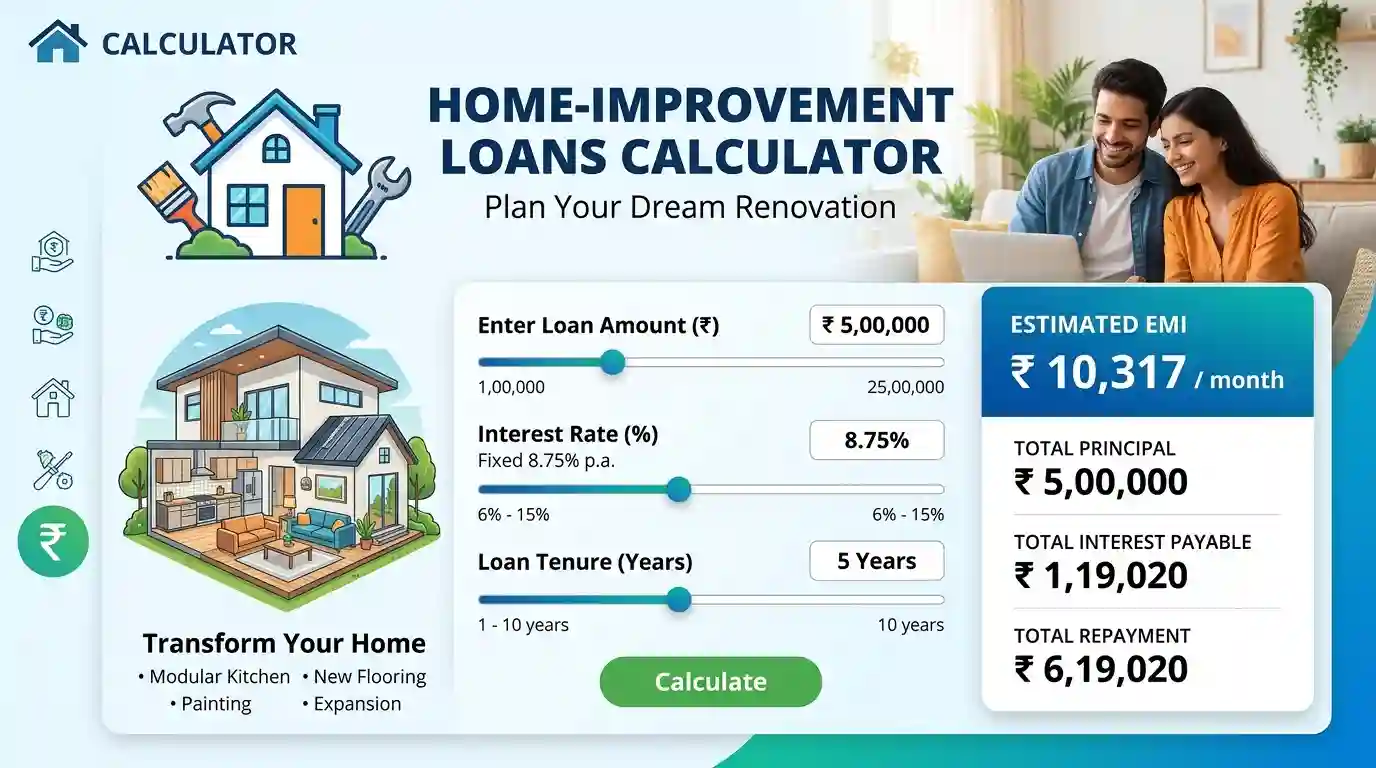
A home improvement loans calculator estimates your monthly payment, interest charges, and total repayment based on your loan amount, interest rate, and repayment term. Enter your expected borrowing amount and loan details to compare financing options, plan your renovation budget, and decide whether the payments fit your finances before applying.
Key Takeaways
- A home improvement loans calculator helps estimate monthly payments and total borrowing costs.
- Your loan amount, APR, and repayment term have the biggest impact on your payment.
- Personal loans, home equity loans, and HELOCs offer different costs and risks.
- Fees and variable interest rates can make actual payments differ from estimates.
- Compare multiple lenders and borrow only what your budget can comfortably support.
Home Improvement Loans Calculator
Introduction
Planning a kitchen remodel, replacing an old roof, or updating your bathroom can be exciting, but the cost can quickly exceed your savings. A home improvement loans calculator helps you estimate the monthly payments, interest charges, and total cost of borrowing before you commit to a renovation project.
Instead of guessing whether a loan fits your budget, you can compare different loan amounts, interest rates, and repayment periods. This makes it easier to understand how much financing you may need and how your monthly expenses could change.
In this guide, you’ll learn how home improvement loan calculators work, how to estimate payments, and which financing options to compare. You’ll also discover how loan terms, fees, and interest rates affect your costs so you can make a more informed decision about financing your home renovation in the United States.
What Is a Home Improvement Loans Calculator?
A home improvement loans calculator is an online tool that estimates the cost of borrowing money for repairs, renovations, and upgrades. You enter your loan amount, annual interest rate, and repayment term to calculate your estimated monthly payment.
Most calculators also show total interest and total repayment over the life of a fixed-rate loan. Some include origination fees and let you compare personal loans, home equity loans, and home equity lines of credit (HELOCs).
Homeowners commonly use these tools when planning projects such as roof replacements, kitchen renovations, bathroom upgrades, new flooring, and energy-efficient improvements.
Remember that a calculator provides an estimate, not a loan approval or a guaranteed offer from a lender.
How to Calculate Home Improvement Loan Payments
To estimate your monthly payment, you need three main details:
- Loan amount: The money you plan to borrow.
- Annual interest rate: The yearly rate charged on the loan.
- Loan term: The time you have to repay the balance.
For a standard fixed-rate installment loan, the monthly payment formula is:
M = P × r × (1 + r)ⁿ ÷ [(1 + r)ⁿ − 1]
Here, M represents the monthly payment, P is the principal, r is the monthly interest rate, and n is the total number of monthly payments.
To calculate r, divide the annual interest rate by 12. Convert the percentage to a decimal first. For example, a 9% annual rate becomes 0.0075 per month.
Home Improvement Loan Example
Suppose you want to borrow $20,000 for a home renovation. Your lender offers a fixed 9% annual interest rate and a five-year repayment term.
| Loan detail | Example |
|---|---|
| Loan amount | $20,000 |
| Annual interest rate | 9% |
| Repayment term | 60 months |
| Estimated monthly payment | $415.17 |
| Total of monthly payments | $24,910.20 |
| Estimated total interest | $4,910.20 |
These figures are illustrative and rounded. They assume equal monthly payments, no additional fees, and a fixed rate.
Your actual payment may differ because of your approved rate, lender fees, payment schedule, and loan structure.
Why Use a Home Improvement Loan Calculator?
A calculator helps you plan a renovation with realistic borrowing costs rather than focusing only on the project price.
Here are its main benefits:
- Plan your monthly budget: Check whether payments fit your income and existing expenses.
- Compare loan terms: See how shorter or longer repayment periods affect monthly costs.
- Estimate interest charges: Understand how much borrowing may cost beyond the original loan amount.
- Set a renovation budget: Adjust the amount you borrow to match your available cash.
- Compare financing options: Evaluate different offers using consistent assumptions.
The Federal Trade Commission and other consumer-protection resources encourage borrowers to review loan terms and costs carefully. You can also consult the U.S. Department of Housing and Urban Development’s home improvement financing guidance.
Compare Home Improvement Financing Options
The right financing method depends on your project cost, credit profile, available home equity, and tolerance for risk.
1. Personal Loans
A personal loan can provide a lump sum for eligible home repairs or renovations. Many personal loans have fixed interest rates, predictable payments, and no home collateral.
However, rates and fees vary by lender and borrower. Compare the APR, repayment period, and total cost before applying.
2. Home Equity Loans
A home equity loan lets eligible homeowners borrow against the equity in their property. It often provides a lump sum with a fixed repayment schedule.
Closing costs and other fees may apply. Because the property secures the loan, missed payments can put your home at risk.
3. Home Equity Lines of Credit
A HELOC provides access to a revolving credit line secured by your home. It may suit renovations completed in stages because you can draw funds as needed during the permitted draw period.
Many HELOCs have variable interest rates, so payments and borrowing costs can change. Review the draw period, repayment period, fees, and rate adjustment terms.
4. Government-Supported Financing
Some homeowners may qualify for government-supported home improvement financing, including FHA Title I Property Improvement Loans through participating lenders. Eligibility, loan limits, and property requirements apply.
Check the official HUD home improvement financing resource for current program information.
Factors That Affect Your Estimated Monthly Payment
Several details can change the result shown by your home improvement loan payment calculator.
Loan amount: Borrowing more generally increases both your monthly payment and total interest when other terms remain unchanged.
Interest rate: A higher rate increases borrowing costs. Your credit history, income, existing debt, loan type, and lender requirements can affect the rate you receive.
Repayment term: A longer term usually lowers the required monthly payment but increases total interest when the rate and other conditions remain the same.
Fees: Origination charges and other costs can increase the amount you pay. Some lenders deduct fees from the proceeds, while others may finance eligible fees.
Rate structure: Fixed-rate loans generally provide predictable principal-and-interest payments. Variable-rate products can become more expensive if rates rise.
For a fair comparison, review both the monthly payment and the total amount you will repay.
Common Mistakes to Avoid
- Looking only at the monthly payment: A low payment may hide a longer repayment period and higher total interest.
- Ignoring the APR: The interest rate alone may not reflect the full cost of borrowing. Compare APRs and fee disclosures.
- Borrowing the entire project estimate: Leave room in your budget for unexpected expenses without taking on unnecessary debt.
- Assuming an estimate guarantees approval: A calculator cannot determine your final eligibility, approved rate, or loan terms.
- Using the wrong loan calculator: A standard installment-loan formula may not accurately model a variable-rate HELOC or a loan with unusual repayment rules.
Before borrowing, compare written offers from several lenders and read the agreement carefully.
Frequently Asked Questions
1. How much would a $10,000 home improvement loan cost per month?
Your monthly payment depends on the interest rate and repayment term. For example, a $10,000 fixed-rate loan at 9% APR over five years would have a payment of roughly $208 per month if the APR and interest rate are equivalent for calculation purposes and no additional fees apply. Your lender’s actual offer may differ.
2. What credit score do I need for a home improvement loan?
Requirements vary by lender and loan type. Some personal loan providers accept applicants with fair credit, while the lowest advertised rates usually require stronger credit profiles. Home equity lenders may also consider available equity, income, existing debt, and payment history.
3. Is a personal loan or home equity loan better for renovations?
A personal loan may suit borrowers who want unsecured financing and fixed payments. A home equity loan may offer different rates or terms but uses your home as collateral. Compare APRs, fees, repayment periods, funding needs, and the risks of each option before deciding.
4. Does a home improvement loan calculator include fees?
Not always. Basic calculators typically estimate principal and interest, while more detailed tools may include origination fees or other charges. Check the calculator’s assumptions and compare its results with the lender’s official disclosures to understand your likely total borrowing cost.
5. Can I calculate payments for a bathroom or kitchen remodel?
Yes. Estimate the total project cost, subtract any cash you plan to contribute, and enter the remaining amount as your proposed loan. Try different rates and terms to see how payments change. Get contractor estimates before finalizing your borrowing budget.
6. Does a longer loan term reduce total interest?
Usually, no. A longer repayment term generally lowers the monthly payment but increases total interest because you repay the balance over more months. Compare both the payment and total repayment amount before choosing a term.
7. Can I use a home improvement loan calculator before applying?
Yes. A calculator is useful for estimating payments and deciding how much you can afford to borrow before contacting lenders. However, it does not replace prequalification, a formal application, or the lender’s review of your credit and financial information.
8. Are home improvement loan payments tax-deductible?
Tax treatment depends on the financing method and how the funds are used. Interest on certain home equity loans may qualify for a deduction when applicable legal requirements are met, including qualifying use to buy, build, or substantially improve the home securing the loan. Personal loan interest generally does not qualify as mortgage interest. Check current IRS guidance or consult a qualified tax professional.
Conclusion
A home improvement loans calculator can help you understand the financial side of a renovation before you borrow. By entering your expected loan amount, interest rate, and repayment term, you can estimate monthly payments, compare repayment schedules, and identify a borrowing amount that fits your budget.
Don’t base your decision on the monthly payment alone. Review the APR, fees, total interest, repayment conditions, and any risks associated with using your home as collateral. Compare personal loans, home equity loans, and HELOCs based on your needs rather than assuming one option suits every homeowner.
Before applying, confirm your project costs with reliable estimates and compare offers from multiple lenders. The best loan is one whose total cost, repayment terms, and monthly payments work for your financial situation.