
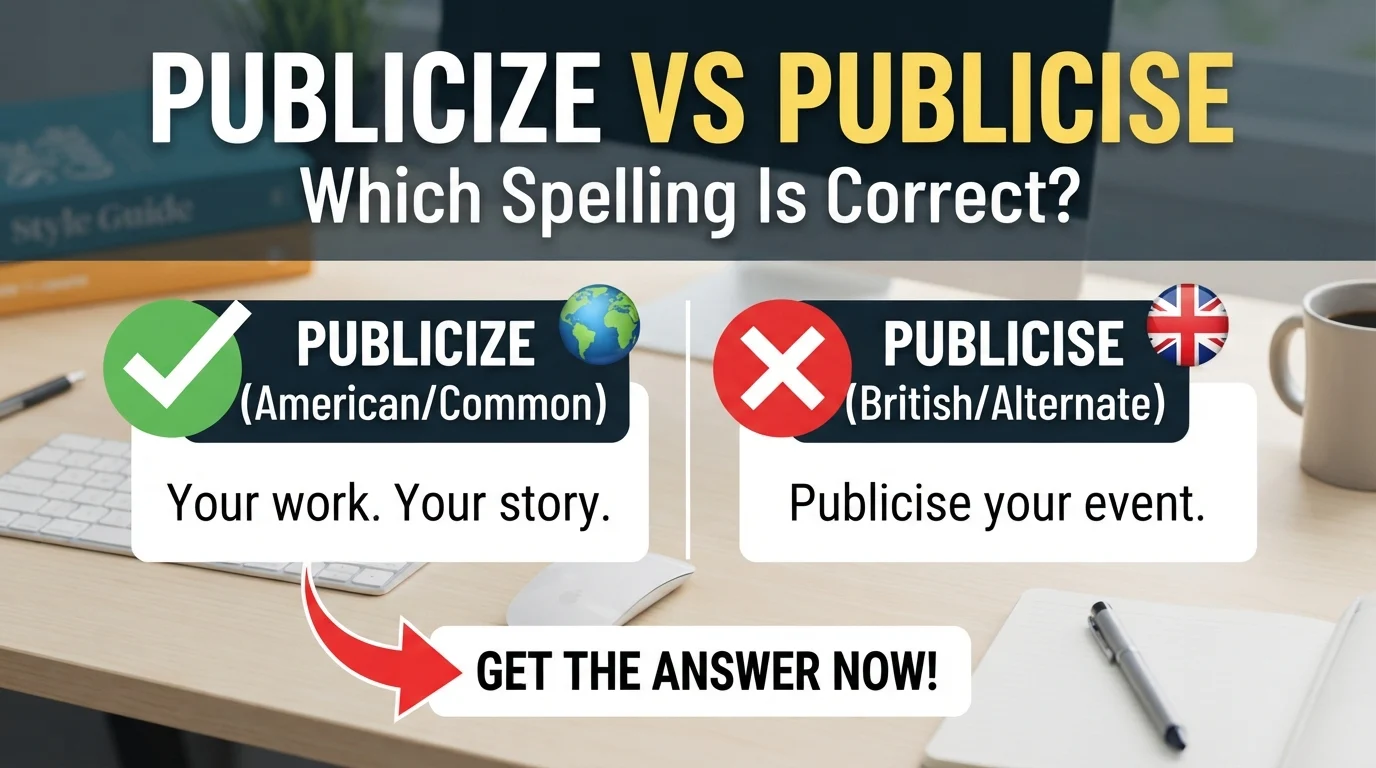
Have you ever wondered whether publicize or publicise is the correct spelling? Both words have the same meaning, but the right choice depends on your audience and the type of English you use.
Publicize is the preferred spelling in American English, while publicise is common in British English. Although the difference is only one letter, choosing the correct form can make your writing look more professional and consistent.
In this guide, you’ll discover the meaning of both words, their spelling differences, real-life sentence examples, and the correct forms to use in business emails, articles, and everyday writing. By the end, you’ll know exactly which spelling to choose.
Key Takeaways
- Publicize is the preferred spelling in American English.
- Publicise is commonly used in British English and other varieties that favor -ise spellings.
- Both words mean to make information, an event, or an activity known to the public.
- Related forms include publicized/publicised and publicizing/publicising.
- For US websites, business emails, and academic writing, choose publicize unless a required style guide specifies otherwise.
What Is the Difference Between Publicize and Publicise?
The difference between publicize and publicise is primarily a matter of spelling, not meaning. Both words describe the act of making something known to a wider audience.
The main distinction is regional preference. American English generally uses publicize, while British English commonly uses publicise. Both spellings can be understood by English speakers around the world.
| Feature | Publicize | Publicise |
|---|---|---|
| Meaning | Make something publicly known | Make something publicly known |
| Preferred US spelling | Yes | Less common |
| British English usage | Accepted | Common |
| Part of speech | Verb | Verb |
| Example | They will publicize the event. | They will publicise the event. |
For example:
- American English: The university will publicize its new scholarship program.
- British English: The university will publicise its new scholarship programme.
Notice that the verb changes its spelling, while the underlying meaning stays the same. The example also uses program in the American sentence and programme in the British sentence.
Meaning of Publicize
The verb publicize means to share information about something so that more people become aware of it. It can refer to an event, a new product, an achievement, a campaign, or an important announcement.
Examples:
- The company plans to publicize its new product.
- The school publicized the upcoming science fair.
- The author hired a publicist to publicize her latest book.
- Local officials publicized the changes to the recycling program.
The word often appears in marketing, public relations, journalism, education, and business communication.
Publicizing something does not always mean paying for an advertisement. It may involve sending a press release, publishing an announcement, sharing news on social media, or informing a community about an important development.
Meaning of Publicise
Publicise has the same meaning as publicize. The spelling is particularly familiar to readers of British English and is also used in other English varieties.
Examples:
- The charity will publicise its fundraising campaign.
- The newspaper publicised the results of the investigation.
- Organizers want to publicise the local arts festival.
- The organization publicised its new community services.
These sentences would have the same meaning if publicise were replaced with publicize. The choice depends on the spelling convention you are following, not on a difference in action or intent.
Is Publicize American or British English?
Both spellings are used in English, but they have different regional preferences.
Publicize is the usual choice in American English. British English commonly uses publicise, although publicize is also accepted in British usage. Some British dictionaries and style guides allow both spellings, so it is not accurate to say that every British writer must use publicise.
Here is a practical comparison:
| English variety | Recommended spelling |
|---|---|
| American English | Publicize |
| British English | Publicise is common |
| Australian English | Publicise is common |
| Canadian English | Publicize is widely used |
| International English | Follow the audience or style guide |
These are general preferences, not absolute rules for every publication or organization. Canadian and other international usage can vary, so check the relevant editorial guidance when consistency is important.
Why Do the Spellings Differ?
Many English verbs have variations involving -ize and -ise. Examples include:
- Organize / organise
- Recognize / recognise
- Realize / realise
- Apologize / apologise
- Publicize / publicise
American English generally favors -ize in these words. British English often favors -ise, although the -ize form is also used in British publications that follow certain dictionary or editorial conventions.
The difference reflects spelling preferences that developed across varieties of English. It does not mean that one form is automatically more correct in every country.
Quick tip: If your audience is in the United States, use publicize. If you are writing for a British publication that prefers -ise, use publicise.
Publicize vs Publicise: Examples in Sentences
Seeing both forms in context makes the difference easier to understand. The following pairs show how the spelling changes without changing the meaning.
| American English | British-style spelling |
|---|---|
| We need to publicize the meeting. | We need to publicise the meeting. |
| The team publicized its achievement. | The team publicised its achievement. |
| They are publicizing a new service. | They are publicising a new service. |
| The school will publicize the results. | The school will publicise the results. |
| The charity wants to publicize its work. | The charity wants to publicise its work. |
Examples in Professional Writing
In a business email:
“We plan to publicize the product launch through our website and newsletter.”
In a news report:
“The organization publicized the findings after completing its review.”
In a school announcement:
“Please publicize the registration deadline so every student has an opportunity to participate.”
In a marketing plan:
“Our team will publicize the campaign through social media, press releases, and community events.”
All four examples use the American spelling. If you are preparing a document for a publication that prefers British spelling, you can replace publicize with publicise and adjust the other relevant word forms.
Publicized vs Publicised and Publicizing vs Publicising
The spelling difference continues in related forms of the verb. If you use publicize, the standard American forms are publicized and publicizing. If you use publicise, the corresponding forms are publicised and publicising.
| American English | British-style spelling | Usage |
|---|---|---|
| Publicize | Publicise | Present-tense verb |
| Publicized | Publicised | Past tense or past participle |
| Publicizing | Publicising | Present participle |
| Publicizes | Publicises | Third-person singular |
Examples:
- US: The company publicized the announcement yesterday.
- UK: The company publicised the announcement yesterday.
- US: They are publicizing the event online.
- UK: They are publicising the event online.
- US: The agency publicizes local programs.
- UK: The agency publicises local programmes.
One common mistake is mixing the two spelling systems in the same document. For example, using publicize in one paragraph and publicised in another may look inconsistent unless you are quoting different sources.
Choose one convention and apply it throughout your writing.
Publicize vs Advertise: Are They the Same?
Although publicize and advertise are related, they do not always mean exactly the same thing.
Publicize means to bring something to public attention. Advertise usually means to promote a product, service, event, or opportunity, often to attract customers or encourage a particular action.
| Word | Meaning | Example |
|---|---|---|
| Publicize | Make something widely known | The university publicized the research findings. |
| Advertise | Promote something to attract interest or customers | The store advertised its weekend sale. |
| Promote | Actively support or increase awareness of something | The team promoted its new community program. |
| Announce | Formally communicate news or information | The company announced its expansion. |
For example, a nonprofit organization might publicize a report about local poverty without trying to sell anything. A business might advertise a product to encourage people to buy it.
Advertising can be one way to publicize something, but publicizing can also involve news coverage, interviews, press releases, or community announcements.
Understanding this distinction helps you select the most accurate word for your sentence.
Common Mistakes to Avoid
Even though publicize and publicise are both accepted spellings, writers sometimes use them incorrectly or inconsistently.
Here are four mistakes to watch for.
1. Assuming publicise is always incorrect
The spelling publicise is common in British English. It is not simply a misspelling. However, publicize is the safer choice for standard American English writing.
2. Mixing spelling conventions
Avoid switching between publicize, publicised, and publicising in your own writing without a clear reason. Choose the spelling system that fits your intended audience.
3. Confusing publicize with advertise
Publicizing means bringing something to public attention. Advertising generally involves promoting a product, service, or opportunity. Use the word that best describes the action.
4. Forgetting related spelling changes
Remember that publicize becomes publicized in the past tense and publicizing in the present participle. The corresponding forms of publicise are publicised and publicising.
Which Spelling Should You Use?
The best spelling depends on your readers and the style guide you follow.
Use publicize if you are writing:
- Articles for an American audience.
- US business emails and reports.
- American school or university assignments.
- Website content targeting US search traffic.
- Marketing materials for US customers.
Use publicise if you are writing for a British audience or following a publication’s preferred -ise spelling convention.
If you manage a website with readers in several countries, consistency is more important than trying to use both spellings. You can choose American English as your site’s standard and use publicize across articles, headings, metadata, and examples.
For US-focused SEO content, publicize vs publicise is a useful comparison keyword because it addresses a clear spelling question. Answer the difference early, provide examples, and use the preferred American spelling naturally throughout the page.
Frequently Asked Questions
Is publicise wrong in American English?
Publicise is recognizable and used in English, but it is less common in standard American writing. If you are writing for US readers, publicize is generally the better choice. Follow any specific spelling rules required by your employer, publisher, or academic institution.
Is publicize accepted in British English?
Yes. Publicize is also used in British English, particularly by writers and publications that prefer -ize spellings. Other British writers prefer publicise. The appropriate choice depends on the dictionary or style guide being followed.
What is the past tense of publicize?
The past tense of publicize is publicized. For example, “The organization publicized the event last week.” The past tense of publicise, commonly used in British English, is publicised.
What are synonyms for publicize?
Common synonyms include announce, promote, advertise, broadcast, circulate, and publicize to a wider audience. The best choice depends on the context. For example, announce suits official news, while advertise is often more appropriate for promoting a product or service.
Should I use publicize or publicise in a US business email?
Use publicize in a US business email unless your organization follows a different spelling standard. For example, write, “We will publicize the upcoming conference through our website and email newsletter.” This follows the usual American spelling convention and sounds natural in professional communication.
Conclusion
When comparing publicize vs publicise, the main difference is regional spelling preference, not meaning. Both words mean to make something known to the public.
However, publicize is the standard choice for American English, while publicise is common in British English and other varieties that favor -ise spellings. If you write articles, business emails, school assignments, or website content for US readers, choose publicize and use its related forms consistently.
Remember that publicized and publicizing follow the American spelling pattern. Once you understand this simple distinction, you can select the right form confidently and make your writing clearer and more consistent.