When searching for employment, you may come across the terms sales or retail jobs. Although these terms are closely related, they describe different aspects of working with customers and selling products or services. Understanding the difference can help you choose a career that matches your skills, interests, and long-term goals.
Sales jobs generally focus on selling products or services, building customer relationships, and meeting sales targets. Retail jobs usually involve working in stores, supermarkets, shopping malls, boutiques, or other businesses that sell products directly to customers. Some positions combine both responsibilities, such as a retail sales associate who helps shoppers select and purchase items.
People often search for this phrase when preparing a resume, completing a job application, exploring career opportunities, or deciding which employment category best describes their experience. In this guide, you will learn what sales and retail jobs mean, how they differ, what responsibilities they involve, and how to choose the right position for your career.
1. Meaning and Definition of Sales or Retail Jobs
Sales or retail jobs are employment opportunities that involve selling products or services, assisting customers, and helping businesses generate revenue. However, the exact responsibilities depend on the position, industry, and workplace.
What Are Sales Jobs?
A sales job involves persuading potential customers to purchase a product or service that meets their needs. Sales professionals may communicate with customers in person, over the phone, through email, or online.
Common sales positions include:
- Sales representative
- Sales associate
- Account executive
- Business development representative
- Inside sales representative
- Outside sales representative
- Sales consultant
- Real estate sales agent
For example, a salesperson working for a software company may contact businesses, explain how a product works, answer questions, and negotiate a contract.
Sales positions often involve specific targets, such as the number of products sold, revenue generated, or new customers acquired. Some employers offer commissions or performance-based bonuses in addition to a basic salary.
What Are Retail Jobs?
Retail jobs involve selling goods directly to consumers, usually through physical stores or online shopping businesses. Retail employees help customers find products, process purchases, maintain displays, and keep the store organized.
Examples include:
- Retail sales associate
- Cashier
- Store assistant
- Department store employee
- Stockroom associate
- Customer service associate
- Store supervisor
- Retail manager
For instance, an employee at a clothing store may help shoppers find the right size, explain return policies, arrange merchandise, and complete purchases at the checkout.
Are Sales and Retail Jobs the Same?
Not exactly. Retail is one area of sales, but sales jobs are not limited to retail environments.
A retail employee might work mainly in a store, while a sales representative could work remotely, visit business clients, or sell services to other companies.
Both career paths require communication, product knowledge, customer service, and problem-solving skills.
2. Background and Development of Sales and Retail Careers
Sales and retail work have developed alongside trade, business, and consumer demand. Although the methods have changed over time, the central purpose remains similar: connecting customers with products or services they want or need.
Traditional Retail Employment
Historically, retail transactions took place in local markets, small shops, general stores, and specialized businesses. Shopkeepers often managed several responsibilities, including selling merchandise, tracking inventory, collecting payments, and maintaining customer relationships.
As cities expanded and businesses grew, department stores and supermarkets created more specialized positions. Employers began hiring cashiers, sales assistants, stock clerks, supervisors, and store managers.
These changes made retail employment accessible to people with different levels of experience and education.
The Growth of Professional Sales
Sales gradually expanded beyond traditional shops. Manufacturers, wholesalers, insurance companies, real estate agencies, and technology businesses began employing dedicated sales professionals.
Instead of simply completing transactions, these workers often needed to understand customer needs, explain complex products, maintain accounts, and develop long-term business relationships.
Professional sales careers became especially important in industries where purchases require consultation, negotiation, or ongoing customer support.
Online Shopping and Modern Employment
The growth of e-commerce has changed how businesses sell products. Customers can now shop through websites, mobile applications, social media platforms, and online marketplaces.
As a result, modern sales and retail jobs may involve:
- Helping customers in physical stores.
- Responding to online product inquiries.
- Managing orders and returns.
- Supporting customers through live chat.
- Updating product listings.
- Using customer relationship management (CRM) software.
- Reviewing sales performance and inventory data.
Some employees work in stores, while others work remotely or in hybrid roles.
Why These Jobs Still Matter
Even as technology changes shopping habits, businesses continue to need people who can answer questions, solve problems, explain product benefits, and provide personal assistance.
Automation may handle certain repetitive tasks, but customer-facing employees remain valuable when shoppers need guidance or when a purchase involves complicated decisions.
For job seekers, this means sales and retail careers can offer entry-level opportunities as well as pathways into supervision, management, training, and business development.
3. Usage in Different Contexts: Chat, Social Media, and Professional Fields
The phrase “sales or retail jobs” is primarily used when discussing employment, career choices, work experience, and job applications. Its meaning can change slightly depending on the context.
In Everyday Conversations
People may use the phrase when asking about someone’s occupation or exploring employment opportunities.
Examples:
- “Are you looking for sales or retail jobs?”
- “I have experience in retail and customer service.”
- “Which sales job would be suitable for a beginner?”
- “I’m applying for retail jobs near my home.”
In these examples, the phrase refers to careers involving selling, assisting customers, or supporting commercial operations.
On Social Media
On platforms such as LinkedIn, Facebook, Instagram, and TikTok, people may discuss sales and retail jobs while sharing vacancies, career advice, workplace experiences, or interview tips.
For example, someone might post, “Looking for retail jobs with flexible hours.”
Another person might share a video explaining how to prepare for a retail sales associate interview.
On professional networking platforms, users may also list sales achievements, customer service experience, and retail management skills to attract employers.
In Professional Settings
Recruiters and hiring managers use these terms to categorize vacancies and identify candidates with relevant experience.
For example, a job advertisement might request:
- Previous retail sales experience.
- Strong customer communication skills.
- Experience handling payments and returns.
- Ability to meet sales targets.
- Knowledge of inventory management.
The phrase may also appear in career counseling, employment reports, resume summaries, and workforce training materials.
On Job Search Websites
When searching for employment, candidates may enter terms such as “retail sales jobs,” “entry-level sales positions,” or “retail associate vacancies.”
Using more specific search phrases can produce more relevant results.
For example, a person interested in clothing stores could search for “fashion retail assistant jobs,” while someone who prefers selling to businesses might search for “business-to-business sales representative jobs.”
The main point: The phrase describes a category of employment, not a special expression with a hidden meaning.
4. Meaning in Chat, WhatsApp, Instagram, and TikTok
Sales or retail jobs do not have a separate, widely recognized slang meaning on popular messaging and social media platforms. Their meaning generally remains connected to work and employment.
Meaning in Chat Messages
In ordinary chats, someone might ask whether you work in sales or retail because they want to understand your profession or help you find a suitable job.
Example:
Person A: “What kind of work are you interested in?”
Person B: “I’m considering sales or retail jobs.”
This means the person is exploring careers involving product sales, customer interaction, or store operations.
Meaning on WhatsApp
WhatsApp users may share job advertisements, recruitment messages, referrals, and employment updates.
For example:
“There’s a retail sales associate position available at a local store. Are you interested?”
Here, the phrase identifies the type of job being offered. It does not imply anything unusual or informal.
Before responding to a job message, check the employer’s identity, job description, salary information, and application process. Be cautious if someone requests upfront recruitment fees or sensitive financial information.
Meaning on Instagram
Instagram users may encounter sales and retail job opportunities through business accounts, recruitment posts, shopping brands, or career creators.
A clothing company might advertise a retail assistant position, while a sales professional might share tips about customer communication.
The phrase can also appear in a profile description when someone explains their profession or experience.
Meaning on TikTok
TikTok videos may discuss retail work experiences, customer service challenges, sales techniques, interview preparation, or workplace humor.
For example, a video titled “Things I learned from working retail” usually discusses the creator’s experience serving customers, managing busy shifts, or handling store responsibilities.
Some videos may exaggerate workplace situations for entertainment, so they should not be treated as a complete picture of every retail job.
Is It Dating Slang?
No. “Sales or retail jobs” is not an established dating term. If someone mentions these jobs on a dating app, they are probably discussing their occupation, career plans, or employment history.
The surrounding conversation determines the exact intention.
5. Meaning in Physics, Medical, and Aircraft Terminology
The phrase “sales or retail jobs” belongs to employment and business vocabulary. It does not have a standard technical definition in physics, medicine, or aviation.
Understanding this distinction helps prevent confusion when searching for unfamiliar terms.
In Physics
Physics studies matter, energy, motion, forces, and the behavior of the natural world.
Terms such as velocity, acceleration, electrical resistance, and momentum have specific scientific meanings. Sales and retail jobs are not physics concepts.
However, someone working in a technical sales position might sell laboratory equipment, electronic components, or scientific instruments. In that situation, the job combines commercial responsibilities with technical product knowledge.
For example, a technical sales representative may explain the features of a measurement device to an engineering company.
In Medical Terminology
Medical terminology includes words used to describe diseases, symptoms, treatments, body structures, and healthcare procedures.
“Sales or retail jobs” is not a recognized medical diagnosis, symptom, or clinical term.
Nevertheless, healthcare businesses employ sales professionals who work with medical equipment, healthcare software, and other business products. These positions may require specialized knowledge, appropriate training, and compliance with relevant regulations.
Retail jobs can also exist in pharmacies and stores selling health-related products, although the duties and qualifications vary by role and jurisdiction.
In Aircraft and Aviation Terminology
Aviation terminology includes technical expressions related to aircraft, flight operations, navigation, maintenance, and airport procedures.
Sales and retail jobs are not aircraft terminology. However, the aviation industry offers commercial employment opportunities.
Examples include:
- Aircraft sales consultant.
- Aviation equipment sales representative.
- Airport retail associate.
- Duty-free shop employee.
- Airline customer service representative.
An aircraft sales consultant may help clients evaluate aircraft options, while an airport retail associate may sell travel accessories, food, or other consumer goods.
These positions operate within the aviation industry but are not themselves technical aviation terms.
Why Context Matters
The same industry can contain technical, commercial, and customer-facing roles. A person selling aircraft components works in sales, but the products they handle belong to a specialized technical field.
When interpreting a phrase, identify whether the conversation concerns a profession, a scientific concept, a medical condition, or an industry-specific term.
6. Common Misconceptions About Sales or Retail Jobs
People sometimes misunderstand sales and retail employment because they assume all positions involve the same duties, pay structure, or career opportunities.
Here are several common misconceptions.
Misconception 1: Sales and Retail Jobs Are Identical
Sales and retail overlap, but they are not interchangeable in every situation.
Retail jobs often focus on store operations and direct consumer assistance. Sales jobs can also involve business clients, telephone sales, online services, or complex negotiations.
A cashier and a business development representative may both support revenue generation, but their daily responsibilities are very different.
Misconception 2: Every Sales Job Pays Commission
Some sales positions offer commission based on individual or team performance. Others provide an hourly wage, a fixed salary, or a combination of salary and incentives.
Retail compensation also varies. Some employees receive hourly pay, while certain retail sales positions offer bonuses or commission.
Always review the advertised compensation structure rather than assuming how a position pays.
Misconception 3: Retail Work Requires No Skills
Retail jobs often require communication, patience, time management, teamwork, product knowledge, and problem-solving.
Employees may need to manage several customers at once, resolve complaints, handle payments accurately, or maintain stock records.
These are transferable skills that can support future career opportunities.
Misconception 4: Sales Jobs Always Involve Pressure
Some sales roles have demanding targets, but not every sales position has the same level of pressure.
The work environment depends on the employer, product, customer base, compensation model, and performance expectations.
A consultative sales role may focus on understanding customer needs and developing long-term relationships rather than making quick transactions.
Misconception 5: Retail Jobs Have No Career Progression
Retail employees can progress into team leadership, department supervision, store management, regional management, training, or operations.
Career advancement is not guaranteed, and opportunities vary by employer. However, employees who develop strong customer service, organizational, and leadership skills may qualify for more senior positions.
Misconception 6: You Must Have a College Degree
Many entry-level sales and retail jobs do not require a college degree. Employers may prioritize communication, reliability, customer service, and a willingness to learn.
Specialized positions, regulated industries, and management roles may require particular qualifications or experience.
The best approach is to review each job advertisement carefully.
7. Similar Terms and Alternatives
Several job titles are related to sales and retail employment, but each emphasizes a slightly different responsibility.
| Job title or term | Typical meaning |
|---|---|
| Sales associate | Helps customers and sells products or services. |
| Retail associate | Supports customers and daily store operations. |
| Sales representative | Promotes and sells products or services to potential customers. |
| Cashier | Processes purchases and handles payments. |
| Customer service representative | Answers questions and resolves customer issues. |
| Store assistant | Helps with merchandise, customer service, and general store duties. |
| Account executive | Manages sales opportunities and customer relationships, often in business settings. |
| Business development representative | Identifies potential customers and creates sales opportunities. |
| Merchandiser | Helps organize product displays and improve product presentation. |
| Store manager | Oversees employees, operations, sales performance, and store objectives. |
Alternative Search Phrases
If you are looking for vacancies, these phrases may help you find more suitable results:
- Retail sales jobs.
- Entry-level sales jobs.
- Retail associate positions.
- Customer service jobs.
- Store assistant vacancies.
- Sales representative careers.
- Part-time retail jobs.
- Full-time sales positions.
- Remote sales jobs.
- Retail management opportunities.
Choose terms that reflect the actual work you want to do. For example, search for “remote sales jobs” if you prefer working from home, or “retail cashier jobs” if you want a position focused on checkout operations.
Which Term Should You Use on a Resume?
Use the job title that accurately reflects your experience.
If you helped shoppers, recommended products, and processed transactions in a store, “Retail Sales Associate” may be appropriate.
If you contacted prospective clients, presented services, and negotiated agreements, “Sales Representative” may be more accurate.
Do not use a more senior or specialized title simply because it sounds impressive. Accurate descriptions help employers understand your background and skills.
8. How to Respond When Someone Mentions Sales or Retail Jobs
Your response should depend on why the person mentions the phrase. They might be asking about your career interests, describing their own work, offering a vacancy, or requesting information about your experience.
If Someone Asks About Your Career Interests
You can respond clearly by describing the kind of work you prefer.
Examples:
- “I’m interested in retail jobs where I can help customers.”
- “I’d prefer a sales role with opportunities for career growth.”
- “I’m open to both sales and retail positions.”
If a Recruiter Offers You a Job
Ask for the essential details before deciding whether to apply.
You could say:
“Thank you for sharing this opportunity. Could you please provide the job description, salary range, working hours, and required qualifications?”
This response is professional and helps you assess whether the position suits your needs.
If Someone Asks About Your Experience
Focus on relevant responsibilities and achievements.
For example:
“I have experience assisting customers, answering product questions, handling transactions, and maintaining organized displays.”
If you have no direct experience, you can mention transferable skills:
“Although I’m new to retail, I have strong communication skills, learn quickly, and enjoy helping people.”
If You Want to Decline an Opportunity
You can politely explain that the position does not match your current goals.
For example:
“Thank you for considering me. I’m currently looking for a role that better matches my experience and career interests.”
If You Are Unsure Which Job Is Suitable
Ask about the day-to-day responsibilities, training, schedule, compensation, and opportunities for advancement.
A job title alone does not reveal everything about the position. Understanding the actual duties will help you make a better decision.
9. Differences Between Sales Jobs and Retail Jobs
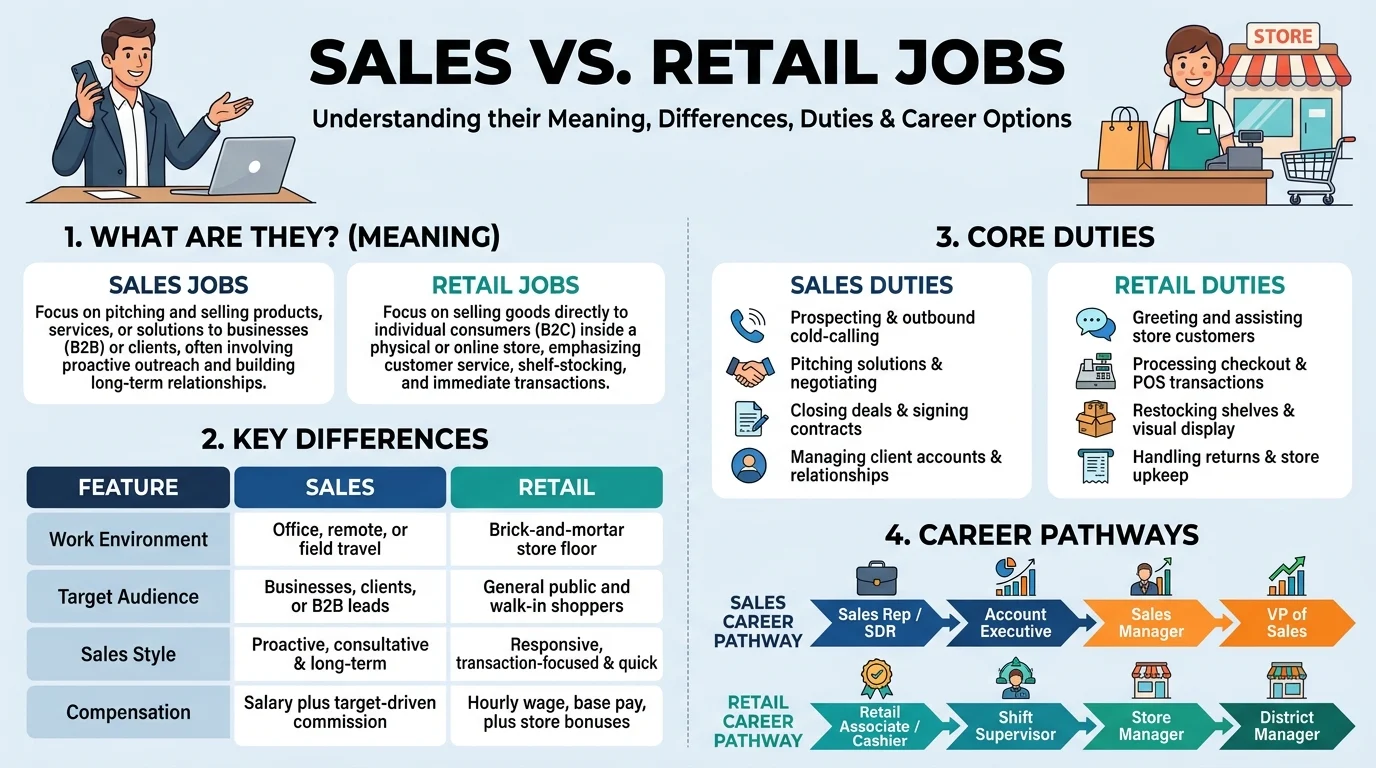
Although both career categories involve commercial activity, the main differences concern the work environment, customer relationships, and daily responsibilities.
| Feature | Sales jobs | Retail jobs |
|---|---|---|
| Main focus | Selling products or services and generating revenue | Selling goods to consumers and supporting store operations |
| Workplace | Office, store, client site, online, or remote | Usually a store, supermarket, shopping mall, or retail facility |
| Customer type | Consumers or business clients | Primarily individual consumers |
| Common duties | Prospecting, presentations, negotiations, follow-ups | Customer assistance, stocking, transactions, displays |
| Performance measures | Sales revenue, conversion rates, accounts, targets | Sales performance, service quality, transactions, store standards |
| Compensation | Salary, hourly pay, commission, or a combination | Often hourly wages or salary, sometimes with bonuses or commission |
| Entry requirements | Vary by industry and role | Many entry-level roles offer on-the-job training |
| Career paths | Account management, business development, sales leadership | Department supervision, store management, retail operations |
These are general patterns, not strict rules. Retail sales associates are sales professionals, and some retail positions include substantial responsibilities for targets and customer relationship management.
Which Career Is Better for Beginners?
Retail may be a practical starting point if you enjoy face-to-face interaction and want to develop customer service skills. Many stores provide training in product knowledge, checkout systems, and store procedures.
Entry-level sales roles may suit people who enjoy communicating with customers, explaining product benefits, following up on leads, and working toward measurable goals.
Neither option is automatically better. Your personality, schedule, financial needs, and long-term career plans should guide your choice.
10. Relevance in Online Conversations and Dating Apps
Sales and retail jobs can appear in online conversations because employment is a common topic when people introduce themselves, discuss daily life, or talk about future plans.
On professional platforms, the phrase usually has a straightforward career-related meaning. On general social media, it may appear in discussions about workplace experiences, job hunting, salaries, or customer interactions.
In Dating App Profiles
Someone might write, “I work in retail,” or “I’m in sales.”
These statements generally describe their occupation. They do not automatically indicate their income, education, personality, or relationship intentions.
A person working in retail could be a cashier, store supervisor, department manager, or retail business owner. Someone working in sales might sell software, vehicles, insurance, clothing, or professional services.
How to Ask About Someone’s Job
If you want to learn more, ask a respectful follow-up question.
For example:
- “What kind of products or services do you sell?”
- “Do you enjoy working in retail?”
- “What does a typical workday look like for you?”
- “Are you hoping to grow in that field?”
These questions invite conversation without making assumptions about the person’s financial situation or career ambitions.
Avoiding Misinterpretation
A brief mention of sales or retail employment should not be treated as a hidden romantic signal, internet abbreviation, or judgment about someone’s status.
If the meaning is unclear, consider the surrounding conversation and ask for clarification.
In online dating, as in everyday communication, a person’s occupation is only one part of their identity. Their interests, values, goals, and behavior provide a much fuller picture.
Conclusion
Sales or retail jobs offer a range of employment opportunities for people who enjoy working with customers, solving problems, and contributing to business success.
Although these career categories overlap, they are not exactly the same. Sales positions can involve selling products or services across many industries, while retail jobs generally focus on selling goods directly to consumers and supporting store operations.
Understanding these differences can help you choose suitable vacancies, prepare a stronger resume, and answer questions about your professional interests.
Entry-level retail positions can help develop customer service and communication skills, while sales roles may provide opportunities to build expertise in negotiation, client relationships, and business development.
Before applying, review the job description, salary structure, working hours, training, and advancement opportunities. Most importantly, select a role that matches your abilities and career goals.
With the right preparation and a willingness to learn, either path can become a valuable starting point for long-term professional growth.