Have you ever wondered whether to write victimize or victimise? Both spellings are correct, but the one you should use depends mainly on your preferred variety of English. This small spelling difference often confuses students, writers, bloggers, and professionals who want their writing to look accurate and natural.
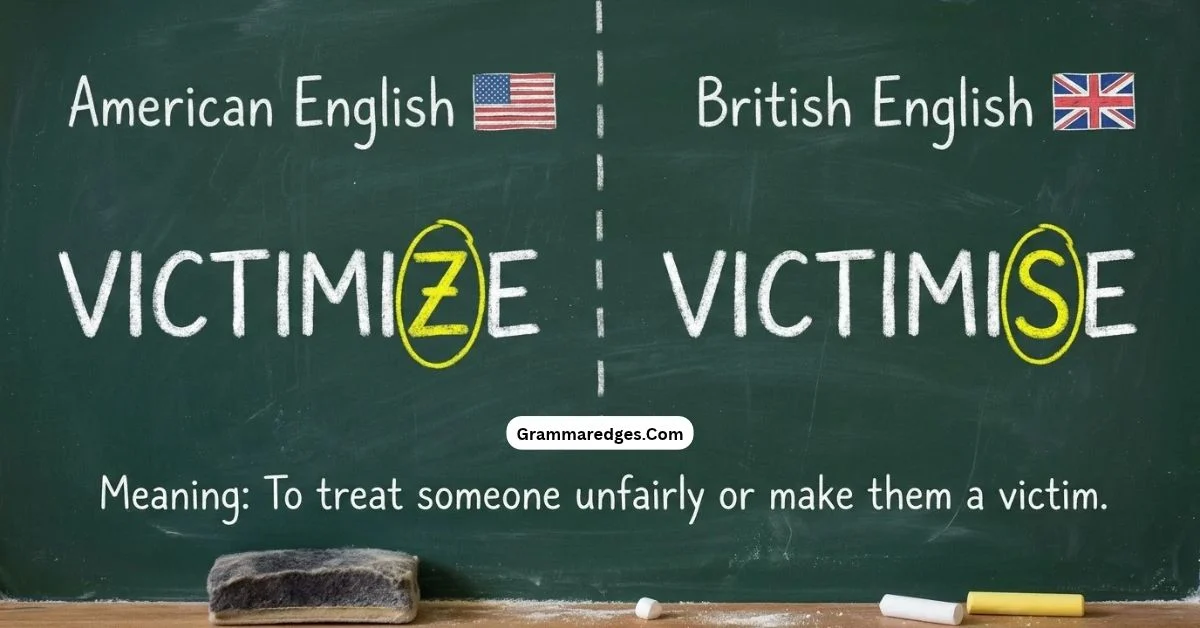
The word describes treating someone unfairly, harming them, or making them a victim of mistreatment. However, American English generally uses victimize, while British English typically prefers victimise. Both words have the same meaning, pronunciation, and grammatical function.
Understanding this distinction is useful when writing school assignments, business emails, social media posts, news articles, and website content. Choosing the appropriate spelling helps maintain consistency and makes your writing easier for your intended audience to understand.
In this guide, we will explore the meanings, origins, examples, common mistakes, and differences between these spellings. You will also learn how to use related expressions naturally in everyday conversations and professional communication.
1. Meaning and Definition of Victimize vs Victimise
The words victimize and victimise are two spelling variations of the same verb. Both describe putting someone in a position where they suffer harm, unfair treatment, exploitation, or abuse.
The difference is not in their meaning. It is in their regional spelling conventions.
What Does Victimize Mean?
Victimize is the standard spelling in American English. It means to treat someone unfairly, deliberately harm them, or take advantage of them.
Examples:
- The company was accused of trying to victimize vulnerable customers.
- Nobody should victimize a person because of their background.
- The scammer attempted to victimize people through fake investment offers.
- Schools should protect students who are at risk of being victimized by bullying.
The word often appears in discussions about crime, discrimination, bullying, exploitation, and social injustice.
What Does Victimise Mean?
Victimise is the standard spelling in British English and is also common in other English varieties influenced by British spelling, including Australian and New Zealand English.
Examples:
- The organization works to prevent employers from victimising workers.
- Children should never be victimised because they are different.
- The campaign aims to protect people who may be victimised by fraud.
- She felt that her colleagues were trying to victimise her.
These sentences communicate exactly the same ideas as their American English equivalents.
Quick Comparison Table
| Feature | Victimize | Victimise |
|---|---|---|
| Meaning | To harm or treat unfairly | To harm or treat unfairly |
| American English | Preferred | Less common |
| British English | Less common | Preferred |
| Part of speech | Verb | Verb |
| Pronunciation | Generally the same | Generally the same |
| Past tense | Victimized | Victimised |
| Present participle | Victimizing | Victimising |
| Noun form | Victimization | Victimisation |
Quick answer: Use victimize for American English and victimise for British English. Both are correct, and neither spelling changes the meaning.
2. Background and Origin of the Two Spellings
The difference between victimize and victimise reflects a broader pattern in the development of American and British English.
English spelling developed over many centuries, and different regions gradually established their own preferences. American English adopted several spelling conventions that differ from those commonly used in British English.
One familiar example is the use of -ize in American English and -ise in many British English publications.
The word victimize is formed from victim and the verb-forming suffix -ize. The alternative victimise uses the spelling -ise instead.
Both spellings are established forms of the same word. The variation does not indicate a difference in grammar, seriousness, or meaning.
Why Does American English Prefer -ize?
American English commonly uses -ize in words such as:
- Organize
- Realize
- Recognize
- Modernize
- Victimize
These spellings are standard in American dictionaries and publications.
Why Does British English Often Use -ise?
British English commonly uses -ise in many of the same words:
- Organise
- Realise
- Recognise
- Modernise
- Victimise
However, British English is not completely uniform. Some British dictionaries and publishers also accept or prefer certain -ize spellings. Therefore, it is inaccurate to claim that -ize is always wrong in British English.
The best approach is to follow the spelling standard required by your school, employer, publisher, or style guide.
Is One Spelling More Correct?
No. Neither spelling is universally more correct than the other.
The choice depends on your audience and the variety of English you are using. A writer producing content for American readers will usually choose victimize, while a writer targeting a British audience will normally choose victimise.
Consistency matters more than choosing one version as universally superior.
3. Usage in Different Contexts
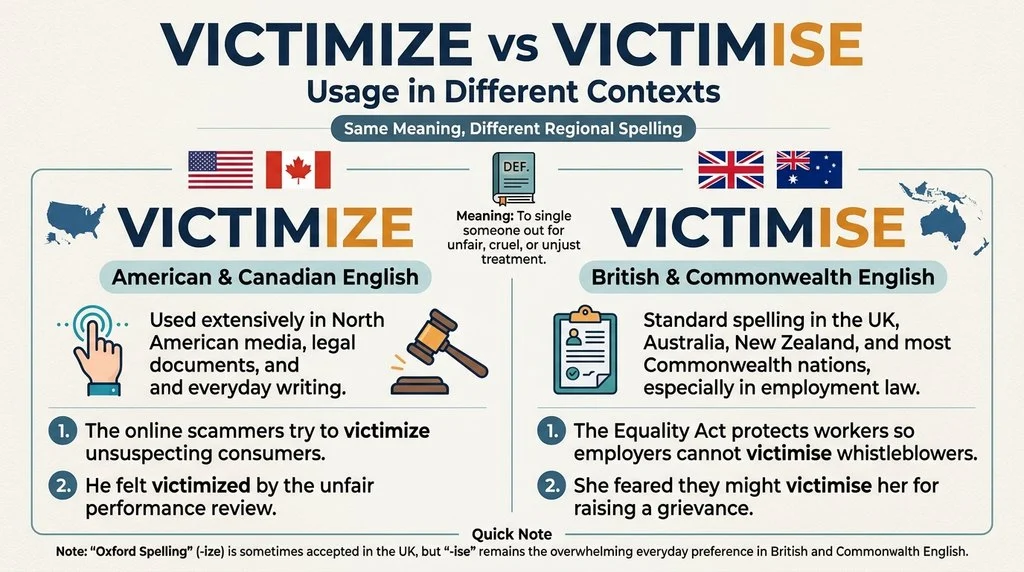
Both spellings can appear in a wide range of situations, from casual conversations to formal reports. The context determines whether the word is appropriate, while regional spelling conventions determine which version to use.
Everyday Conversations
People may use the word when discussing unfair treatment or harmful behavior.
Examples:
- Nobody deserves to be victimized by a dishonest person.
- He believes his coworkers are trying to victimise him.
- We should support people who experience bullying instead of blaming them.
In everyday speech, the two spellings sound essentially the same, so the difference usually becomes noticeable only in writing.
Academic Writing
Students may encounter the word in essays about social problems, criminal justice, psychology, or discrimination.
Examples:
- The essay examines how online harassment can victimize teenagers.
- The research discusses the effects of victimisation on affected communities.
Academic writers should follow the spelling conventions required by their institution.
Professional Communication
In workplaces, the word may appear in policies, complaints, investigations, and reports about unfair treatment.
Examples:
- The policy prohibits managers from victimizing employees who report misconduct.
- The company investigates allegations that workers were victimised after raising safety concerns.
Because the term can imply serious wrongdoing, it should be used carefully and accurately in formal documents.
News and Public Discussions
Journalists and commentators may use the word when reporting on fraud, abuse, discrimination, or exploitation.
Examples:
- Authorities warned residents about online scams designed to victimize older citizens people.
- The report examined whether vulnerable families had been victimised by fraudulent schemes.
Writing tip: Select one spelling based on your target audience and use it consistently throughout the article, report, or website.
4. Meaning in Chat, WhatsApp, Instagram, and TikTok
On social media, victimize and victimise retain their standard dictionary meaning. They do not have a separate meaning simply because they appear in a message, caption, comment, or video.
However, online users may employ the word informally to describe bullying, unfair blame, manipulation, or feeling mistreated.
WhatsApp Messages
Example:
“Please don’t victimize someone just because they made a mistake.”
This message asks someone not to treat another person unfairly.
Another example:
“I feel like I’m being victimised at work.”
The sender is expressing a feeling of being unfairly targeted.
Instagram Captions
A creator might write:
- Stop victimizing people for being different.
- Nobody should be victimised for speaking up.
- Choose kindness instead of making others feel powerless.
These captions communicate messages about fairness, empathy, and respectful behavior.
TikTok Videos
The word might appear in videos discussing bullying, relationship problems, workplace conflicts, or social issues.
For example:
“Don’t victimize someone for setting healthy boundaries.”
Here, the creator is criticizing behavior that unfairly targets someone for establishing personal limits.
Does It Have a Special Slang Meaning?
No. Unlike abbreviations such as LOL or BRB, these words are not primarily texting slang. Their meaning remains connected to treating someone as a victim of harmful or unfair behavior.
Online users sometimes confuse victimizing someone with playing the victim. These expressions are related but different:
- Victimizing someone: Treating another person unfairly or causing them harm.
- Playing the victim: Presenting yourself as the wronged person, sometimes to avoid responsibility or gain sympathy.
The second expression can be used unfairly, so it is important not to assume that someone is pretending to suffer simply because they describe themselves as a victim.
5. Meaning in Physics, Medical, and Aircraft Terminology
Some readers search for victimize vs victimise because they encounter unfamiliar words in technical material. However, neither spelling is a specialized technical term in physics, medicine, or aviation.
The word retains its general meaning when used in these fields, although the situations being described may differ.
Physics
In physics, victimize and victimise do not describe a standard scientific process, law, measurement, or physical property.
A sentence such as “The experiment victimized the participants” would refer to the treatment of people involved in the experiment, not to a physical principle.
Scientific writing generally uses more precise language, such as expose participants to harm, cause an injury, or subject participants to unfair treatment, depending on the situation.
Medical and Healthcare Contexts
In healthcare, the word may appear in discussions about patient mistreatment, discrimination, exploitation, or abuse.
Examples:
- Healthcare providers must not victimize patients because of their disabilities.
- Patients should not be victimised for seeking a second medical opinion.
The word does not name a disease, diagnosis, medical procedure, or treatment.
In clinical documentation, specific descriptions of what happened are often more useful than broad accusations. The appropriate terminology depends on the facts and the purpose of the document.
Aircraft and Aviation Terminology
Neither spelling is an established aircraft component, flight maneuver, aviation measurement, or standard technical term.
The word could be used in a report about passengers or employees who experienced fraud, harassment, or unfair treatment connected to an aviation-related situation.
For example:
“The investigation examined whether passengers were victimized by a fraudulent ticket seller.”
This describes alleged misconduct involving passengers. It does not describe an aircraft function.
Remember: These are ordinary English verbs, not specialized terminology in physics, medicine, or aviation.
6. Common Misconceptions About Victimize and Victimise
Several misunderstandings make this spelling choice more confusing than it needs to be.
Misconception 1: Victimize Is Correct and Victimise Is Wrong
This is incorrect. Both spellings are recognized English forms. American English generally favors victimize, while British English commonly favors victimise.
Misconception 2: The Words Have Different Meanings
They do not. Both refer to treating someone unfairly, harming them, or making them a victim of mistreatment.
Misconception 3: Victimise Is Only Used in the United Kingdom
Although it is strongly associated with British spelling, victimise is also used in other English-speaking regions that follow British conventions.
Misconception 4: The Words Are Pronounced Differently
In ordinary English pronunciation, the two spellings are generally pronounced the same way. The difference is primarily written rather than spoken.
Misconception 5: Changing the Spelling Changes the Verb Tense
The spelling variation does not change tense. Compare:
- Present: They victimize others.
- Past: They victimized others.
- Present: They victimise others.
- Past: They victimised others.
The spelling changes according to regional conventions, but the grammatical function remains the same.
Misconception 6: Every Person Who Feels Victimized Is Pretending
Feeling victimized and deliberately pretending to be a victim are not the same thing. People may experience genuine harm, and their experiences should be evaluated fairly rather than dismissed based on assumptions.
The most useful rule is simple: understand the meaning, consider the context, and choose the spelling that matches your intended English variety.
7. Similar Terms and Alternatives
Several English words are related to victimize and victimise, but they are not always interchangeable.
| Word or expression | Meaning | Example |
|---|---|---|
| Harm | To cause damage or injury | The decision harmed the community. |
| Exploit | To take unfair advantage of someone | The scammer exploited vulnerable customers. |
| Abuse | To treat someone in a harmful or cruel way | The report described workplace abuse. |
| Bully | To intimidate or mistreat someone | Students should never bully their classmates. |
| Persecute | To subject someone to persistent hostility or oppression | The group was persecuted for its beliefs. |
| Mistreat | To treat someone badly or unfairly | Employees should not mistreat customers. |
| Target | To direct attention or an action toward someone | The fraudsters targeted older adults. |
| Oppress | To exercise unjust or cruel power over people | The system oppressed vulnerable communities. |
Which Alternative Should You Choose?
The best alternative depends on what actually happened.
Use exploit when someone takes unfair advantage of another person, use bully when describing intimidation or repeated mistreatment and use persecute when the situation involves sustained hostility or oppression, often connected to identity or beliefs.
Use harm when you need a broad term without specifying the type of wrongdoing.
For example, “The business victimized customers” is a general statement. “The business misled customers into paying hidden fees” is more specific if that accurately describes the conduct.
Choosing precise language makes your writing clearer and reduces the risk of overstating an allegation.
8. How to Respond When Someone Uses the Word
Your response should depend on the situation. Someone might use the word to describe a genuine experience, make an accusation, or discuss a general social issue.
When Someone Says They Feel Victimized
Listen to what they are saying before deciding how to respond.
Possible response:
“I’m sorry you’re going through that. Can you tell me what happened?”
This response shows concern without automatically assuming that every detail has been established.
When Someone Accuses You of Victimizing Them
Stay calm and ask for specific information.
Possible response:
“I want to understand your concern. Can you explain which action made you feel that way?”
If you recognize that you treated the person unfairly, acknowledge the behavior and consider how to correct it.
When Discussing Online Bullying
You could say:
“People should be able to express themselves without being harassed or targeted.”
This focuses on respectful conduct rather than escalating an argument.
When Writing a Formal Reply
In a workplace or institutional setting, use neutral language and address the specific allegation.
For example:
“Thank you for raising this concern. We will review the reported behavior and consider the available information.”
This avoids making premature conclusions while taking the concern seriously.
Important: You do not need to accept an accusation automatically, but you should avoid dismissing someone’s experience without considering the circumstances.
9. Differences From Similar Words
Understanding related expressions helps prevent common grammar and vocabulary mistakes.
Victimize vs. Play the Victim
Victimize means to treat someone unfairly or cause them harm. Play the victim means to present yourself as the person who has been wronged, sometimes to gain sympathy or avoid responsibility.
Example:
- The manager allegedly victimized an employee who reported misconduct.
- He tends to play the victim whenever someone questions his decisions.
These statements describe different behaviors.
Victimize vs. Victim
Victim is a noun, while victimize is a verb.
Examples:
- The victim reported the incident.
- The criminals attempted to victimize more customers.
The first sentence identifies a person affected by an incident. The second describes an action.
Victimize vs. Victimization
Victimization is the noun form of the verb. It refers to the process or experience of being treated as a victim.
Examples:
- The organization works to prevent victimization.
- The organization works to prevent victimisation.
Both noun spellings follow the same American and British spelling distinction.
Victimize vs. Blame
To blame someone is to hold them responsible for something. To victimize someone is to subject them to harm or unfair treatment.
For example, blaming someone for a mistake does not automatically mean that you are victimizing them. The circumstances and behavior matter.
Victimized vs. Victimised
These are the past-tense and past-participle forms of the same verb.
- American English: She was victimized by a scam.
- British English: She was victimised by a scam.
Both sentences are grammatically correct.
10. Relevance in Online Conversations and Dating Apps
Online communication makes word choice especially important because messages can be misunderstood without facial expressions, tone of voice, or additional context.
On dating apps, victimize and victimise might appear in conversations about emotional manipulation, dishonesty, harassment, or unhealthy relationships.
For example:
“I don’t want anyone to feel victimized in a relationship.”
This sentence expresses a desire for fairness and respect.
Another example:
“Nobody should be victimised for ending a relationship.”
This communicates that people should not be mistreated for deciding to leave a relationship.
How to Use the Word Respectfully
When discussing dating experiences, focus on specific behavior rather than making assumptions about someone’s character.
Instead of writing, “You always victimize people,” you might say, “I felt hurt when you shared my private messages without permission.”
The second statement identifies a particular action and explains its impact. It also creates a clearer starting point for a conversation.
Should You Use Victimize or Victimise on Dating Profiles?
Choose the spelling that matches your audience. If you primarily communicate with American English users, victimize will usually look more familiar. If your audience follows British English conventions, victimise may be the better choice.
Neither version is more romantic, formal, emotional, or powerful than the other.
In dating profiles and messages, clear language is more important than the spelling variation itself. Use the word when it accurately describes the situation, and avoid using serious terms casually to label ordinary disagreements.
Conclusion
The difference between victimize vs victimise is simple: both words have the same meaning, but they follow different regional spelling preferences. Victimize is generally preferred in American English, while victimise is commonly used in British English and other varieties influenced by British spelling. Neither form is inherently incorrect, and both describe treating someone unfairly, harming them, or making them a victim of mistreatment.
Understanding this distinction helps you write more confidently in academic assignments, workplace documents, social media posts, and everyday conversations.
Remember to choose the spelling that matches your target audience and maintain consistency throughout your writing. Also, distinguish the word from related expressions such as play the victim, blame, and victimization, because these terms have different meanings.
If you choose the American or British version, clear wording and accurate context will always matter more than the spelling difference.