
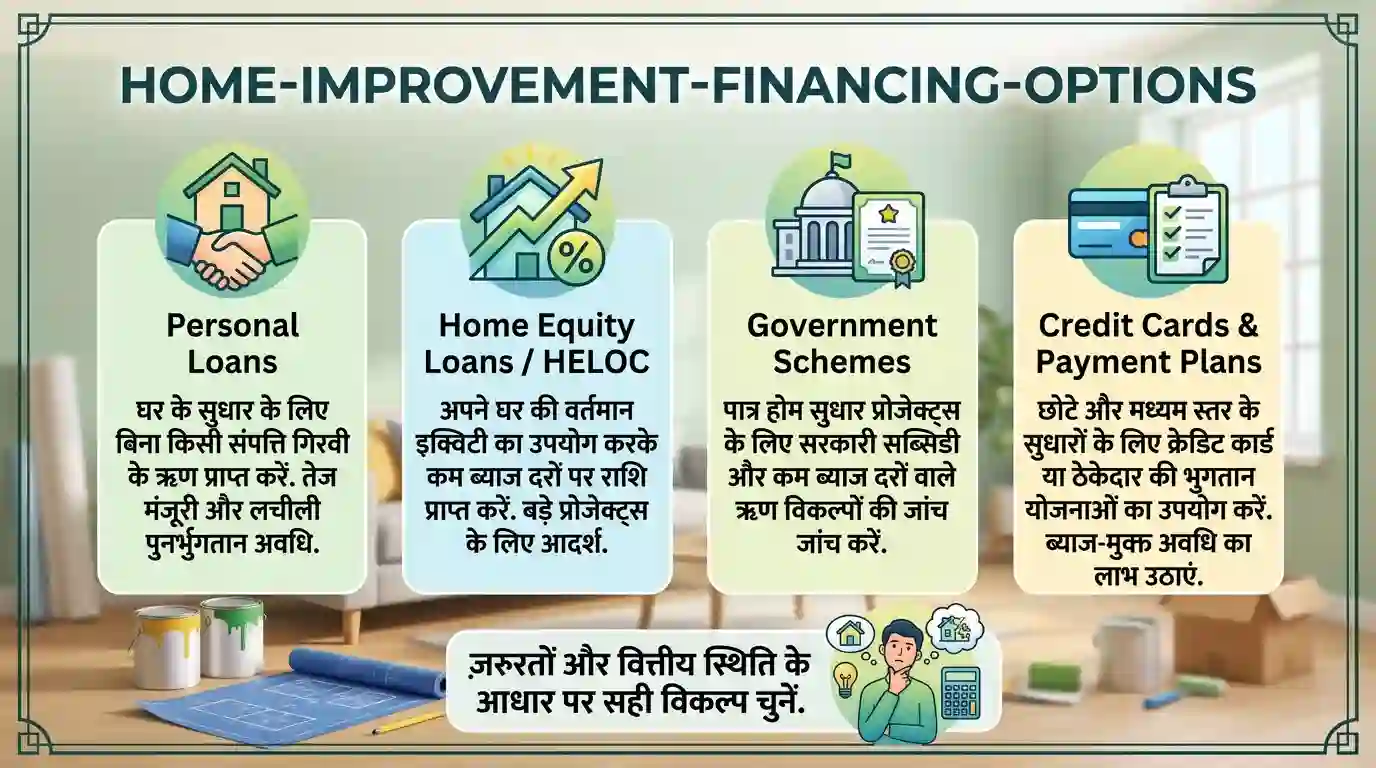
Home improvement financing options include personal loans, home equity loans, home equity lines of credit (HELOCs), cash-out refinancing, credit cards, contractor financing, and government assistance programs. The right choice depends on your project cost, credit score, available home equity, repayment period, and budget. Compare APRs, fees, and monthly payments before borrowing.
Key Takeaways
- Personal loans can fund renovations without using your home as collateral.
- Home equity loans and HELOCs let eligible homeowners borrow against their equity.
- Credit cards and contractor financing may suit smaller projects, but promotional terms require careful review.
- Government programs may help eligible homeowners pay for essential repairs and energy improvements.
- Compare the total borrowing cost, not just the advertised interest rate or monthly payment.
Home Improvement Financing Options
Introduction
Home repairs and renovations can make a home safer, more comfortable, and more valuable. However, projects such as replacing a roof, remodeling a kitchen, upgrading electrical systems, or improving energy efficiency can cost thousands of dollars. Paying the entire bill upfront is not always practical, especially when several repairs need attention at once.
That is why homeowners explore home improvement financing options. These include loans, credit lines, credit cards, contractor payment plans, and assistance programs that can spread costs over time. Each option has different eligibility rules, interest rates, repayment periods, and financial risks.
The right choice depends on how much money you need, how quickly you can repay it, and whether you have equity in your home. This guide explains the main financing methods, their advantages and drawbacks, and the questions to ask before signing an agreement. You will also learn how to compare offers and avoid common borrowing mistakes.
What Does “Home Improvement Financing Options” Mean?
Home improvement financing options are the different ways homeowners can pay for repairs, renovations, upgrades, and remodeling projects. These methods help cover expenses when savings alone are not enough.
For example, a homeowner might use a personal loan to replace an aging roof or a home equity line of credit to renovate a kitchen in stages. The best method depends on the project’s cost, the homeowner’s finances, and the repayment terms.
People commonly use this term when researching ways to finance bathroom remodels, new flooring, heating and cooling systems, accessibility upgrades, and major structural repairs.
Why Explore Different Home Improvement Financing Options?
Comparing financing methods helps you choose a payment plan that fits your budget and avoids unnecessary borrowing costs.
Consider different options to:
- Reduce borrowing costs: Compare annual percentage rates (APRs), fees, and total interest.
- Protect your home: Understand whether the loan uses your property as collateral.
- Manage monthly payments: Choose a repayment period you can afford.
- Match the project: Use flexible funding for phased renovations or a fixed loan for a single major repair.
- Avoid surprises: Check promotional rates, variable interest rates, and early repayment rules before signing.
10 Best Home Improvement Financing Options
1. Personal Loans for Home Improvements
Meaning
A personal loan provides a lump sum that you repay through scheduled installments. Many personal loans are unsecured, so you do not need to use your home as collateral.
Lenders usually review your credit history, income, existing debts, and ability to repay. Interest rates and loan limits vary by lender and borrower.
Best For:
Professional, practical, planned projects.
Example 1:
A homeowner takes out a personal loan to replace damaged flooring before moving into a new house.
Example 2:
A family borrows a fixed amount to upgrade an outdated electrical system.
Quick Tip:
Compare the APR, origination fees, monthly payment, and total repayment amount. A longer term may lower monthly payments but increase total interest.
2. Home Equity Loans
Meaning
A home equity loan lets you borrow against the equity you have built in your property. You receive the money upfront and generally repay it in fixed monthly installments, often at a fixed interest rate.
Consumer Financial Protection Bureau+1
Because your home secures the loan, failure to repay can put your property at risk.
Best For:
Formal, planned, major renovations.
Example 1:
A homeowner uses a home equity loan to finance a complete kitchen renovation with a contractor’s fixed-price estimate.
Example 2:
A couple borrows against their equity to replace an aging roof and repair exterior damage.
Quick Tip:
Ask about appraisal costs, closing fees, and the total amount you will repay. Do not borrow more than your project requires.
3. Home Equity Lines of Credit (HELOCs)
Meaning
A HELOC gives you access to a revolving credit line secured by your home’s equity. You can generally borrow money as needed during a specified draw period, making it useful when renovation costs arise in stages.
Many HELOCs have variable interest rates, so payments can change. Your lender may also impose restrictions or fees that affect how you use the credit line.
Consumer Financial Protection Bureau+1
Best For:
Flexible, ongoing, phased projects.
Example 1:
A homeowner draws funds over several months while completing a basement renovation.
Example 2:
A family uses a HELOC to pay for plumbing repairs first and new bathroom fixtures later.
Quick Tip:
Understand when the repayment period begins and whether payments could increase substantially. Your home is at risk if you cannot repay the balance.
4. Cash Out Mortgage Refinancing
Meaning
Cash out refinancing replaces your existing mortgage with a larger mortgage and provides the difference in cash, after applicable costs and payoffs.
This approach may work when the new mortgage terms make financial sense. However, refinancing can increase your interest costs or replace an existing mortgage with a less favorable rate.
Consumer Financial Protection Bureau+1
Best For:
Formal, large-scale renovations.
Example 1:
A homeowner refinances a mortgage to fund a major addition to the house.
Example 2:
A family compares cash-out refinancing with a home equity loan before financing several structural upgrades.
Quick Tip:
Compare closing costs, the new mortgage rate, and the total interest over the full term. Do not focus only on the cash you receive.
5. Credit Cards With Promotional Offers
Meaning
Credit cards can cover smaller repairs, appliances, paint, or materials. Some cards offer a promotional period with a reduced or 0% introductory APR, subject to their terms.
However, regular credit card interest rates can be high. A promotional offer may also expire before you finish repaying the balance.
Consumer Financial Protection Bureau+1
Best For: Casual, small, short-term expenses.
Example 1: A homeowner uses a promotional credit card to purchase a new kitchen faucet and cabinet hardware.
Example 2: A family pays for paint and basic supplies with a card they can repay before the introductory offer ends.
Quick Tip: Confirm the promotional end date and standard APR. Avoid charging a project to a card unless you have a realistic repayment plan.
6. Contractor Financing
Meaning
Some remodeling companies, roofers, and home improvement contractors offer financing through third-party lenders. This can combine project planning with a financing application.
The contractor’s advertised monthly payment does not tell you the full cost. Review the lender’s agreement, interest rate, fees, and promotional conditions independently.
Best For: Practical, project-specific renovations.
Example 1: A homeowner finances a heating and cooling system through a payment plan offered by an installation company.
Example 2: A family compares a contractor’s bathroom remodeling offer with a personal loan from a bank.
Quick Tip: Ask whether the contractor receives a commission for arranging financing. Check the loan terms and understand when payments begin.
7. Government Home Repair Assistance and Loans
Meaning
Eligible homeowners may qualify for government-backed loans, local repair assistance, or programs designed for specific needs. Eligibility can depend on income, age, location, property type, and the repairs required.
HUD’s Title I Property Improvement Loan program insures eligible loans made by participating private lenders. Local governments may also offer repair assistance, particularly for essential housing improvements.
hud.gov+1
Best For: Formal, essential repairs and eligible improvement projects.
Example 1: An eligible homeowner investigates assistance for repairing damaged parts of a house.
Example 2: A rural homeowner checks whether local or federal programs support necessary property improvements.
Quick Tip: Start with USA.gov’s home repair assistance information. Verify eligibility and current funding directly with the administering agency. Avoid websites promising guaranteed government grants.
8. Personal Lines of Credit
Meaning
A personal line of credit provides access to borrowed money up to an approved limit. Unlike a standard personal loan, you can generally draw funds as needed and pay interest on the amount borrowed, subject to the agreement.
These lines are typically based on your creditworthiness rather than your home’s equity. Rates, access fees, and credit limits vary.
Best For: Flexible, unexpected repair expenses.
Example 1: A homeowner keeps an approved credit line available for plumbing or electrical emergencies.
Example 2: A family uses a personal line of credit to cover additional materials when a renovation exceeds its initial estimate.
Quick Tip: Compare the APR, annual fees, draw fees, and minimum payments. Confirm whether the rate can change.
Consumer Financial Protection Bureau+1
9. Cash Savings and a Dedicated Renovation Fund
Meaning
Using savings allows you to pay for improvements without taking out a loan or paying interest to a lender. You can save for the full project or combine available cash with a smaller loan.
This method works best when the project can wait and paying upfront will not leave you without money for emergencies or essential expenses.
Best For: Practical, budget-conscious, smaller or planned renovations.
Example 1: A homeowner saves monthly to replace old kitchen cabinets without borrowing.
Example 2: A family pays cash for new flooring and keeps its emergency fund separate.
Quick Tip: Request written estimates and include a contingency for unexpected costs. Do not use every dollar of your emergency savings to complete a renovation.
10. Retirement Plan Loans
Meaning
Some employer-sponsored retirement plans, such as certain 401(k) plans, allow participants to borrow from their vested balance. Availability, limits, repayment rules, and fees depend on the plan.
This option carries risks. Leaving your job or failing to follow repayment requirements can create tax consequences, and borrowing reduces the money available for potential retirement growth.
Best For: Carefully evaluated, planned projects when other financing methods are unsuitable.
Example 1: An employee reviews a permitted retirement plan loan to determine whether it could cover essential structural repairs.
Example 2: A homeowner compares the cost of a plan loan with personal loan offers before making a decision.
Quick Tip: Read your plan’s rules and speak with a qualified tax or financial professional before borrowing. Consider the effect on your long-term retirement savings.
Comparison Table
| Financing option | Best used for | Typical considerations |
| Personal loan | Planned repairs and renovations | Creditworthiness, APR, fees |
| Home equity loan | Large, defined projects | Home collateral, closing costs |
| HELOC | Renovations in stages | Variable rates, draw and repayment periods |
| Cash-out refinance | Major renovations | New mortgage terms, closing costs |
| Credit card | Small purchases | Promotional terms, potentially high APR |
| Contractor financing | Specific installation projects | Lender terms, fees, promotional offers |
| Government assistance | Eligible essential repairs | Program rules and funding availability |
| Personal line of credit | Unplanned or changing expenses | Credit limit, variable rates, fees |
| Cash savings | Planned, affordable improvements | Available cash and emergency reserves |
| Retirement plan loan | Carefully evaluated projects | Repayment rules, tax and retirement risks |
Common Mistakes to Avoid
- Choosing based only on the monthly payment. A smaller payment can hide a longer term and higher total interest.
- Ignoring home collateral. Home equity loans and HELOCs can put your property at risk if you fail to repay.
- Misunderstanding promotional financing. Check what happens when a low-rate or 0% offer expires.
- Borrowing more than necessary. Base your loan amount on written estimates, necessary repairs, and a reasonable contingency.
- Skipping the fine print. Review fees, variable rates, early repayment rules, contractor agreements, and payment deadlines before committing.
Frequently Asked Questions
1. What is the best way to finance home improvements?
The right method depends on your project and financial situation. A personal loan may work without home equity, while a home equity loan may suit a larger project with a defined cost. A HELOC can offer flexibility for staged renovations. Compare the APR, fees, total repayment cost, and risks before deciding.
2. Can I finance home improvements with bad credit?
Possibly. Some lenders consider applicants with lower credit scores, but approval is not guaranteed. You may face higher interest rates, lower loan limits, or stricter terms. Compare offers from banks, credit unions, and reputable online lenders, and check whether a smaller project or savings plan would reduce your borrowing needs.
3. Can I get a home improvement loan without equity?
Yes. Unsecured personal loans and some contractor financing plans do not require home equity. Approval usually depends on factors such as credit history, income, existing debt, and the lender’s criteria. Because your home is not collateral for an unsecured personal loan, the lender generally cannot foreclose on your home solely because you default on that loan.
4. Are home improvement loans tax-deductible?
Interest on a home improvement loan is not automatically tax-deductible. Certain interest on qualifying home-secured debt may be deductible when the loan proceeds, property, and other requirements meet federal tax rules. Personal loan and credit card interest generally do not qualify for the home mortgage interest deduction. Consult a tax professional about your circumstances.
5. Can I finance a roof replacement or emergency repair?
Yes. Depending on your eligibility and the repair cost, you could consider a personal loan, home equity loan, HELOC, contractor financing, or available assistance programs. For urgent damage, compare how quickly funding can arrive, but avoid signing a high-cost agreement under pressure. Obtain written estimates and verify the contractor’s credentials.
6. Are there government grants for home improvements?
Some government and local programs offer grants, loans, or other assistance to eligible homeowners for specific repairs. Availability varies by location, income, age, and project purpose. Not everyone qualifies, and federal assistance is not guaranteed. Check official government websites and local housing agencies instead of trusting claims of free money for every homeowner.
7. Is a HELOC better than a home equity loan?
Neither option is universally better. A home equity loan generally provides a lump sum with predictable payments when its rate is fixed. A HELOC allows repeated borrowing during the draw period, but its variable rate can make payments less predictable. Both use your home as collateral, so consider your repayment ability and project needs.
8. How much should I borrow for a home renovation?
Start with written contractor estimates, material costs, permit fees, and any temporary living expenses. Include a reasonable contingency for unexpected problems, especially in older homes. Then subtract the amount you can safely pay from savings. Borrow only what you need and can repay without compromising essential bills, emergency savings, or other financial goals.
Conclusion
Choosing among home improvement financing options starts with understanding the work your home needs and how much you can comfortably afford. Personal loans may suit homeowners who want to avoid using their property as collateral, while home equity loans can provide a lump sum for larger projects. HELOCs may work for renovations that happen in stages, and contractor financing can simplify payment for certain installations.
Savings are worth considering when a project can wait, while government assistance may help eligible homeowners with essential repairs. Credit cards and retirement plan loans require particular care because of their potential costs and long-term risks.
Before making a decision, obtain written project estimates and compare multiple financing offers. Look beyond advertised rates to examine fees, repayment terms, and total interest. Most importantly, choose a payment plan that leaves enough room in your budget for everyday expenses and unexpected emergencies.
A renovation should improve your home without creating financial stress that lasts long after the work is finished.