Current home improvement loan rates in the U.S. depend on your credit score, lender, loan amount, and financing type. In October 2026, home equity loan rates average around 8.6% to 8.8% in Bankrate’s recent surveys, while HELOC and personal loan rates vary by borrower and lender. Compare APRs, fees, and repayment terms before borrowing. Bankrate+2
Key Takeaways
- Home improvement loan rates vary based on creditworthiness, loan type, and lender requirements.
- Unsecured personal loans do not require home equity, but rates can be higher for borrowers with weaker credit.
- Home equity loans usually offer fixed rates, while HELOC rates are typically variable.
- APR helps you compare borrowing costs because it can include certain fees as well as interest.
- Getting quotes from several lenders can help you find suitable terms and avoid unnecessary costs.
Current Home Improvement Loan Rates
Home improvement projects can make your house more comfortable, efficient, and valuable. However, whether you want to replace an old roof, remodel a kitchen, or update your bathroom, financing costs can affect your budget.
Understanding current home improvement loan rates can help you decide how to pay for these projects without taking on more debt than you can manage. Your rate will depend on factors such as your credit score, income, existing debts, available home equity, and the type of financing you choose.
In this guide, you’ll learn about current U.S. rate benchmarks, the main financing options, and the factors that influence your offer. You’ll also see how to compare loan costs, estimate monthly payments, and avoid common borrowing mistakes.
Rate information in this article was checked on October 28, 2026. Rates change frequently, so treat published averages as reference points rather than guaranteed offers.
What Are Current Home Improvement Loan Rates?
Current home improvement loan rates are the interest rates lenders charge borrowers who finance repairs, renovations, upgrades, or other eligible home projects.
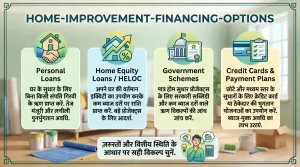
Some lenders offer unsecured personal loans specifically for home improvements. Others allow homeowners to borrow against their home’s equity through a home equity loan or home equity line of credit (HELOC).
Here are some recent U.S. benchmarks:
| Financing type | Recent rate benchmark | Rate structure |
|---|---|---|
| Unsecured home improvement personal loan | Approximately 6% to 36% APR across a published marketplace range | Usually fixed |
| Home equity loan | 8.63% average for a five-year loan in Bankrate’s October 14 survey | Usually fixed |
| HELOC | 8.47% average in LendingTree’s October 2026 reporting | Usually variable |
Credible+2
These figures come from different sources and may use different borrower profiles, loan amounts, and calculation methods. They are not directly interchangeable.
For example, the 6% to 36% range for personal loans reflects a broad range of advertised or available APRs, while Bankrate’s home equity figure represents an average for a particular loan term and amount. Your own offer may be higher or lower.
Why Compare Home Improvement Loan Rates?
Comparing lenders can help you find financing that fits both your renovation budget and your monthly income.
Consider these benefits:
- Lower borrowing costs: A lower APR may reduce the total interest you pay.
- Affordable payments: The right repayment term can help you manage monthly expenses.
- Clearer fees: Comparing offers helps you identify origination charges, closing costs, and other expenses.
- Better loan flexibility: Some products let you borrow a lump sum, while others allow you to access money as needed.
- Reduced financial risk: Understanding the terms can help you avoid payments that strain your budget.
Remember that the lowest advertised rate is not automatically the best deal. Check the full loan terms before making a decision.
10 Home Improvement Financing Options and Rate-Comparison Strategies
Rather than treating every financing product as interchangeable, compare these 10 options and strategies according to your project’s needs.
1. Unsecured Personal Loan
Meaning: A personal loan provides a lump sum without requiring your home as collateral. You typically repay it in fixed monthly installments.
Best for: Professional planning, predictable payments, and borrowers who do not want to use home equity.
Example 1: A homeowner finances a $12,000 bathroom renovation with a five-year personal loan.
Example 2: Someone replaces damaged flooring without putting their property up as collateral.
Quick Tip: Compare APRs, origination fees, and the total repayment amount, not just the advertised interest rate.
2. Home Equity Loan
Meaning: A home equity loan allows eligible homeowners to borrow against the equity they have built in their property. It generally provides a lump sum with a fixed interest rate.
Best for: Large, clearly priced projects when predictable payments matter.
Example 1: A homeowner borrows $40,000 to replace a roof and renovate a kitchen.
Example 2: A family uses a fixed-rate loan to fund accessibility upgrades.
Quick Tip: Remember that your home secures the debt. Failure to repay can put your property at risk.
3. Home Equity Line of Credit (HELOC)
Meaning: A HELOC provides a revolving credit line secured by your home. You can draw funds as needed, subject to the lender’s terms.
Best for: Renovations completed in stages or projects with changing costs.
Example 1: A homeowner pays contractors in several stages during a major remodel.
Example 2: A family draws money as it replaces windows throughout the year.
Quick Tip: Check how the variable rate works and when repayment requirements change.
4. FHA Title I Property Improvement Loan
Meaning: The Federal Housing Administration’s Title I program supports eligible property improvement loans through approved lenders, subject to program rules.
Best for: Homeowners or property owners who need qualifying improvement financing and want to explore a government-backed program.
Example 1: An eligible homeowner explores financing for essential property repairs.
Example 2: A property owner checks whether planned improvements qualify under the program.
Quick Tip: Verify current program limits, property eligibility, and participating lenders before applying. Do not assume every renovation qualifies.
5. FHA 203(k) Rehabilitation Mortgage
Meaning: An FHA 203(k) loan can combine eligible home purchase or refinancing costs with qualifying rehabilitation expenses under program rules.
Best for: Eligible buyers purchasing a home that needs repairs or homeowners considering a qualifying refinance with renovations.
Example 1: A buyer finances an eligible property purchase and planned repairs through one rehabilitation mortgage.
Example 2: An existing homeowner explores a qualifying rehabilitation refinance.
Quick Tip: Compare the mortgage’s full costs and program requirements. This is not the same as a standard unsecured renovation loan.
6. Fannie Mae HomeStyle Renovation Loan
Meaning: This conventional mortgage option can finance eligible renovation expenses alongside a home purchase or refinance, subject to underwriting rules.
Best for: Borrowers whose projects and financial profiles meet the program’s requirements.
Example 1: A buyer plans eligible upgrades after purchasing an older home.
Example 2: A homeowner explores a renovation refinance to modernize a property.
Quick Tip: Ask the lender about eligible improvements, contractor requirements, loan limits, and the complete APR.
7. Cash-Out Refinance
Meaning: A cash-out refinance replaces your existing mortgage with a larger one and gives you the eligible difference in cash after paying off the original mortgage and applicable costs.
Best for: Homeowners whose overall mortgage refinancing terms make financial sense.
Example 1: A homeowner compares refinancing options to fund a major home addition.
Example 2: A borrower evaluates whether a new mortgage could cover both the existing balance and eligible renovation funds.
Quick Tip: Compare the new mortgage rate, closing costs, and long-term interest expense with keeping your existing mortgage.
8. Credit Union Renovation Loan
Meaning: Some credit unions offer personal loans or other financing products that can fund home improvements.
Best for: Members who want to compare community-based lending options.
Example 1: A member requests a renovation loan quote from a local credit union.
Example 2: A homeowner compares a credit union’s fixed-rate offer with a bank’s personal loan.
Quick Tip: Check membership eligibility, fees, loan limits, and whether the advertised rate requires automatic payments.
9. Contractor Financing
Meaning: Some contractors partner with lenders to offer payment plans or renovation financing.
Best for: Homeowners who want to review financing alongside a project estimate.
Example 1: A homeowner compares a contractor’s financing offer with an independent bank loan.
Example 2: A family checks the promotional terms offered for new energy-efficient windows.
Quick Tip: Read the agreement carefully. Deferred-interest promotions and special introductory rates can become expensive if you miss the required conditions.
10. Compare APR and Total Repayment
Meaning: Comparing APR and total repayment helps you evaluate the full cost of borrowing across different offers.
Best for: Every borrower comparing loans.
Example 1: A homeowner compares two loans with different interest rates and origination fees.
Example 2: A borrower checks whether a longer repayment term lowers the monthly payment but increases total interest.
Quick Tip: Request written quotes using the same loan amount and comparable repayment terms.
Comparison Table
| Alternative | Best Used In | Tone or Structure |
|---|---|---|
| Unsecured personal loan | Smaller or medium projects | Fixed payments, typically |
| Home equity loan | One large renovation | Fixed rate, typically |
| HELOC | Staged projects | Usually variable |
| FHA Title I loan | Eligible property improvements | Program-dependent |
| FHA 203(k) mortgage | Eligible purchase or refinance renovations | Mortgage-based |
| HomeStyle Renovation loan | Eligible conventional renovation financing | Mortgage-based |
| Cash-out refinance | Projects suited to mortgage refinancing | New mortgage terms |
| Credit union loan | Comparing member financing offers | Product-dependent |
| Contractor financing | Contractor-led project financing | Offer-dependent |
| APR comparison | Evaluating all offers | Cost-focused |
What Affects Current Home Improvement Loan Rates?
Lenders consider several factors when determining your rate.
- Credit score: Stronger credit often helps borrowers qualify for lower rates. In Credible’s published data for loans closed between October 2025 and September 2026, average personal loan APRs ranged from 9.31% for borrowers with excellent credit to 29.57% for those below a 580 FICO score. Credible
- Debt-to-income ratio: Lenders may offer different terms depending on how much of your monthly income already goes toward debt.
- Loan amount and term: The amount you borrow and how long you take to repay it can affect pricing.
- Home equity: For secured borrowing, your equity and loan-to-value ratio can influence eligibility and rates.
- Market conditions: Benchmark rates and lender pricing can change over time.
- Fees and discounts: Origination fees, autopay discounts, and other conditions can change the overall cost.
Common Mistakes to Avoid
- Focusing only on the interest rate. APR and fees provide a fuller view of borrowing costs.
- Choosing a longer term without checking total interest. Smaller monthly payments can mean paying more over time.
- Ignoring variable-rate risk. HELOC payments may increase when the rate rises.
- Borrowing against your home without considering the risk. Missed payments on secured loans can put your property at risk.
- Accepting the first offer. Compare multiple lenders using similar loan amounts and terms.
Frequently Asked Questions
1. What are the current home improvement loan rates?
Rates depend on the lender and loan type. In October 2026, Bankrate reported an average of 8.63% for five-year home equity loans, while LendingTree reported an average HELOC APR of 8.47%. Personal loan APRs can vary much more widely. Always check current offers before applying. Bankrate+2
2. What is a good interest rate for a home improvement loan?
A good rate is one that compares favorably with similar offers for your credit profile, loan amount, and repayment term. A rate that works for an excellent-credit borrower may not be available to someone with fair credit. Compare APR, fees, monthly payments, and total repayment before deciding.
3. Are home improvement loan rates fixed or variable?
Many unsecured personal loans and home equity loans have fixed rates, so their scheduled principal-and-interest payments generally remain predictable. HELOCs usually have variable rates, which can change with market conditions. Some products have introductory or special terms, so check the loan agreement for rate adjustments and payment changes.
4. Can I get a home improvement loan with a 600 credit score?
Possibly. Some lenders accept applicants with a 600 credit score, but approval is not guaranteed. Your income, existing debt, loan amount, and lender requirements also matter. Borrowers with lower scores may face higher APRs, so compare several offers and consider whether delaying the project to improve your credit is practical.
5. Is a home equity loan cheaper than a personal loan?
A home equity loan may offer a lower interest rate because your home secures the debt. However, it can involve appraisal costs, closing fees, and greater financial risk if you cannot repay. A personal loan may cost more in interest but does not normally use your home as collateral.
6. What credit score do I need for the lowest home improvement loan rates?
There is no single score that guarantees the lowest rate across all lenders. Excellent credit generally improves your chances of qualifying for competitive offers, but lenders also review income, debt, loan size, and other factors. Ask lenders about their credit requirements and whether rate discounts come with additional conditions.
7. How can I calculate monthly home improvement loan payments?
Use a loan calculator that includes the principal, APR, and repayment term. For example, a $20,000 loan at a hypothetical 10% fixed annual interest rate over five years would cost approximately $425 per month in principal and interest, before any separate fees. The exact payment depends on the lender’s terms.
8. Will home improvement loan rates go down in 2027?
No one can reliably guarantee how rates will move in 2027. Economic conditions, inflation, Federal Reserve policy, and lender pricing can influence borrowing costs differently across products. If your project is urgent, compare the offers available now. If it can wait, monitor rates while saving and improving your credit profile.
Conclusion
Current home improvement loan rates can make a meaningful difference in the total cost of your renovation. The right financing option depends on your credit profile, project budget, repayment plans, and willingness to use your home as collateral.
Personal loans can offer straightforward funding without home equity, while home equity loans may suit larger projects that need predictable payments. HELOCs can provide flexibility for staged renovations, but their variable rates introduce uncertainty. Government-backed rehabilitation programs and contractor financing may also be worth exploring when you meet their requirements.
Before applying, compare at least three offers with similar loan amounts and repayment periods. Review the APR, fees, monthly payment, and total repayment amount, and make sure the payment fits your budget.
The most useful rate is not simply the lowest advertised number. It is the rate and loan structure you qualify for and can repay comfortably.