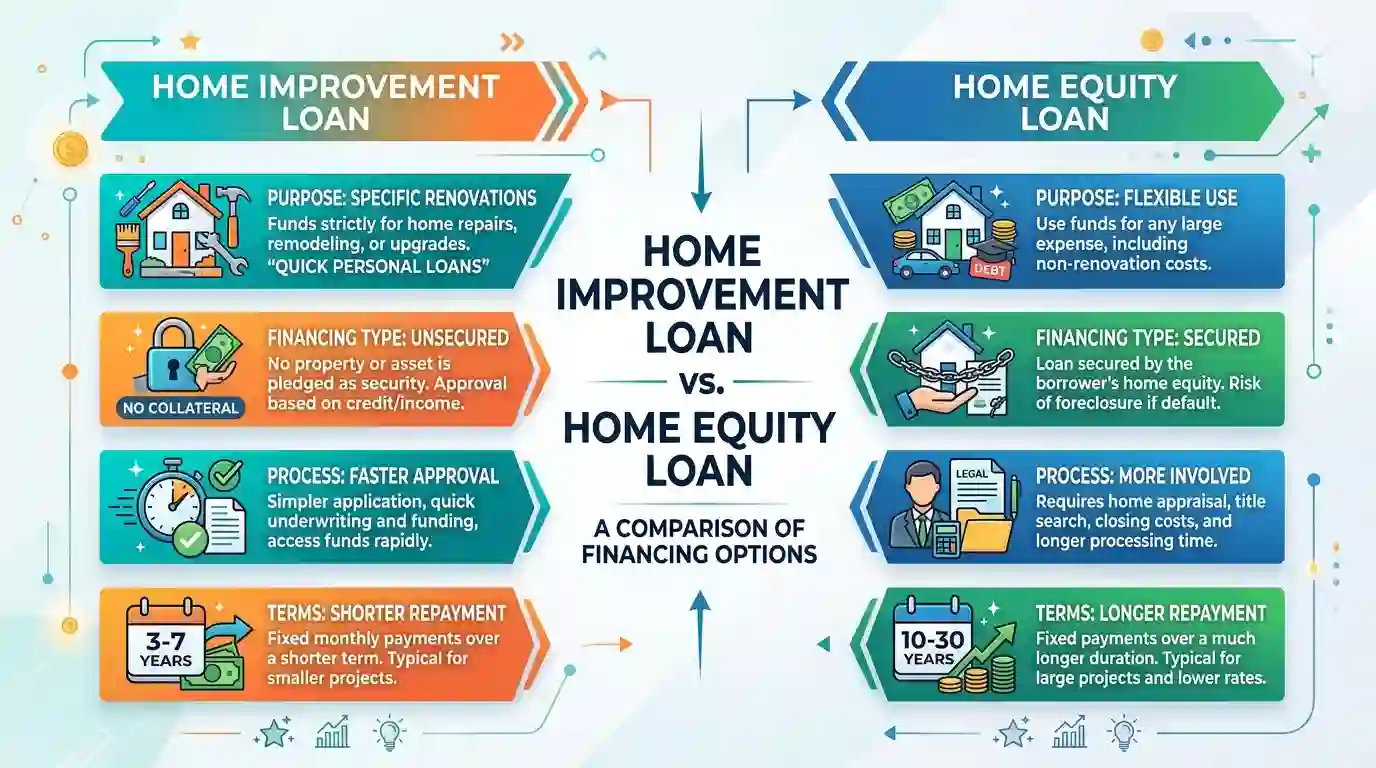
A home improvement loan is often an unsecured personal loan that lets you finance renovations without using your home as collateral. A home equity loan lets you borrow against your home’s equity, usually at a fixed interest rate. Personal loans may offer faster funding, while home equity loans may provide lower rates for qualified borrowers but put your home at risk if you fail to repay.
Key Takeaways
- Home improvement loans often do not require home equity or collateral.
- Home equity loans use your home as security and may offer lower interest rates.
- Personal loans may provide faster funding with fewer closing requirements.
- Home equity loans can involve appraisal fees, closing costs, and longer approval times.
- Compare APRs, monthly payments, total interest, and the risk to your home before choosing.
home improvement loan vs home equity loan
Introduction
Planning a kitchen remodel, replacing an old roof, or updating your bathroom can be expensive. If you need to borrow money for these projects, understanding the difference between a home improvement loan and a home equity loan can help you choose financing that fits your budget.
The phrase home improvement loan vs home equity loan describes a comparison between two ways to pay for home repairs and renovations. A home improvement loan often refers to an unsecured personal loan, although lenders also offer secured renovation loans. A home equity loan is a specific type of borrowing that uses the equity in your property as collateral.
Both options can help you cover renovation expenses, but they differ in interest rates, approval requirements, repayment periods, and financial risk. This guide explains how each loan works, compares its costs and benefits, and shows you what to consider before applying.
What Does “Home Improvement Loan vs Home Equity Loan” Mean?
The phrase compares two financing options for paying for home repairs, remodeling, and upgrades. However, home improvement loan is a broad term, not one specific loan product.
An unsecured personal loan used for renovations is one common option. A home equity loan is a secured loan that allows you to borrow a lump sum against the equity you have built in your property. Consumer Financial Protection Bureau+2
For example, you might use an unsecured loan to replace damaged flooring or borrow against your home equity to finance a larger kitchen remodel. Your available loan amount, credit history, income, and repayment ability can affect which option a lender offers.
Why Compare a Home Improvement Loan With a Home Equity Loan?
Comparing these options helps you understand the full cost of borrowing before committing to a loan.
- Avoid unnecessary costs: Compare interest rates, APRs, origination fees, and closing costs.
- Protect your property: Understand whether your home serves as collateral.
- Choose suitable payments: Match the monthly payment and repayment term to your budget.
- Find the right loan amount: Consider whether you need a few thousand dollars or funding for a major renovation.
- Understand eligibility: Check credit requirements, income verification, and home equity requirements.
The key is to compare actual loan offers rather than assuming one product will always be cheaper or easier to obtain.
10 Best Alternatives to Consider When Comparing Home Improvement Financing
These 10 options and comparison approaches help you evaluate renovation financing based on your needs.
1. Unsecured Personal Loan for Home Improvements
Meaning: An unsecured personal loan provides money for renovations without using your home as collateral. Approval generally depends on factors such as your credit history, income, existing debts, and the lender’s requirements.
Best For: Professional, practical planning.
Example 1: Maria chose an unsecured personal loan to replace her damaged kitchen flooring.
Example 2: Our contractor needs payment next week, so we are comparing personal loan offers.
Quick Tip: Compare APRs and origination fees, not just advertised interest rates.
2. Home Equity Loan for Renovations
Meaning: A home equity loan lets you borrow a lump sum against your property’s equity. You typically repay it through scheduled installments, often at a fixed interest rate.
Best For: Formal financial planning.
Example 1: James used a home equity loan to finance a major bathroom renovation.
Example 2: We are checking our available home equity before requesting renovation financing.
Quick Tip: Remember that failing to repay this secured loan could put your home at risk. Consumer Financial Protection Bureau+1
3. Home Renovation Financing Options
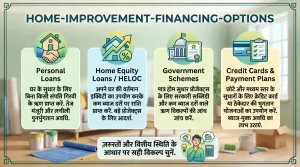
Meaning: This broad term covers loans and other financing methods used to pay for repairs or upgrades. Options may include personal loans, home equity loans, HELOCs, and specialized renovation mortgages.
Best For: Professional, formal comparisons.
Example 1: We reviewed several home renovation financing options before choosing a lender.
Example 2: Our budget includes both contractor fees and the cost of financing the renovation.
Quick Tip: Check whether the lender restricts how you can use the funds.
4. Secured vs. Unsecured Renovation Loan
Meaning: This comparison focuses on whether you must pledge an asset as collateral. A home equity loan is secured by your property, while an unsecured personal loan generally does not require collateral.
Best For: Professional, educational discussions.
Example 1: The secured versus unsecured renovation loan comparison helped us understand the risks.
Example 2: Before applying, I checked whether the lender required my home as collateral.
Quick Tip: A secured loan may offer a lower rate, but compare the total cost and consequences of default.
5. Fixed-Rate Renovation Loan
Meaning: A fixed-rate loan keeps its interest rate unchanged throughout the agreed term. Both unsecured personal loans and home equity loans may offer fixed rates, depending on the lender and product.
Best For: Formal budgeting.
Example 1: We selected a fixed-rate renovation loan to keep our monthly payments predictable.
Example 2: A stable interest rate will help us plan our bathroom remodeling budget.
Quick Tip: Confirm whether the quoted rate is fixed for the entire repayment period.
6. Home Equity Line of Credit (HELOC)
Meaning: A HELOC is a revolving credit line secured by your home’s equity. Unlike a home equity loan, it lets you draw money as needed up to an approved limit.
Best For: Flexible, practical project planning.
Example 1: We considered a HELOC because our renovation will take place in several stages.
Example 2: The contractor will complete the roof and kitchen at different times, so we need flexible access to funds.
Quick Tip: Many HELOCs have variable rates, and payments may rise. Understand the draw and repayment periods before applying. Consumer Financial Protection Bureau+1
7. Personal Loan vs. Second Mortgage
Meaning: This comparison weighs an unsecured personal loan against a home equity loan, which is commonly considered a second mortgage when you already have a primary mortgage.
Best For: Formal financial comparisons.
Example 1: We compared a personal loan with a second mortgage before renovating our older home.
Example 2: My lender explained how a second mortgage would affect my existing housing payments.
Quick Tip: Include your current mortgage payment when checking whether you can afford additional debt.
8. Low-Cost Home Repair Financing
Meaning: This term describes funding options that may reduce the expense of necessary repairs. Depending on eligibility, these could include credit union loans, local repair assistance programs, or affordable loan offers.
Best For: Practical, budget-conscious planning.
Example 1: We researched low-cost home repair financing before replacing the heating system.
Example 2: The family checked local assistance programs to help cover essential repairs.
Quick Tip: Check government and nonprofit assistance programs before taking on additional debt.
9. Home Improvement Loan Rates and Fees
Meaning: This comparison focuses on the borrowing cost rather than the loan’s name. APR, interest rate, origination charges, closing costs, and repayment length can all affect the total amount you pay.
Best For: Professional, analytical comparisons.
Example 1: We compared home improvement loan rates and fees from three lenders.
Example 2: The loan with the lowest monthly payment was not the cheapest option overall.
Quick Tip: Request written estimates and compare APRs, fees, and total repayment costs.
10. Renovation Loan Eligibility Requirements
Meaning: This phrase refers to the conditions a borrower must meet to qualify for financing. Personal loans often emphasize creditworthiness and income, while home equity loans also involve property value and available equity.
Best For: Practical, formal planning.
Example 1: We checked renovation loan eligibility requirements before submitting our application.
Example 2: The lender reviewed our income, debts, credit history, and property value.
Quick Tip: Ask each lender about minimum credit scores, debt-to-income limits, and documentation before applying.
Comparison Table
| Alternative | Best Used In | Tone |
|---|---|---|
| Unsecured personal loan for home improvements | Smaller repairs without home collateral | Practical |
| Home equity loan for renovations | Larger projects with sufficient equity | Formal |
| Home renovation financing options | Comparing several funding methods | Professional |
| Secured vs. unsecured renovation loan | Understanding collateral and risk | Educational |
| Fixed-rate renovation loan | Planning predictable payments | Reassuring |
| Home equity line of credit (HELOC) | Projects with expenses spread over time | Flexible |
| Personal loan vs. second mortgage | Comparing different borrowing structures | Analytical |
| Low-cost home repair financing | Exploring affordable repair options | Budget-conscious |
| Home improvement loan rates and fees | Comparing the total borrowing cost | Analytical |
| Renovation loan eligibility requirements | Preparing to apply for financing | Practical |
Home Improvement Loan vs. Home Equity Loan: Common Mistakes
1. Assuming Every Home Improvement Loan Is Unsecured
The term can describe different products, including secured loans. Confirm the exact loan type, collateral requirements, and repayment terms before applying.
2. Comparing Interest Rates Instead of APRs
An advertised interest rate does not show every borrowing cost. APR can include certain fees, making it a more useful comparison tool, although you should still review all disclosed costs.
3. Ignoring the Risk to Your Home
A home equity loan uses your property as collateral. If you cannot repay it, the lender may be able to foreclose. An unsecured personal loan does not directly pledge your home as collateral, but missed payments can still damage your credit and lead to collection or legal action. Consumer Financial Protection Bureau+1
4. Choosing a Loan Only Because the Monthly Payment Is Lower
A longer repayment term may reduce monthly payments while increasing the total interest you pay. Compare the full repayment schedule and total cost.
5. Borrowing More Than the Project Requires
Large loans can increase financial pressure, particularly when renovation costs rise unexpectedly. Obtain contractor estimates, include a reasonable contingency in your budget, and borrow only what you can comfortably repay.
Frequently Asked Questions
1. Is a home improvement loan the same as a home equity loan?
No. A home improvement loan is a broad term for financing home repairs and upgrades. A home equity loan is a specific product secured by your home’s equity. Some home improvement loans are unsecured personal loans, while others may use property as collateral.
2. Is a home equity loan cheaper than a home improvement loan?
A home equity loan may offer a lower interest rate because your property secures the debt. However, appraisal charges, closing costs, and other fees can affect the total cost. Compare actual APRs and repayment schedules before deciding.
3. Can I get a home improvement loan without home equity?
Yes. An unsecured personal loan may finance eligible home improvements without requiring equity in your property. Lenders typically assess your credit history, income, debt obligations, and ability to repay. Approval and available loan amounts depend on the lender’s criteria.
4. What credit score do I need for a home improvement loan?
There is no single credit score requirement for every lender. Some personal loan providers accept borrowers with fair credit, while others prefer stronger credit profiles. Home equity lenders also consider income, debt-to-income ratio, property value, and available equity.
5. How much equity do I need for a home equity loan?
Requirements vary by lender, and there is no universal minimum equity percentage. Lenders generally consider your home’s appraised value, outstanding mortgage balance, creditworthiness, income, and combined loan-to-value ratio. Ask how much you could borrow after accounting for existing mortgage debt.
6. Are home equity loan interest payments tax-deductible?
They may be deductible if you meet IRS requirements. Generally, interest on home equity debt is deductible only when the borrowed funds are used to buy, build, or substantially improve the home securing the loan, subject to applicable limits and other rules. Consult IRS guidance or a tax professional. Citi+1
7. Which loan is better for emergency home repairs?
An unsecured personal loan may suit urgent repairs when you need funds quickly and do not want to pledge your home. However, approval and funding times vary. Compare available offers and consider savings or assistance programs before borrowing.
8. Should I choose a home equity loan or a HELOC for renovations?
A home equity loan provides a lump sum, often with a fixed rate and predictable payments. A HELOC offers reusable access to funds, which may suit phased projects. HELOC rates are often variable, so payment changes and future repayment obligations deserve careful review. Consumer Financial Protection Bureau+1
Conclusion
Choosing between a home improvement loan and a home equity loan depends on your renovation budget, financial situation, and comfort with risk. An unsecured personal loan may work well for smaller repairs, especially if you have limited home equity or prefer not to use your property as collateral. A home equity loan may suit larger projects when you have sufficient equity, qualify for favorable terms, and can manage the added risk.
Before applying, compare offers from banks, credit unions, and online lenders. Review APRs, fees, monthly payments, repayment periods, and the total interest you will pay. Also, check whether your budget can handle the new payment alongside your existing mortgage and other debts.
The most useful rule is simple: compare the full cost of borrowing, not just the monthly payment, and never risk your home without a realistic repayment plan.